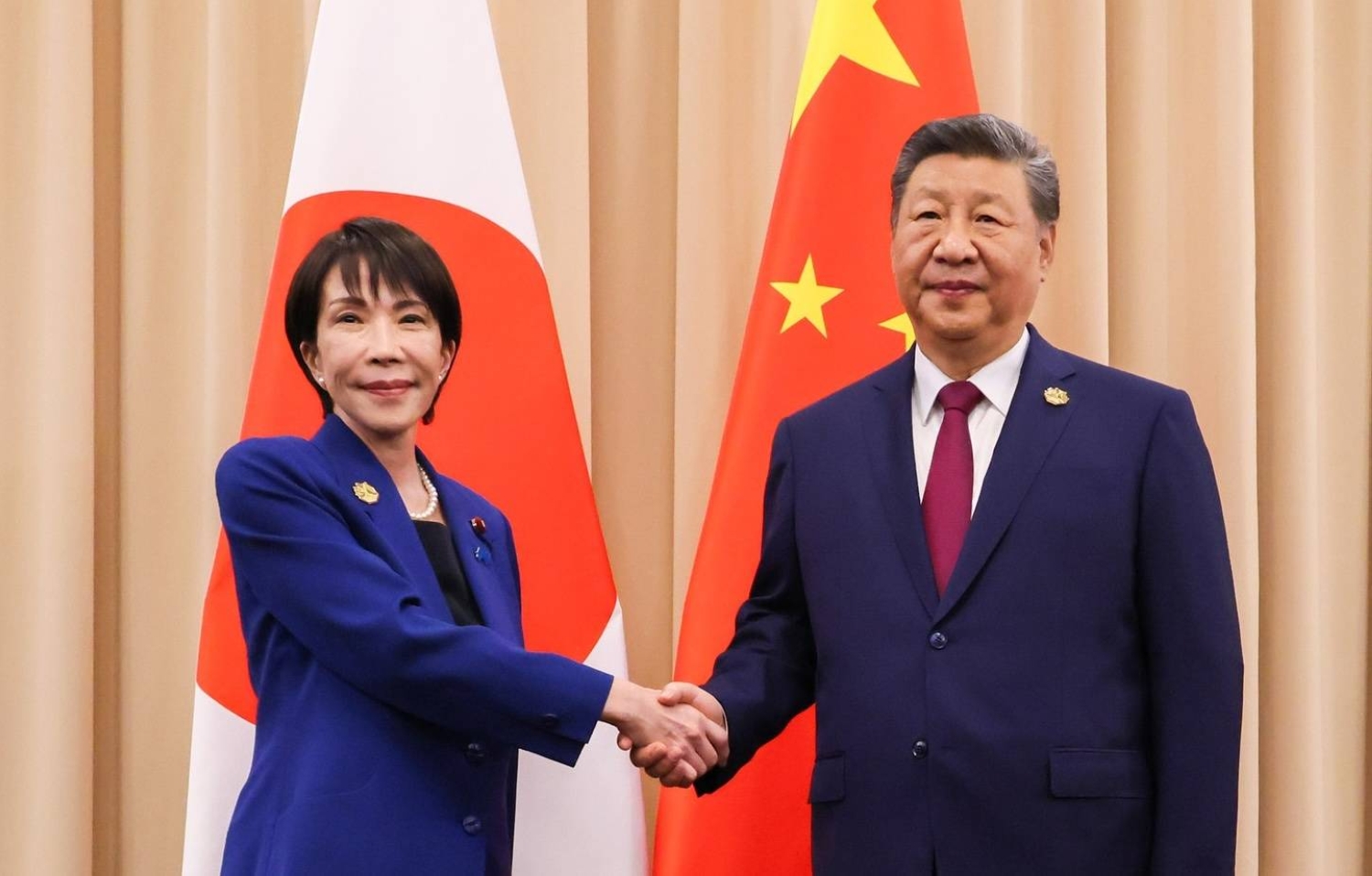
Japan’s relationship with China has entered a deep freeze following Prime Minister Sanae Takaichi’s November remarks that Tokyo could intervene militarily in a Taiwan crisis, with ties showing few signs of warming anytime soon.
But a deeper look reveals that rather than a mere flare-up, which has at times punctuated the relationship, the latest deterioration of ties has highlighted that a dangerous new equilibrium between the two countries is emerging — one that will test each other’s resolve, especially in the year ahead.
“What began as a diplomatic spat over Taiwan is spiraling into something structural,” said Elli-Katharina Pohlkamp, a Japan expert at the European Council on Foreign Relations. “The two Asian powers are edging away from coexistence in a rules-based regional order and towards strategic competition punctuated by periodic crises.”
This row began following Takaichi’s remarks in parliament on Nov. 7 that the Self-Defense Forces could be deployed under the right to collective self-defense in “worst-case” scenarios, such as a Chinese naval blockade of Taiwan, which the prime minister said would constitute a “survival-threatening situation” for Japan.
Takaichi’s comments in parliament were the first by a sitting prime minister to detail a specific case of how Tokyo might respond to a Taiwan Strait crisis.
While her words may not signal a clear policy shift in relation to Taipei, they can be seen as part of a larger and more gradual evolution of Japan’s relationship with China and its growing concern over Beijing’s designs on democratic Taiwan.
Predictably, China, which claims Taiwan as its own and has vowed to bring the democratic island into its fold, by force if necessary, reacted with fury. The country’s ambassador to Japan called for Takaichi’s head — literally — while Beijing demanded that the prime minister retract and reflect on her remarks, a move that would amount to political suicide for the popular prime minister.
China has also looked to informal economic coercion to get its way. It has urged tourists and students to refrain from visiting Japan, reimposed a recently lifted ban on seafood imports and — often without clear explanation — halted shows by Japanese entertainers, sometimes mid-performance.
Beijing has also sought to win the international community over to its side via diplomatic outreach, though its appeals proclaiming a return of militarism in Japan have largely fallen on deaf ears.
More worryingly, experts say, the row has boiled over into the military arena.
On Dec. 7 — exactly a month after Takaichi’s Taiwan remarks — Japan said Chinese military fighter jets had twice directed their radar on Air Self-Defense Force aircraft over international waters southeast of Okinawa Prefecture a day earlier, raising the ominous specter of an inadvertent military…