
The Eagle
The F-15 Eagle still holds a combat record for achieving 104 air-to-air kills to no losses.
It’s an impressive fighter in all respects, and it’s big!
The top surfaces of the F-15 are so large that it was nicknamed ‘The Tennis Court’.
In production since the early 1970s, the aircraft is still in service with the US Air Force (USAF), which is just starting to operate the latest incarnation, the F-15EX Eagle II.
Popular with pilots, weapon system operators, maintainers, and enthusiasts alike, the F-15 Eagle remains at the leading edge of US defence.
F-15C pilot
Andy Croft served as an F-15C pilot with a variety of units, not least the US Air Force Weapons School. After a remarkable career, he retired as a lieutenant general.
Croft completed pilot training with the 14th Flying Training Wing at Columbus Air Force Base, Mississippi in May 1990. He was selected for the F-15 Eagle which required him to complete Lead in Fighter Training (LIFT) at Holloman Air Force Base, New Mexico flying the AT-38B with the 479th Tactical Training Wing.
In February 1991 he was assigned to the 27th Fighter Squadron, a component unit of the 1st Fighter Wing at Langley Air Force Base, Virginia. In August 1990, he knew his first operational assignment would be with the 27th Tactical Fighter Squadron based at Langley Air Force Base, Virginia, the second F-15 squadron deployed to Saudi Arabia for Operation Desert Shield before Desert Storm.
Talking through his course of events, Andy said in Key Publishing Bookazine Inside The F-15 Eagle ‘I missed Operations Desert Shield and Desert Storm by about eight months because I joined the 27th Tactical Fighter Squadron in March 1991 after the squadron had returned from Saudi Arabia. I was the first lieutenant to join the squadron after it had completed a nine-month combat tour. I served with the 27th for four years [1991-1995], qualified as an instructor pilot and mission commander, and during that time, deployed to Saudi Arabia twice in support of Operation Southern Watch and flew fly zone enforcement missions over southern Iraq.

Weapons officer with the 67th Fighter Squadron
‘At the end of my tour at Langley, in 1995 was assigned to Tyndall Air Force Base as an instructor [academic and pilot) with the 2nd Fighter Squadron. During that tour, in June 1997, l attended the US Air Force Fighter Weapons School at Nellis, returned to Tyndall for another eight months, and then in early 1998 started my new assignment with the 18th Fighter Wing based at Kadena Air Base in Okinawa as the weapons officer with the 67th Fighter Squadron for nearly two years and then as the 18th Fighter Wing weapons officer for my last eight months. The wing weapons officer oversaw all weapons officers assigned to the three resident fighter squadrons, wrote the flying standards documents, standardised tactics, and flew with all three squadrons.
‘It was a busy squadron which conducted training deployments to mainland Japan, the Republic of Korea, Singapore, and Thailand. In the summer of 1999, the squadron deployed to Incirlik Air Base, Turkey in support of Operation Northern Watch and flew fly zone enforcement missions over northern Iraq.
In the ejection seat for 15 hours
‘Our route was from Okinawa to Alaska, which is about seven or eight hours of flying, then from Alaska all the way to Lajes on the Azores, which is a heck of a long flight. We flew with a KC-10 most of the way across Canada routing just south of Hudson Bay. When we got to the Newfoundland coast near St John’s we had enough fuel in the jets that we didn’t need the tanker for the crossing of the Atlantic to, so the tanker went home before we had crossed the Canadian coastline, leaving the Eagles to fly all the way across the Atlantic to the Azores without the tanker. The F-15 was built to fly long range when fitted with three external tanks.
‘Upon arrival in the Azores, the weather at Lajes was terrible, so we all had to fly PAR approaches. In addition, eight F-16s happened to arrive at the same time meaning that 14 fighter aircraft needed individual approaches given the weather conditions. Because my aircraft had the most fuel in the tanks, I was the last to land. By the time I had to get out of the cockpit, I had been sitting in the ejection seat for 15 hours, which is a long time, and it was hard to stand up and get out of the aeroplane after that amount of time. From the Azores we flew to Incirlik.’
Inside The F-15 Eagle is published by Key Publishing and is available to order here.
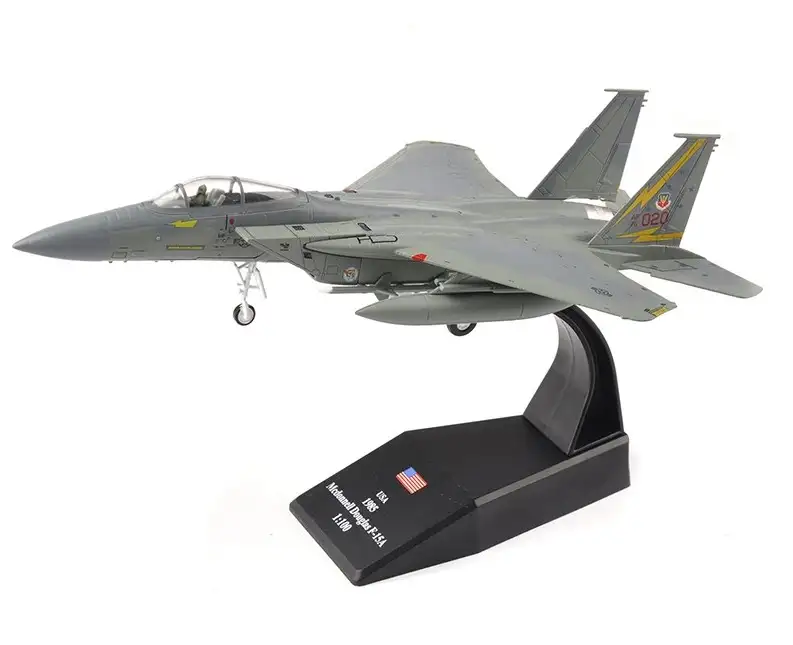 This model is available to order from AirModels – CLICK HERE TO GET YOURS.
Photo credit: Staff Sgt. Kenya Shiloh / U.S. Air Force