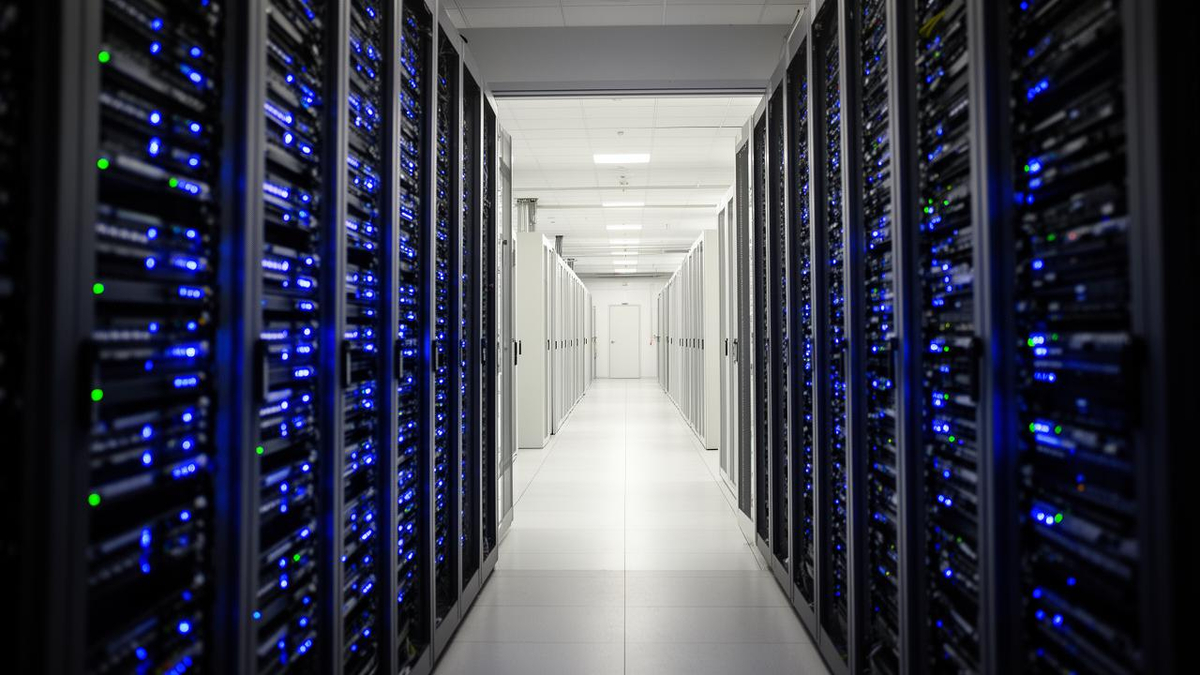
The proliferation of generative AI and the expansion of cloud services are driving a sharp surge in demand for data centers in Japan, both in scale and sophistication. At the same time, the geographic distribution of these facilities is heavily skewed toward the Tokyo and Osaka metropolitan areas, raising concerns about vulnerability to large-scale disasters and power supply constraints. Soichiro Shimada of NLI Research Institute is urging a shift toward regional dispersal that treats power and communications infrastructure as an integrated whole.
Communications Traffic Has Grown More Than 23-Fold in 13 Years
A key indicator underpinning data center demand is the volume of communications traffic flowing across the internet. According to the Ministry of Internal Affairs and Communications’ “Aggregation and Estimation of Traffic on Japan’s Internet,” download traffic from fixed broadband subscribers has continued its long-term upward trajectory. From approximately 1.9 Tbps in November 2012, traffic expanded to roughly 44.6 Tbps by November 2025. With 2012 indexed at 100, the figure reached approximately 2,347—meaning traffic grew more than 23-fold over roughly 13 years.
PeriodDownload TrafficNovember 2012Approx. 1.9 TbpsNovember 2016Approx. 8.3 TbpsNovember 2021Approx. 23.7 TbpsNovember 2024Approx. 38.9 TbpsNovember 2025Approx. 44.6 Tbps
Source: Ministry of Internal Affairs and Communications, “Aggregation and Estimation of Traffic on Japan’s Internet”
This growth represents more than just an increase in raw data volume. Beyond storage capacity for photos, videos, and business documents, it simultaneously drives demand for computing power for search, analytics, and AI processing, as well as security capabilities such as intrusion prevention. Shimada notes, “Traffic growth isn’t simply a phenomenon of ‘more data flowing’—it’s a phenomenon that expands the need for infrastructure to process data safely, continuously, and with low latency.”
Roughly 90% Concentrated in Kanto and Kansai: Three Key Risks
While demand expands, the geographic distribution of Japan’s data centers remains strikingly lopsided. According to the Agency for Natural Resources and Energy’s Energy White Paper 2025, approximately 90% of data centers nationwide were concentrated in the Kanto (Greater Tokyo) and Kansai (Greater Osaka) regions by floor area as of 2023.
There is a certain logic to this concentration. Major data demand from corporations, government agencies, and financial institutions clusters in these regions, enabling lower communications latency and easier access to existing infrastructure such as fiber-optic networks and skilled labor. However, Shimada identifies three risks stemming from this imbalance.
First, there is the risk of disaster and service disruption. If a major earthquake or widespread blackout strikes a metropolitan area, the data centers clustered in that region could be affected simultaneously. Redundancy at the individual facility level is insufficient to mitigate risks arising from regional concentration.
Second, there are constraints on power, land, and water resources. Data centers require continuous, high-volume electricity. Adding new facilities to regions where demand is already concentrated risks straining power grids, land availability, and construction labor.
Third, there is the risk of community acceptance. Concerns over large-scale power consumption, visual impact, waste heat, and noise could trigger NIMBY (“Not In My Back Yard”) opposition from local residents.
Function-Based Dispersal and “Watt-Bit Coordination” Are Key
In response to these challenges, Shimada argues that rather than rejecting the role of the Tokyo and Osaka metropolitan areas, Japan should develop regional hubs that complement and back them up, pursuing a dispersal strategy tailored to different use cases. This approach pairs each function with an optimal location: latency-sensitive services stay close to demand centers, backup and distributed processing go to regional hubs, and AI training and large-scale computation are sited in regions with favorable power and cooling conditions.
On the power front, the “watt-bit coordination” framework outlined by the Agency for Natural Resources and Energy—which calls for efficiently linking power and communications infrastructure—is critical. By leveraging regional advantages such as renewable energy, underutilized land, and cooler climates, Japan could achieve both power load dispersal and greater operational efficiency for facilities.
Equally essential is building consensus with local communities. Shimada warns, “It’s not enough for operators and government agencies to explain the role of data centers in abstract terms.” He argues that demonstrating concrete benefits—such as maintaining communications and administrative services during disasters, utilizing local renewable energy, and generating property tax revenue—while also being transparent about burdens, and engaging in dialogue with municipalities and residents from the earliest stages of site selection, is key to avoiding NIMBY opposition.
Data center development is not merely an information and communications policy issue. It spans multiple policy domains, including power grids, decarbonized energy sources, industrial siting, regional revitalization, and disaster preparedness. Treating demand growth as a facilities-construction problem alone is insufficient. The real question for strengthening Japan’s digital infrastructure going forward is how to approach siting as a location policy—determining where to build, and in combination with what power sources and communications networks.