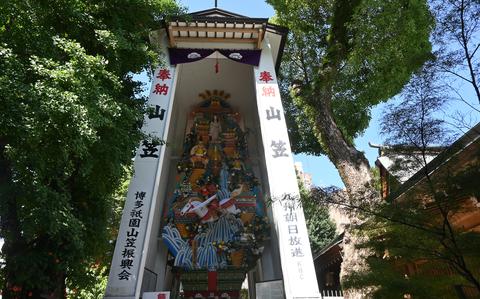

A float used during the annual Hakata Gion Yamakasa festival centered around Kushida Shrine stands within the shrine’s grounds in the Hakata district of Fukuoka, Japan, June 29, 2026. (Brian McElhiney/Stars and Stripes)
Right in the center of Fukuoka city’s ultra-modern urban landscape, a piece of ancient Japan beckons history buffs and nature lovers alike.
On a recent visit to Fukuoka, I walked from Kushida Shrine to Jotenji Temple in the heart of the Hakata district’s Old Town area, then made my way to Tochoji, a temple housing Japan’s largest wooden Buddha.
Kushida Shrine, built in 757 under orders from Emperor Koken, is dedicated to the gods Ohatanushi-no-mikoto, Amaterasu-omikami and Susanowo-no-mikoto, according to Fukuoka city’s official tourist website. It was rebuilt in 1585.
With impeccable timing, I visited right before the two-week Hakata Gion Yamakasa festival centered around the shrine. However, I was still able to see some of the preparations for the event, including a yamakasa, an impressive float within the shrine that towered over curious visitors and served as a backdrop for their photos.

A gate marks the entrance to the Hakata Old Town area of Fukuoka, Japan, June 29, 2026. (Brian McElhiney/Stars and Stripes)
Jotenji is along Jotenji-dori. A gate welcoming visitors to the Old Town area sits at one end of the avenue; because my sense of direction is as excellent as my timing, I entered from the other direction.
The Rinzai Buddhist temple was constructed in 1242, according to the Fukuoka website. I wandered around the garden, taking in the quiet morning.
The temple’s role as the birthplace of Japanese udon and soba noodles is commemorated with a statue at the garden’s entrance. Temple founder and priest Enni-Ben’en brought the noodles’ production method to Japan from China, where he mastered Zen Buddhism, in 1941, according to the website.

Two monuments commemorate the birthplace of Japanese soba noodles, left, and manju, a sweet bun made with beans, at Jotenji Temple in the Hakata district of Fukuoka, Japan, June 29, 2026. (Brian McElhiney/Stars and Stripes)
However, Tochoji, a short walk away, was perhaps the most impressive stop on my trek. The temple was built in 806 by Kukai Kobo-Daishi after he completed training in Buddhism in China, according to Fukuoka prefecture’s tourism website.
But its most impressive feature is the 35-foot-tall, 30-ton sitting wooden Buddha, the largest of its kind in Japan.
Visitors pay a tribute and bow to the statue and can walk behind it to view the treasure exhibition hall. Take care exiting, though – the hall grows pitch black beyond the exhibit, and I needed to guide myself with my hands on the walls and listen to the surprised yells of the family in front of me to find my way safely.
I could have visited temples and shrines all day, but I decided to take a quick train ride on the Kukou, or Airport, line to Ohorikoen Station and walk about 15 minutes to the Fukuoka Castle ruins in Maizuru Park.

A torii opens leads the way to Kushida Shrine in the Hakata district of Fukuoka, Japan, June 29, 2026. (Brian McElhiney/Stars and Stripes)
The main base of the keep was closed due to construction during my visit. I was still able to find a good vantage point at the top of the castle for an impressive view of the Fukuoka skyline.
Signs scattered throughout the park provide historical information in English, Japanese, Chinese and Korean. The castle was built by military tactician Kuroda Kanbei and his son Nagamasa over seven years beginning in 1601 and was designed to withstand enemy attacks, according to the signs. It is designated as a Japanese National Historic Site.
While I may have missed any major festivals or events, the visit was well worth my time to soak up some history.
On the QT
Directions: By train, the Hakata district is three stops from Fukuoka airport on the Kukou Line.
Times: Temples and shrines in the city open early and close between 5 p.m. and 7 p.m.
Costs: Admission to the temples and shrines is free. A 100-yen tribute is required to visit the Buddha at Tochoji.
Food: Lots of options available nearby. Ramen in Fukuoka is highly recommended.
Information: Online: gofukuoka.jp