
While scientists are working to pin down the exact mechanism behind last month’s deadly mudslide in Nepal, they say that climate change had a role in the ice-rock avalanche that resulted in massive flooding.
Though the scale and mechanisms may vary, Japan is not immune to the risk of catastrophic mudslides hitting mountainous communities, experts say. The country has already seen warming intensify extreme heat and flooding in recent years.
In Nepal, where over 1,300 people were killed and more than 5,000 are still missing, scientists say climate change and natural geology likely combined to spur the disaster. The affected mountain range is made up mostly of sedimentary rocks, which are prone to weathering and erosion, said Farooq Azam, a cryosphere specialist at the International Centre for Integrated Mountain Development.
“Glaciers are receding and exposing rock surfaces underneath, which absorb heat,” he told a news briefing last week. “When glaciers are receding, there is always some loose … debris left behind. So it seems like a combination of both climate treatment as well as the geologic process.”
Azam added that there are chances that “because of the extreme warming over the recent decades, permafrost layers below the surface are also warming up and are degrading.”
Seita Emori, a climatologist at the University of Tokyo, said mountain slopes around the world are generally becoming more unstable due to the warming-induced melting of glaciers and permafrost, though the direct cause of the Nepal disaster remains unknown.
In Japan, however, the size of mountain glaciers is very small compared with the Himalayan region, so the scale of mudslides caused by changes in the cryosphere will be much smaller, he said.
For Japan, heavy rain — rather than glaciers — is a bigger risk for slope collapses, as torrential rain and floods are becoming more frequent, he said, citing the 2014 Hiroshima mudslides. That disaster, which caused 166 slope failures, killed 77 people.
Katsuhisa Kawashima, professor of glaciology at Niigata University, likewise said the size and process of glacier formation in Japan are different from those abroad. But, he added, Japan has seen its share of disasters caused by the melting of perennial snow patches.
Following the 2004 collapse of a snow patch on Mount Arasawa in Niigata Prefecture that killed three amateur photographers, Kawashima analyzed disasters caused by snowfield collapses across the country, based on newspaper reports from 1965 through 2004. There were 45 incidents, all the way from Hokkaido to Gunma to Toyama. Victims have been mostly mountain hikers, tourists and vegetable pickers.
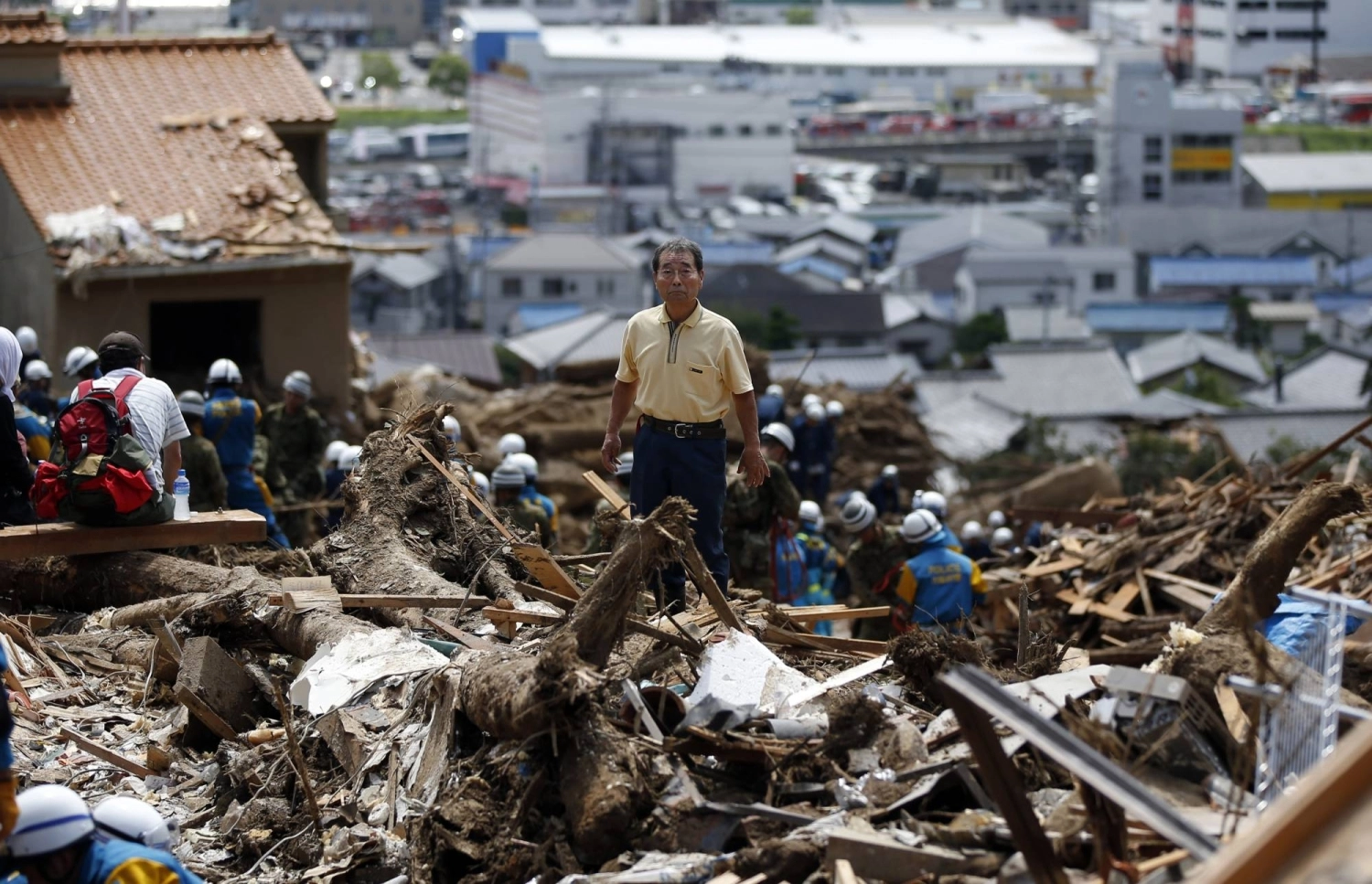
A local resident stands amid rubble where a landslide swept through a residential area in the city of Hiroshima’s Asaminami Ward in August 2014, after landslides triggered by torrential rain slammed into the outskirts of the city, leaving 77 dead.
| REUTERS
As rainfall in Japan has intensified in recent years, the chance of mountain snow disasters happening could rise in the future, Kawashima said.
“Heavy rainfall degrades permanent snow and glaciers,” he said. “When rain falls and enters the bottom of the glacier, it can make ice easier to glide. It can make the glacier movement active and prone to collapsing.”
On the other hand, since the volume of permanent snow is small in Japan, rises in temperatures may lead it to melt and disappear, he added.
“In that case, the risk (of avalanches in Japan) would go down. So it’s difficult to say the risk will universally rise with warming.”
Another key question in Nepal’s flood disaster is whether an early warning system could have reduced the damage.
Azam said that this event was a “sudden-onset hazard that could not be captured by conventional warning systems,” noting that, even with such a system, it would have been difficult to identify the breakpoints, because they can be below the bedrock or glaciers and cannot be analyzed by satellites.
Japan is also confronting issues over the accuracy of rain-related disaster forecasts. In 2022, the Japan Meteorological Agency began issuing warnings up to half a day in advance of a linear rainband, which forms when successive, well-developed thunderstorms organize into a line and linger in the same area for several hours. Such linear rainbands often lead to landslides, as well as river overflow and road flooding.
In May, the agency added a system to warn three hours before a rainband forms. This year, the rate of accurately predicting linear rainbands three hours in advance stood at 30% as of Aug. 30, meaning that rainbands formed 16 times out of the 53 times predicted, below the agency’s expectation of getting it right 50% of the time.
Still, Japan’s warning systems help people better prepare for disasters, especially for typhoons, for which alerts are issued well in advance, Emori said.
At the same time, given the call by the Nepalese government for the world’s biggest carbon emitters to pay for the damage caused by the flood, Japan should stay committed to not just adapting to, but also mitigating climate change, including through its net-zero goals, Emori said.
“I think we have to use this disaster as a wake-up call for the international community to realize more strongly that, if we don’t stop climate change, we could see devastating events like this happening in many places around the world,” he said.