
Sep 14, 2026 06:00:00

The act of thinking or talking to oneself using words in one’s head without speaking aloud is called ‘inner speech.’ A research team led by Kota Otani, a researcher at the University of Tsukuba, and Takashi Kuwasui, an assistant professor, and Yusuke Moriguchi, a professor at Kyoto University Graduate School, investigated how this inner speech develops in early childhood using a ‘task of counting numbers in one’s head.’
The developmental origin of inner speech: Evidence from a mental counting task in 3- to 6-year-old children – ScienceDirect
https://www.sciencedirect.com/science/article/pii/S0001691826015179
Counting from 1 to 5 can measure a child’s ‘internal language development’ | Medical & Health – TSUKUBA JOURNAL
https://www.tsukuba.ac.jp/journal/medicine-health/20260909140000.html

Counting from 1 to 5 can measure a child’s ‘internal language development’ – University of Tsukuba Press Release
(PDF file) https://www.tsukuba.ac.jp/journal/pdf/p20260909140000.pdf
Inner speech is thought to be involved in functions such as controlling one’s own actions and emotions. According to the research team, the idea that inner speech develops when young children start talking to themselves while playing and gradually move into a silent form of speech has long been supported. However, it has been difficult to confirm the developmental process because the words in a child’s head cannot be observed from the outside, and the child themselves cannot adequately explain what is happening in their mind.
The research team then had 77 children aged 3-6 and 25 adults participate in a task involving counting from 1 to 5. All participants first performed the ‘external speech condition’ five times, counting aloud, followed by the ‘internal speech condition’ five times, counting internally. For the first count, they were asked to count at a natural and comfortable speed, and to maintain that speed as much as possible for subsequent counts, including the internal speech condition. The left side of the diagram below shows the external speech condition, and the right side shows the internal speech condition.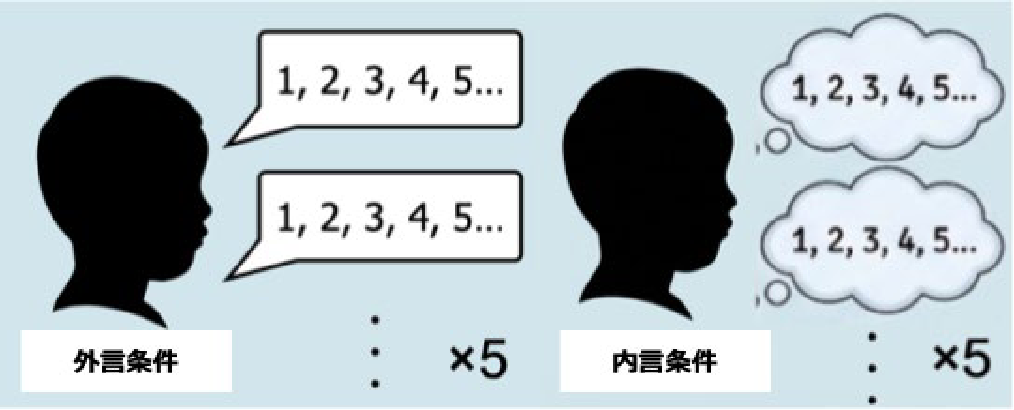
The research team hypothesized that consistent internal speech was indicated if the time taken to count in one’s head was roughly the same each time, and compared the variability of the time taken over five counting attempts. A tablet stopwatch with the seconds hidden was used for measurement, and participants were asked to press a button before starting to count and immediately after counting to ‘5’.
Furthermore, we confirmed through observations during the experiment and recorded video footage whether the children were making sounds, moving their lips, or counting with their fingers in accordance with the inner speech condition. Excluding children who had difficulty completing the tasks as instructed, 58 children were included in the analysis of the time required.
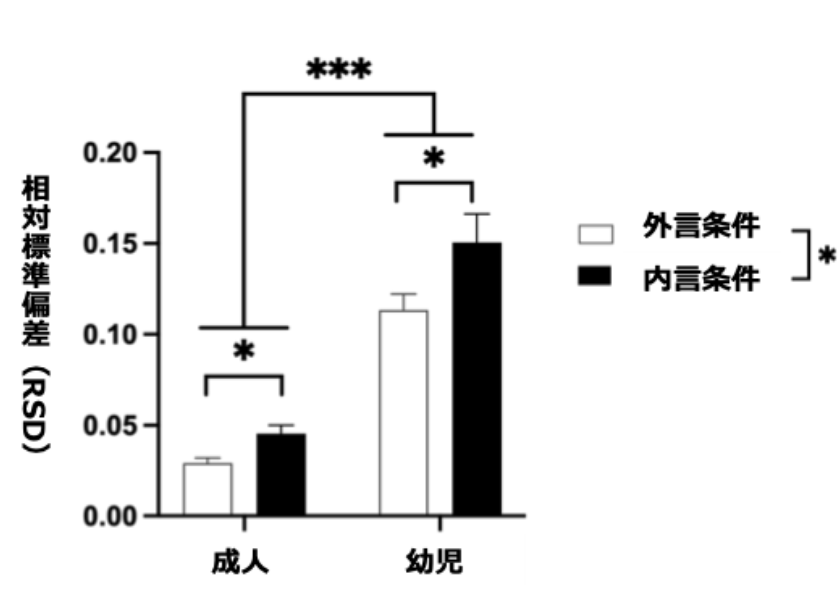
The analysis revealed that toddlers showed greater variability in counting time than adults, and both toddlers and adults showed greater variability when counting internally than when counting aloud. The graph below shows the distinction between adults and toddlers on the horizontal axis, with white bars representing external counting conditions and black bars representing internal counting conditions. The vertical axis represents the relative standard deviation (RSD), which indicates the variability in the time taken; a smaller value indicates that the counting time was more consistent each time.
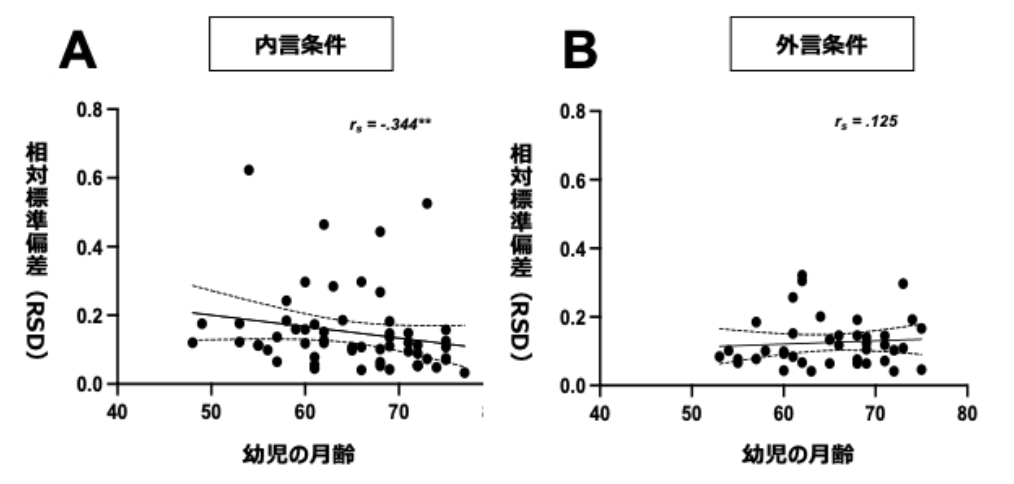
Among infants, there was a tendency for the variability in the time it took to count internally to decrease with increasing age in months. On the other hand, when counting aloud, no clear relationship was found between age in months and variability. In the graph below, A on the left represents the internal speech condition, and B on the right represents the external speech condition. The horizontal axis represents the infant’s age in months, and the vertical axis represents the RSD, which indicates the variability in counting time. Each point represents data for one infant.
Furthermore, there were age-based differences in whether the children could count in their heads as instructed, without making sounds or moving their fingers or lips. The median age for children who could count in their heads was 5 years and 6 months, while for those who found it difficult it was 4 years and 5 months. In the latter group, children were also observed using their fingers to count or moving their lips. Based on these results, the research team believes that around age 5 is a benchmark for when inner speech gradually stabilizes throughout early childhood, and children become able to count in their heads without relying on sounds or finger movements.
Furthermore, the research team also asked questions to assess understanding of inner speech, analyzing the responses of 29 of the 32 children (excluding 3 who gave the same answer to all questions) and 25 adults. The percentage of those who answered ‘yes’ to the question, ‘Can people speak to themselves in their heads?’ was 65.5% for children and 92% for adults.
In young children, no clear correlation was found between their answers to questions and their performance on counting tasks. The research team points out that ‘the ability to use words in one’s mind and the ability to understand and explain them may not necessarily progress simultaneously.’
However, the research team investigated inner speech when participants counted numbers in their heads at the request of the experimenter. They did not determine when words that naturally come to mind in everyday life begin to arise.