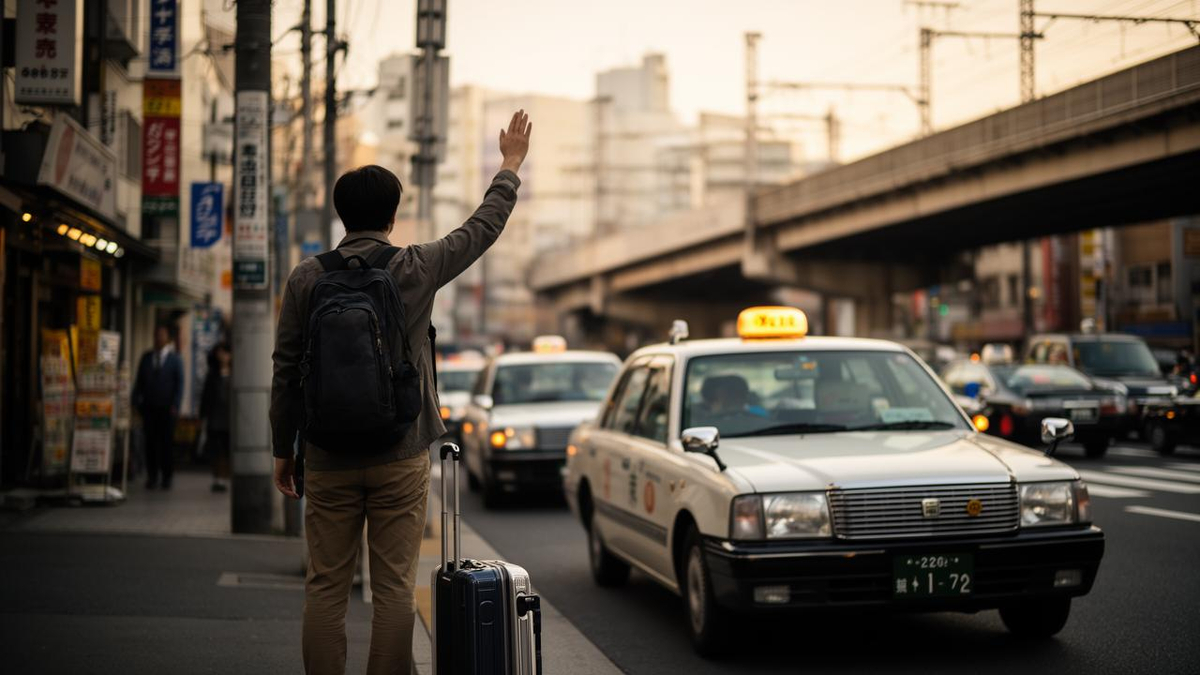
In Tokyo, hailing a taxi with a Korean-language search and completing automatic payment with a registered card took just over five minutes. The feat was made possible by Kakao Mobility’s system integration with local operators including GO, Japan’s leading taxi-hailing app, allowing overseas users to hail taxis through Kakao T alone — no separate app installation required.
Around noon on the 20th, as Typhoon Dujuan dumped rain across Tokyo, opening the “Going Abroad” menu in the Kakao T app revealed an “Overseas Ride Hailing” button. Setting the pickup and destination points and tapping the hail button was nearly identical to the process used in South Korea.
Typing “Aoto Station” in Korean into the search bar instantly displayed the destination. There was no need to convert unfamiliar place names into Japanese or English. A vehicle was dispatched immediately after the request, and the taxi’s location, estimated arrival time, and license plate number appeared on the map in real time.
Upon boarding, passengers had to show the driver a confirmation number displayed in the app — a safeguard against passenger-vehicle mix-ups. The ability to check the estimated fare before hailing also reduced concerns about being overcharged. The actual fare varied depending on traffic conditions, but travelers could gauge approximate costs in advance. Payment was settled automatically with the credit card already registered in Kakao T.
The vehicle dispatched this time was a taxi operated by Nihon Kotsu, running through Kakao Mobility’s system integration with local partners such as GO. Actual operations are handled by local taxi companies.
The overseas ride-hailing service is not limited to Japan. It is available in 39 countries total, including 11 Asian nations such as Vietnam, Thailand, Taiwan, and Singapore; 25 European countries including France, Italy, and the United Kingdom; plus the United States, Canada, and Australia. Kakao Mobility continues to expand its global service footprint.
Tokyo to Commercialize Driverless Autonomous Taxis by 2027
Japan’s mobility market is racing to introduce driverless autonomous taxis. GO, Nihon Kotsu, and Waymo — the autonomous driving unit under Alphabet — announced on the 15th that they will launch driverless autonomous taxi services in Tokyo in 2027. The plan calls for a phased rollout, eventually scaling up to 100 vehicles.
Waymo already operates commercial driverless taxi services in 14 U.S. cities. In Tokyo, riders will be able to hail vehicles through the GO and Waymo apps. Whether driverless taxis can operate reliably on Tokyo’s narrow, complex roads remains a challenge to be verified during the commercialization process.
The move puts Japan ahead of South Korea. A total of 19 autonomous taxis currently operate in South Korea (13 by SWM, 6 by Kakao Mobility), all confined to late-night hours (10 p.m. to 5 a.m.) in Seoul’s Gangnam district. Since safety personnel ride aboard, they are difficult to classify as fully autonomous taxis.
Japan is grappling with a taxi driver shortage driven by an aging population and demographic decline. Whether the introduction of driverless taxis can translate into actual operations that ease the labor crunch is a key point of focus.
Why the “Taxi Prince” Embraced Autonomous Driving
The figure who drew as much attention as the technology in this announcement was Ichiro Kawanabe, director of Nihon Kotsu, chairman of GO, and chairman of the National Hire-Taxi Federation. A third-generation member of the Nihon Kotsu founding family, he is known as the “Taxi Prince” and has led the taxi industry’s opposition in the ride-sharing debate. Yet he personally championed the push into autonomous driving.
On the surface, this appears to be a reversal. But from an institutional standpoint, the contradiction is minimal. The industry’s objection was never about driver skill — it was about who bears ultimate responsibility for accidents and vehicle maintenance. In ride-sharing, the operator — not the taxi company — becomes the entity transporting passengers, which was the crux of the dispute. In autonomous driving, even when the human driver disappears, the taxi company can remain the party responsible for transporting passengers.
Waymo supplies the technology, Nihon Kotsu handles operations as the taxi company, and GO serves as the dispatch app. It is a structure where new technology is accepted, but the taxi industry controls the market’s entry point. This can be interpreted not as rejecting ride-sharing while embracing autonomy, but as consistently enforcing the principle — twice over — that “new technology may be absorbed, but the taxi company remains the responsible party for passenger transport.”
Since the 1951 Road Transport Act, Japan has in principle banned “shiro-taku” — the practice of using private vehicles to carry passengers for a fare. The system institutionalizes taxi company responsibility for accident liability, vehicle maintenance, and passenger safety. Japan’s version of ride-sharing, launched in 2024, allows ordinary drivers to carry passengers in private vehicles, but drivers work under taxi companies, and operating areas, hours, and vehicle counts are restricted to ranges the government has certified as facing taxi shortages. Operational management and maintenance responsibility still rest with taxi companies.
How Autonomous Driving Could Reshape the Market
Autonomous driving is not merely a new technology for the taxi industry — it changes the very nature of the driver shortage problem. In rural areas, taxi companies often have vehicles but no drivers to operate them. In regions where bus routes have been cut and taxi companies have shut down, elderly residents who have surrendered their driver’s licenses lose their means of reaching hospitals and train stations. If vehicles that run without drivers become practical, they could serve as a mobility solution for these communities.
Japan’s Ministry of Land, Infrastructure, Transport and Tourism has designated autonomous driving as a response to transportation gaps and driver shortages, setting a goal of operating 10,000 autonomous service vehicles — including buses, taxis, and logistics — by fiscal 2030. The Waymo deployment in Tokyo is part of that plan.
However, viewing autonomous driving merely as a “new form of taxi” risks missing the market’s fundamental shift. If ride-sharing sought to expand mobility by increasing the number of people driving, autonomous driving is a technology that creates transportation networks that move without people at all. If vehicles can continue operating in areas where the economics previously didn’t work, the market could grow far beyond the current taxi market.
The fare question also remains. Most of a taxi’s cost is understood to be driver labor. When the driver disappears, the cost structure changes dramatically — but no one can guarantee that this will automatically translate into lower fares. A 2025 survey by U.S. ride-comparison app Obi found that Waymo’s average fares exceeded those of Uber and Lyft. In other words, there is no guarantee that fares will drop even without a driver.
Whether the labor cost savings go to Waymo as the technology provider, to GO as the dispatch app, to taxi companies like Nihon Kotsu, or back to users through fare reductions depends on the competitive landscape ahead. Autonomous driving is not simply a change where “the driver disappears” — it is an event that rewires the cost and profit distribution structure of the taxi industry.
Will It Remain a “Single Port of Entry”?
The Waymo–Nihon Kotsu–GO partnership represents meaningful progress in commercializing overseas autonomous driving technology in Japan. But to those who watched the ride-sharing debate unfold, it is clear that the same structure is being recreated. The wariness toward foreign platforms has resulted in keeping the passenger transport entry point in the hands of taxi companies.
Uber did not withdraw from Japan; it settled into a dispatch service partnering with taxi companies. Chinese ride-hailing giant DiDi also operates in Japan as a taxi dispatch business. And now Waymo enters in partnership with Nihon Kotsu and GO. Japan has not excluded foreign companies — it has simply kept the gateway for their entry on the side of its domestic taxi industry.
Autonomous vehicles also require safety standards. Rules different from conventional taxis are needed for accident liability, insurance, remote monitoring, vehicle maintenance, and data management. But “who bears responsibility” and “no one but taxi companies may transport passengers in autonomous vehicles” are fundamentally separate issues. Observers note that while safety regulations are necessary, there is no need to carry entry restrictions designed to protect incumbent operators from competition into the autonomous driving era.
The argument goes that automakers should be allowed to operate autonomous taxis, IT companies should be able to enter, and foreign autonomous driving firms should have a path into Japan without partnering with Japanese companies. If the entry condition shifts from “must be a taxi company” to “must be able to transport passengers safely,” then GO, Nihon Kotsu, Waymo, automakers, and startups would all compete under the same rules.
Whether the driverless taxis that begin running in Tokyo in 2027 become vehicles that carry a closed market into the future, or vehicles that open up new competition, depends less on the autonomous driving technology itself than on how much the market that adopts that technology is opened up.