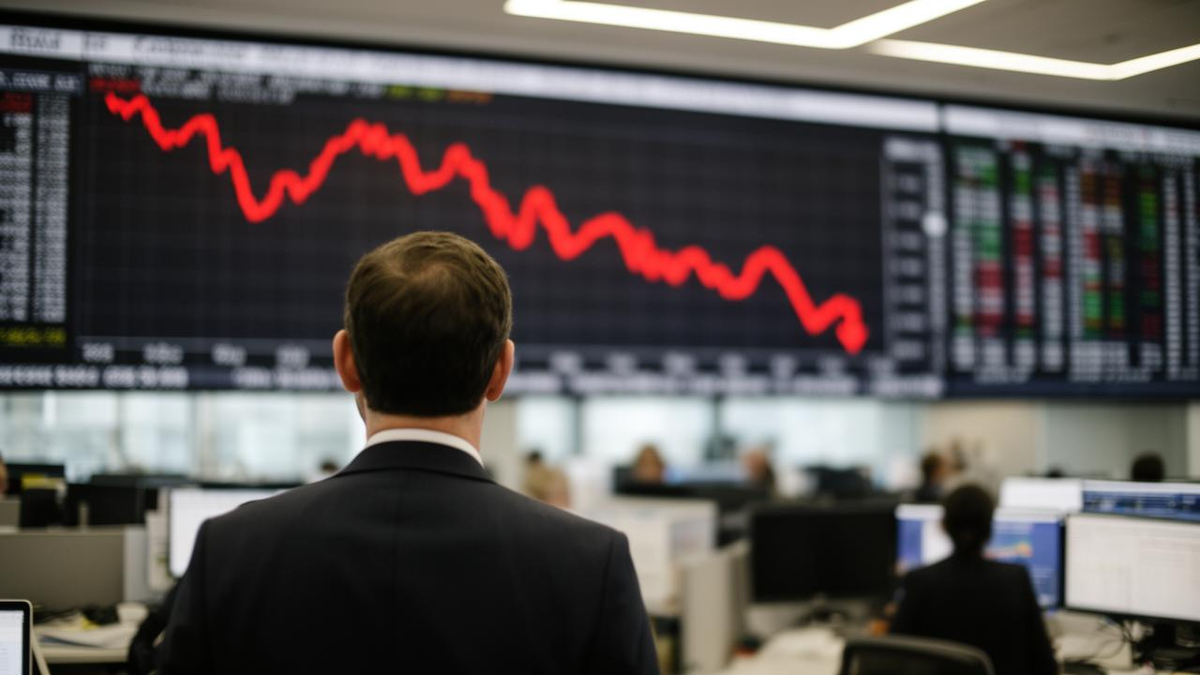
Seven out of every 10 stocks listed on South Korea’s KOSPI and KOSDAQ markets posted negative returns in July amid the sharp market downturn. Investor sentiment deteriorated rapidly as concerns over a semiconductor industry peak-out (decline after peaking) combined with geopolitical risks stemming from the Middle East.
According to Edaily, the semiconductor peak-out concerns were triggered by a slowdown in memory export price increases, controversy surrounding long-term supply agreements (LTAs) involving Samsung Electronics and SK Hynix, the successful Shanghai IPO of China’s CXMT (ChangXin Memory Technologies), and reports of China’s push to localize lithography equipment. As a result, Samsung Electronics shares fell 21.41% last month, while SK Hynix dropped 35.17%.
Data from the Korea Exchange on Sunday showed that 1,859 stocks fell in the KOSPI and KOSDAQ markets last month compared to June 30. That represents 70% of all 2,645 listed stocks.
By market, 566 stocks — or 62% of the 917 listed on the KOSPI — declined, while 1,293 stocks — or 75% of the 1,728 listed on the KOSDAQ — fell. The proportion of declining stocks was higher on the KOSDAQ than on the KOSPI.
The KOSPI plunged 22.2% last month, and the KOSDAQ index dropped 21.4% — the largest monthly decline since October 2008, during the global financial crisis. Analysts noted that profit-taking selling emerged as the KOSPI had surged 101% in the first half of the year, leading to perceptions that the market had peaked.
In particular, the KOSPI plunged 10.84% in a single day on July 28, followed by additional declines of 5.98% and 1.23% on July 29 and 30, respectively — a cumulative crash of 17.20% over three days. The index then rebounded sharply by 17.91% on July 31, marking its largest single-day gain on record, but it still remains more than 1,881 points below its June 30 closing level of 8,476.48.
Kolon TissueGene Plunges 86% on Failed Clinical Trial
Kolon TissueGene was the worst-performing stock on South Korean markets last month, tumbling 86% over the four-week period. The stock, which closed June at 93,600 won (approximately $65.20) per share, crashed to 13,000 won (approximately $9.05) by the end of July. The sell-off was triggered by news that the company’s cell and gene therapy for osteoarthritis failed to achieve statistically significant results in clinical trials.
Kolon TissueGene’s osteoarthritis treatment, TG-C (formerly Invossa), failed to meet the co-primary endpoints with statistical significance in its U.S. Phase 3 trial. The stock began declining ahead of the official announcement on July 13, raising questions in the market about possible information leaks.
Other notable decliners included The Technology (-76%), Kolon Life Science (-67%), ContentreeJoongAng (-67%), StradVision (-65%), and Justek (-64%).
Meanwhile, G&E Healthcare was the top gainer over the same period, surging 222%. It was followed by ICH (87%), VECT (86%), Enex (85%), and Joyswork&Co (75%). As large-cap semiconductor stocks on the KOSPI stumbled, buying rotated into select small-cap names, driving outsized gains in that segment.
CategoryStockReturnBiggest DeclinerKolon TissueGene-86%2nd Biggest DeclinerThe Technology-76%3rd Biggest DeclinerKolon Life Science-67%3rd Biggest DeclinerContentreeJoongAng-67%5th Biggest DeclinerStradVision-65%6th Biggest DeclinerJustek-64%Top GainerG&E Healthcare+222%2nd Top GainerICH+87%3rd Top GainerVECT+86%4th Top GainerEnex+85%5th Top GainerJoyswork&Co+75%
“KOSPI in Extreme Undervaluation Territory… Rebound Possible”
Experts believe the KOSPI could attempt a meaningful rebound this month, citing solid earnings momentum and increasingly attractive valuations.
“From both a valuation and technical standpoint, the KOSPI has entered a zone of excessive decline,” said Lee Kyung-min, an analyst at Daishin Securities. “Forward EPS and earnings estimates for this year and next have been revised upward recently, suggesting that recent negative news has not yet affected the earnings or economic trajectory.”
He added: “The KOSPI’s 12-month forward P/E ratio stands at just 4.7 times — the lowest level since 2000, placing it in extremely undervalued territory. If the KOSPI can quickly establish a foothold in the 5,700–5,800 range, the late-July crash phase could rapidly transition into a normalization phase.”
Han Ji-young, an analyst at Kiwoom Securities, also noted: “Despite the surge on July 31, the KOSPI remains in oversold and over-extended decline territory. It’s worth noting that earnings credibility across the index is being restored through the results of key sectors like Samsung Electronics and SK Hynix.”
August Strategy… Foreign Buying Is Key
Brokerages are advising investors to focus on identifying oversold stocks rather than trying to predict short-term index movements in August. Historically, after sharp market crashes, leading sectors have often posted 1-month, 3-month, and 6-month returns that significantly outperform the index — suggesting investors should prioritize stocks whose P/E ratios have compressed rapidly but whose earnings outlooks remain intact.
The key variable determining whether the rebound can be sustained is foreign investor buying. While individuals and institutions have historically turned to net buying relatively quickly after sharp declines, there have been cases where foreign investors maintained a selling stance for six months or longer. If foreign buying does not recover in August, the rebound could be limited in scope.
“Investment strategy should focus on stocks where a rapid P/E recovery can be expected,” said Lee Jae-man, an analyst at Hana Securities. “Investors should look at companies that offer both growth and profitability, particularly those with free cash flow (FCF) growth rates exceeding net income growth.”
Meanwhile, on July 31’s surge, foreign investors and individual investors recorded their largest-ever net buying and net selling, respectively. Foreign investors bought more than 7 trillion won (approximately $4.9 billion) worth of stocks on the main bourse, while individuals sold over 8 trillion won (approximately $5.6 billion). Samsung Electronics and SK Hynix surged 26.81% and 29.95%, respectively, and all stocks ranked 2nd through 4th by market capitalization (excluding preferred shares) hit their daily price limits.