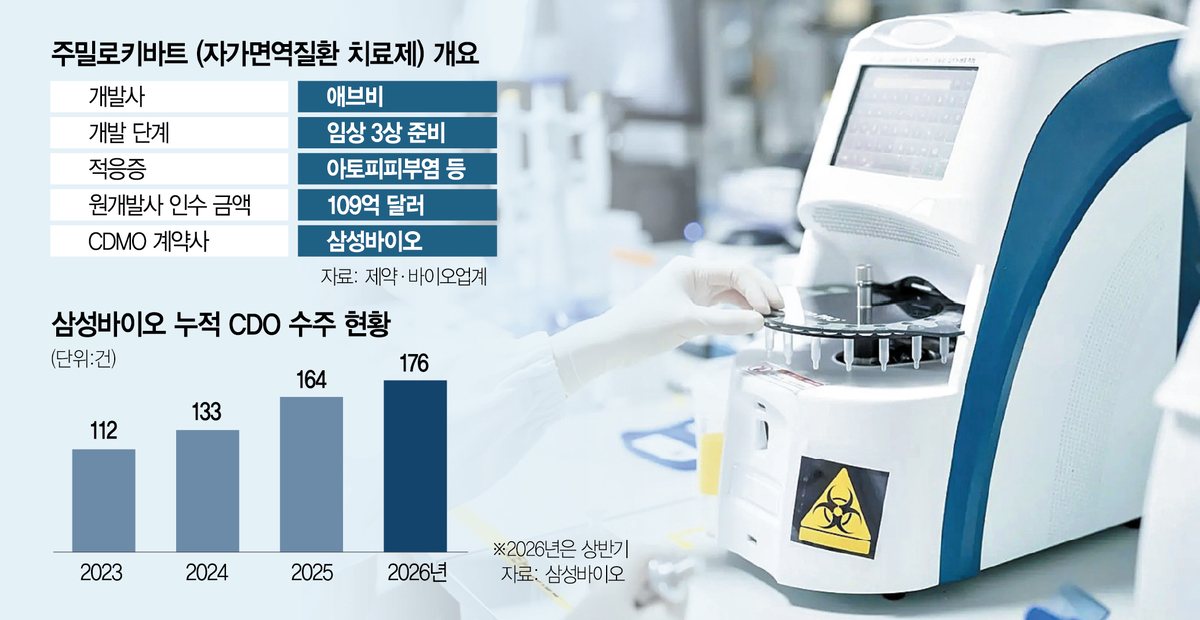

Samsung Biologics (207940.KS) will handle contract manufacturing (CMO) of “zumilokibart,” a new drug candidate developed by global pharmaceutical giant AbbVie. AbbVie’s decision to acquire Apogee means the CMO contract that Apogee had earlier signed with Samsung Biologics will also be transferred to AbbVie. Analysts say the company is gaining momentum in “one-stop” deals that span the full range from new drug development to commercial production, as seen in its recent joint participation in an Eli Lilly clinical trial in China.
According to the pharmaceutical and biotech industry on the 13th, Samsung Biologics was confirmed to have signed a conditional commercial production contract for zumilokibart with Apogee, which AbbVie is in the process of acquiring, early this year. Under the contract, Samsung Biologics will handle commercial production of the active pharmaceutical ingredient once zumilokibart wins regulatory approval. Samsung Biologics is also guaranteed a termination fee worth several million dollars, including contractual obligation costs, should distribution become impossible due to problems on the developer’s side.
The contract expands on the CDO deal that Samsung Biologics signed with Apogee in February last year. At that time, Samsung Biologics agreed to handle clinical batch production of the drug candidate, along with process characterization and validation. Zumilokibart is a treatment for autoimmune diseases, indicated for conditions including atopic dermatitis, and is being developed with the goal of entering Phase 3 trials within the year and reaching commercialization in 2029. Having shown potential as a next-generation standard therapy in Phase 2 trials, it is regarded as the key asset that led AbbVie to acquire Apogee for about $10.9 billion. AbbVie is the company that developed the autoimmune disease treatment “Humira,” which was the world’s top-selling drug by revenue until Keytruda broke the record.
Samsung Biologics also listed itself as a co-applicant last month for the Phase 2 clinical trial in China of Eli Lilly’s autoimmune disease treatment “LY4005130.” The candidate is intended to treat conditions including vitiligo and alopecia areata, and the industry believes Samsung Biologics took on tasks such as clinical batch production. Because CDO firms that collaborate from the clinical stage often go on to handle commercial production after approval, this is expected to lead to a CMO contract as well.
Samsung Biologics has conducted CDO work on autoimmune disease candidates in the past. On HanAll Biopharma’s “batoclimab,” the two companies collaborated on cell line development, production process development and clinical sample production from 2021. Immunovant, a subsidiary of U.S.-based Roivant, later licensed the substance and signed a CMO contract, but commercial production effectively fell through after batoclimab failed its Phase 3 trial in April this year. In contrast, the two recent candidates are being developed directly by big pharma companies such as AbbVie and Lilly, so their chances of reaching final commercialization are seen as higher.
Unlike CMO, in which a company produces drugs based on a completed manufacturing method it is handed, CDO is the business of building the manufacturing foundation for a drug candidate. Because it involves participation from the early stages of new drug development, it allows a company to accumulate data on the candidate’s characteristics and manufacturing, providing a foundation for strengthening the competitiveness of the contract development and manufacturing (CDMO) business. An industry official said, “Because CDO often leads to CMO several years later, it has the effect of securing production volume in advance,” adding, “Competitor Lonza generates about 30% of its total revenue from CDO, and China’s WuXi Biologics about 40%, showing how much they are investing in it.”
Samsung Biologics started with CMO in 2011 and entered the CDO business in 2018. It had signed a cumulative 164 CDO contracts by early this year, of which 49 received approval for their investigational new drug (IND) applications. Unlike the early days of the business, which centered on domestic biotech firms, 70% to 80% of its clients are now said to be global. Lee Sang-myung, executive vice president in charge of CDO development at Samsung Biologics, stressed at the JP Morgan Healthcare Conference early this year, “By combining our technology, know-how and infrastructure with our clients’ ideas, we will establish ourselves as a one-stop partner covering the entire life cycle of new drug development.”