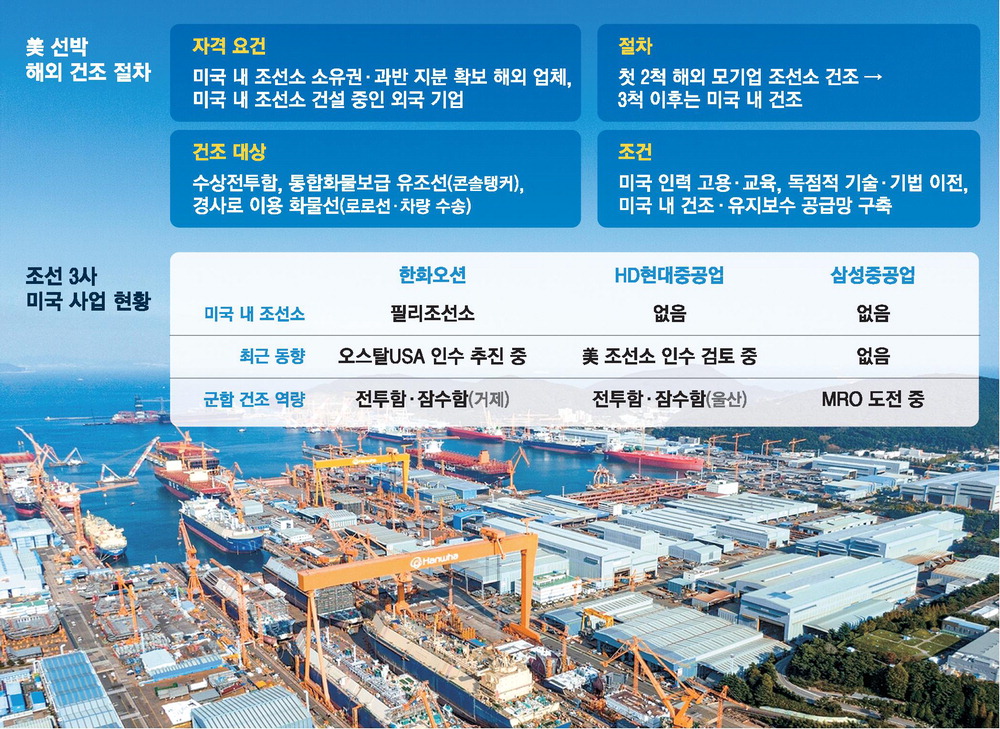
 사진 확대 A view of Hanwha Ocean’s Geoje Shipyard. Hanwha Ocean
A new opportunity has opened up for South Korea’s shipbuilding industry after U.S. President Donald Trump signed a national security presidential memorandum. Foreign shipbuilders that meet the required conditions will be allowed to build U.S. Navy vessels at shipyards in their home countries, putting Hanwha, which owns Philly Shipyard, in the spotlight as a likely beneficiary.
According to the memorandum released by The White House on the 13th local time, foreign shipbuilders must either build a new shipyard in the United States or secure ownership or a majority stake in an existing one in order to take part in U.S. Navy ship construction. They must also hire and train American workers, transfer shipbuilding technology from their parent shipyards to the United States, and establish a domestic supply chain.
If these conditions are met, the first two vessels may be built at the overseas parent shipyard and delivered quickly. All later orders must be built at U.S. shipyards. The policy applies to up to three ship types, including surface combatants that conduct anti-submarine warfare, surface warfare, and convoy escort missions, as well as maritime integrated cargo and fuel tankers and roll-on/roll-off ships. The defense secretary must submit a ship procurement plan within 90 days of the memorandum taking effect.
◆ South Korea is the only country that meets the conditions
Hanwha is the only domestic company that meets the new conditions. Its foothold is Philly Shipyard in Philadelphia, which Hanwha Ocean and Hanwha Systems acquired at the end of 2024 with a combined investment of $100 million, split 40 percent and 60 percent respectively. Hanwha also moved this week to secure a second base in the United States by proposing to acquire Austal’s U.S. operations for up to $1.2 billion. Industry watchers say Hanwha is still the strongest candidate even if the search is expanded to Europe and Japan. European shipbuilding has shrunk for years and lacks the capacity for major new investment in the United States, while Japanese yards are already stretched by domestic demand from the Self-Defense Forces.
The most likely scenario is that the first two ships will be built at Hanwha Ocean’s Geoje Shipyard and sent to the United States, while later vessels will be built at Philly Shipyard. A leading candidate is the Chungnam-class frigate, the latest frigate in the South Korean Navy, also known as the Ulsan-class Batch-III and a 3,600-ton class vessel. The Chungnam-class has already been mentioned as a possible target in the process of the United States sending a request for information on combat vessels to Korean shipbuilders.
◆ Also seen as a move to pressure investment in U.S. shipyards
HD Hyundai Heavy Industries is cooperating with Huntington Ingalls, the largest defense shipbuilder in the United States, but it does not meet the memorandum’s requirements for shipyard ownership or equity. Still, HD Hyundai has been reviewing shipyard acquisitions and equity investments in the United States for some time, so the latest memorandum is expected to accelerate those efforts. Industry observers say the move will effectively push other Korean and foreign shipbuilders, aside from Hanwha, to speed up investment in the United States.
Trump’s approval for foreign shipbuilders that have invested in the United States to build vessels in their home countries is a bold step aimed at restoring U.S. shipbuilding capacity and meeting urgent national security needs. In particular, it opens the door not only for combat ships but also for console tankers and roll-on/roll-off vessels to be built overseas, while directing the use of investment funds promised under trade agreements. That is widely interpreted as a reference to the Korea-U.S. shipbuilding cooperation project known as Make American Shipbuilding Great Again.
Until now, all U.S. military vessels have been effectively barred from overseas construction under the Burns-Tollefson amendment. Even for merchant ships, the Jones Act requires vessels used in domestic coastal shipping to be built at U.S. shipyards. Since the launch of Trump’s second administration, the president has repeatedly emphasized rebuilding the shipbuilding industry and cooperating with allied shipbuilders. However, many expected that revising or working around these laws would be difficult because of resistance from affected regions and labor groups. Even so, Trump’s decision to allow overseas construction is being interpreted as a response to the view that the Navy’s force buildup and the decline of U.S. shipbuilding can no longer be left unchecked.
◆ Attention turns to whether Congress will agree
The latest move expands the so-called Finnish model, first adopted by the United States and Finland for icebreaker construction last year, to U.S. Navy vessels and support ships. In a memorandum signed in October last year, Trump had already approved the overseas construction of up to four Arctic Security Cutters. The rationale was to meet short-term demand while U.S. shipbuilding remains uncompetitive globally, and to encourage long-term investment in the United States.
However, Congress remains a hurdle. The House last month passed the 2027 National Defense Authorization Act (NDAA), which includes a provision barring defense funds from being used to procure combat vessels built at overseas shipyards. The Senate has also drawn a line against overseas construction of combat ships, allowing it only for support vessels. A defense industry source said, “There is a chance the budget holders will put the brakes on it,” but added that “among the executive actions issued by the U.S. administration so far, this is the strongest.”
[Park Seung-ju / Washington, D.C. Seungjin Choi]
This article has been translated by GripLabs Mingo AI.