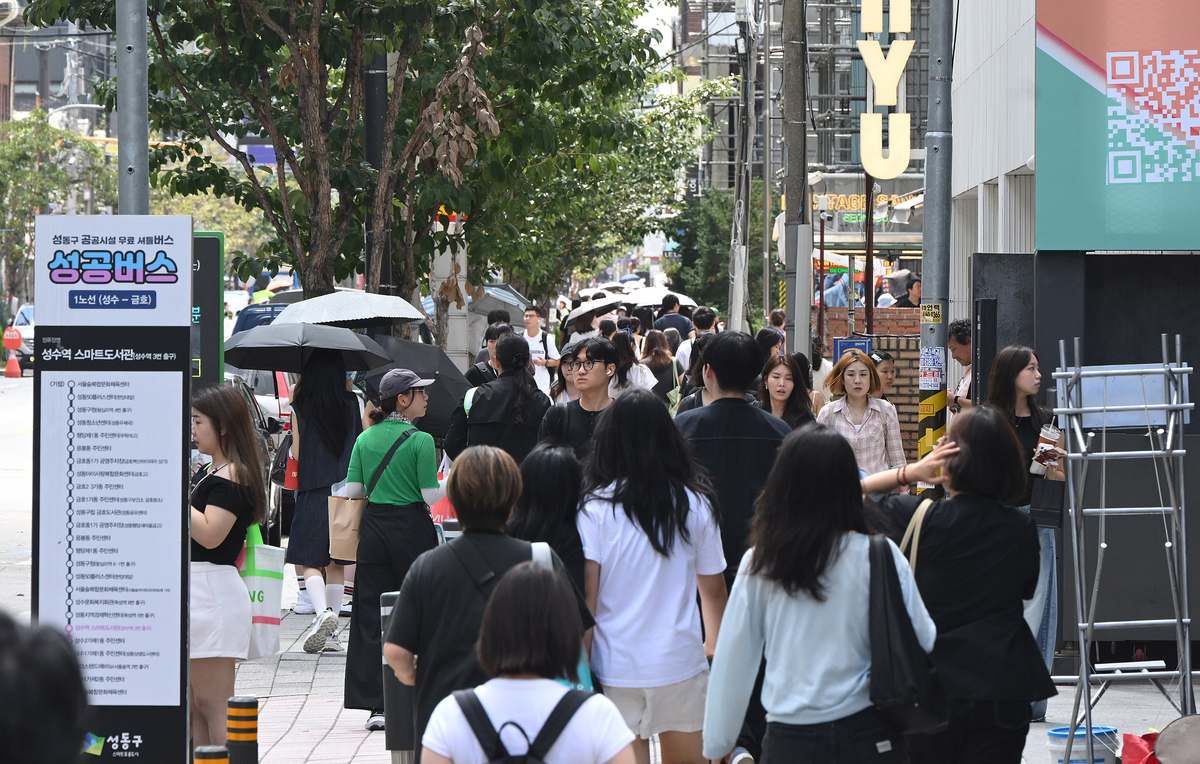
Anyone who visits Seongsu-dong in Seoul’s Seongdong District, whether on a weekday or weekend, runs into long lines. Queues regularly stretch out in front of well-known restaurants and popular cafes as people wait their turn, at flashy pop-up stores as visitors wait to enter, and outside the headquarters that famous brands have built to express their identity, where people line up to take photos.
It has already been 10 years since Daelim Warehouse, the multipurpose cultural space widely cited as the starting point of Seongsu’s rise, opened its doors. Steep rent increases pushed out the small, distinctive shop owners to other areas and vacancies rose, prompting concerns at one point that “Seongsu is now past its prime.” Yet the area today is more crowded and larger than ever, as foreign tourists have rapidly filled the space left by domestic visitors, mostly people in their 20s and 30s, whose numbers have somewhat thinned.
 Offices and a shopping district near Exit 3 of Seongsu Station in Seongdong-gu, Seoul, are crowded with citizens and foreign tourists. Reporter Oh Seung-hyun
According to the Korea Tourism Data Lab on the 24th, cumulative card spending from January to July this year in Seongsu 2-ga 3-dong — which runs from Exit 3 of Seongsu Station on Seoul Subway Line 2 to Yeonmujang-gil, the area’s main commercial strip — reached 350.3 billion won, nearing the 367.7 billion won spent over all of 2024. Of that, 54.4% came from foreign tourists. The number of foreign visitors, which stood at about 22,000 in 2021, jumped more than 100-fold to about 2.228 million last year, and 1.98 million had already visited by July this year. According to global real estate services firm CBRE Korea, rents on Seongsu’s main street-level commercial areas rose 14% year-on-year in the second quarter, while the vacancy rate stood at 3.4%, lower than in Gangnam (13.6%) and Hongdae (10.4%).
From a Place to Play to a Place to Work: Fashion and Big Tech Converge in the Rise of the ‘SBD’
The bigger change is taking place in the office market. The backstreets that first drew crowds evolved into a battleground for major brands, and are now emerging as a new business district pulling in large companies from Gangnam and Pangyo. With the stylish local image and drawing power created by its young consumer base, a location embracing Seoul Forest and the Han River, transport access close to Gangnam, and a large supply of newly built offices, Seongsu — once “a place to play” — is transforming into “a place to work.” Some forecast that a Seongsu business district (SBD) will emerge alongside the central business district (CBD), Gangnam (GBD) and Yeouido (YBD) in the office market.
The early Seongsu office market was led by fashion and lifestyle companies. After Musinsa left Gangnam and moved its headquarters to Seongsu-dong in 2022, it went on to open offices, studios and stores one after another, while IICOMBINED, which operates Gentle Monster and Tamburins, also built a large workspace and brand space in Seongsu. Musinsa now runs six offices in Seongsu alone and is jointly developing a seventh, a 12-story office called E4, with Mastern Investment Management. IICOMBINED’s headquarters, “Gentle Monster House Nowhere Seoul,” has established itself as a landmark where tourists line up to take photos, thanks to its unconventional exterior design. These brands’ strategy of running the streets as one giant “showroom” has clustered numerous fashion and cosmetics companies in Seongsu.

More recently, the character and scale of the companies coming to Seongsu have expanded. Krafton, the game company famous for “PUBG: Battlegrounds,” is building a massive new headquarters with a total floor area of about 218,000 square meters on the site of the former E-Mart Seongsu store, aiming to bring together its organization scattered across Gangnam and Pangyo. Krafton has also secured rights of first refusal on eight surrounding offices and is working to tie the Seongsu area together into a single “Krafton Town.” Gmarket and Hyundai AutoEver have also announced plans to relocate their headquarters to newly built offices completed in Seongsu-dong this year.
A Flood of Major Developments at the Sampyo Site and Booyoung Hotel: ‘Set to Move Up a Class’
A series of large development projects that will lift Seongsu up another notch are also waiting in the wings. A prime example is the redevelopment of the former Sampyo ready-mixed concrete site next to Seoul Forest, a project to build a residential tower of up to 81 stories and an office tower of 53 stories on a 28,332-square-meter site. Foundation work such as soil remediation is currently underway, with construction set to begin next year and completion planned for 2032. Once finished, it is expected to become Seoul’s second-tallest landmark building and the birth of a large mixed-use business district linking Seoul Forest and the Han River.
 A view of Seoul Forest and the surrounding Seongsu-dong area in Seongdong-gu, Seoul. Reporter Oh Seung-hyun
Booyoung Group is also pursuing the development of a high-end mixed-use complex combining a hotel, residences and cultural and commercial facilities at the nearby Ttukseom Booyoung Hotel site. Development had been stalled for 17 years after the group bought the site from the Seoul city government for 370 billion won in 2009, but foundation work resumed after Chairman Lee Choong-keun expressed a commitment to restart the project early this year. According to the plan, two towers of up to 49 stories will include a 604-room five-star tourist hotel, 332 residence units and a multipurpose performance hall seating about 900.
Still, with at least 600,000 square meters of office space expected to be supplied over the next five to six years, some worry about oversupply. According to RSQUARE, a commercial real estate services firm, the office vacancy rate in Seongsu-dong, which had stayed below the natural vacancy rate of 5% through the third quarter of last year, spiked to 14.5% in a single quarter. Ryu Kang-min, head of RSQUARE’s research center, said, “A concentration of new buildings came in the fourth quarter of last year, but leasing demand filled up quickly and the office vacancy rate has been declining steadily,” adding, “In the Seongsu area, office leasing demand based on preferred sectors such as IT, fashion, beauty and content is combining with commercial growth to raise the concentration of companies, so it is worth watching whether it will grow into one of Seoul’s major business districts going forward.”
A Mammoth Complex of 10,000 Homes Along the Han River: The High-Rise Battle Across Seongsu Zones 1-4
As Seongsu-dong — which established itself as Seoul’s most vibrant commercial district centered on pop-up stores, fashion, beauty and dining — evolves into a business district where major corporations and unicorn companies gather, the residential piece, the final part of the “work-live-play” puzzle, is also poised for a complete makeover. High-end mixed-use residential buildings near Seoul Forest such as Galleria Foret, Trimage and Acro Seoul Forest currently lead the luxury housing market, but once the redevelopment of the Seongsu Strategic Improvement Zones 1-4 along the Han River is completed, creating a mammoth high-end apartment complex of nearly 10,000 homes, the entire area’s status is expected to rise sharply.

According to the redevelopment industry, Seongsu Zones 1-4 have all entered the project implementation authorization stage, and the process of selecting construction firms is in its final phase. After GS Engineering & Construction won the construction rights for Seongsu Zone 1 with a sole bid in April, Lotte Engineering & Construction secured the rights for Seongsu Zone 4 in July. For Seongsu Zone 3, with construction costs reaching 1.8275 trillion won, Samsung C&T submitted sole bids in both the first and second rounds and is proceeding toward a negotiated contract. For Seongsu Zone 2, with construction costs of 2.0137 trillion won, attention is high over whether a competitive bid will materialize, as DL E&C and HDC Hyundai Development attended the site briefing. The first-round bidding closes on the 31st of this month.
The four construction firms are expected to compete to claim a Han River landmark with high-rise designs and differentiated technology. After the Seoul city government scrapped the uniform 35-story height cap it had applied in the past, Seongsu Zones 1-4 emerged as a flagship redevelopment site set to redraw the Han River skyline. Each builder is promising everything from exterior designs to showcase complexes rising from 64 to 72 stories, to more advanced floor plans and high-end community facilities. One industry official said, “Seongsu-dong is a symbolic project site where changes in Seoul’s urban planning and the high-rise residential trend are realized first,” adding, “Which brand, design and technology will complete Seongsu’s new skyline has become the core of the competition.”
The Final Piece of ‘Work-Live-Play’ Is Redevelopment: Hopes for a New Wealthy Enclave Along the Han River
Luxury housing to be supplied at sites including the Sampyo ready-mixed concrete site bordering Seoul Forest is also expected to drive part of the change. According to the supply plan, the residential facilities include 403 medium-to-large apartments ranging from 111 to 760 square meters in exclusive-use area and 61 officetel units. According to local brokers, at Acro Seoul Forest, now in its sixth year since completion, a penthouse with an exclusive-use area of 260 square meters carries a jeonse price in the 15 billion won range and an asking sale price of up to 30 billion won. For Trimage’s 84-square-meter units, a 40th-floor unit sold for 5.2 billion won in April and a 22nd-floor unit for 4.65 billion won in July.
An official at a brokerage near Seoul Forest said, “Demand is limited so there aren’t many transactions, but Acro Seoul Forest is one of Seoul’s top-tier residential areas, where large units are leased at monthly rents of more than 30 million won,” predicting, “If new, large luxury housing is supplied, high earners living in Apgujeong, Cheongdam and Hannam will show interest.”
 A view of the Seongsu Strategic Redevelopment Zone in Seongdong-gu, Seoul. From the right, Zones 1 through 4 are located along the Han River. Reporter Oh Seung-hyun
Experts also assess that if the redevelopment of Seongsu Zones 1-4 is completed, it will become an “emerging wealthy enclave near work” that absorbs young, high-earning professionals. The explanation is that Seongsu’s residential facilities — connected directly to Apgujeong and Cheongdam just across the Seongsu and Yeongdong bridges, and combining views of Seoul Forest and the Han River with trendy infrastructure — are popular among young high earners who value quality of life.
Also drawing attention is the strong likelihood that more young companies and talent will flock to the area, after the Seoul city government in January expanded the Seongsu IT Industry Development Promotion District to 2.05 million square meters covering the entire Seongsu semi-industrial zone, introducing policies such as easing floor area ratios and height limits by up to 1.2 times when cultural content businesses such as fashion and design move in.
One industry official said, “Seongsu’s competitiveness lies not in any single function of commerce or business, but in the fact that consumption, work, housing and culture are advancing at the same time,” adding, “It is also worth noting that as young talent comes to prefer working in Seongsu, it is becoming a place that absorbs both companies and manpower.”