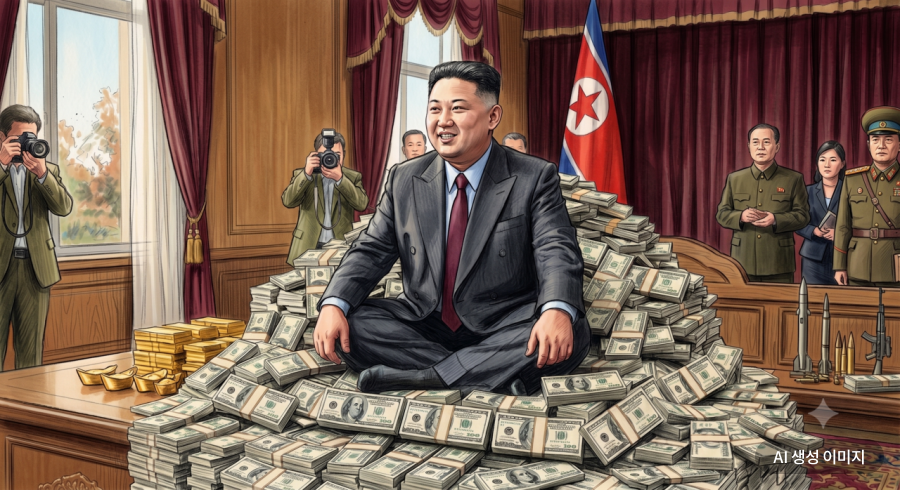
20 Trillion Won in Foreign Currency Surplus Thanks to Troop Deployment to Ukraine and Weapons Exports… Unprecedented Boom of Luxury Goods and High-Rise Apartments

North Korea is enjoying an unprecedented boom due to its military closeness with Russia and the deployment of troops to Ukraine. Getty Images
North Korea is experiencing an unprecedented boom as a result of its close military relationship with Russia and the deployment of troops to Ukraine. With a surge in incoming foreign currency, high-rise apartment complexes have sprung up in downtown Pyongyang and world-famous luxury brands are being displayed at department stores, leading to a visibly more dynamic economy. However, experts agree that this growth is not based on fundamental reforms or improved productivity, but rather on external factors—suggesting clear limitations in translating this boom into long-term development.
Omega Watches, Chanel Cosmetics, and Expensive Smartphones Featured at Pyongyang Department Store… Even Knockoff IKEA Appears

North Korean woman photographed in downtown Pyongyang. Photo by Yonhap News Agency
The Financial Times (FT), a British daily, recently reported a striking transformation in Pyongyang’s consumer culture. According to FT, back in 2019, when Chinese President Xi Jinping visited, Pyongyang’s economy was in a grim state; but now, vibrant high-rise apartment complexes line the roads from the airport to the city center.
Notably, at the Taesong Department Store in Pyongyang, foreign luxury goods such as Omega watches and Chanel cosmetics—imported via China despite sanctions—are on open display and being circulated. At the Ryukyong Golden Commercial Center, a complex shopping mall, what appears to be an IKEA store was spotted; this is believed to be a case of blatant trademark infringement by North Korea. Stores selling smartphones priced at $500 (about 700,000 won)—with app-based taxi calling and QR code payment capabilities—have also appeared.
Rachel Minyoung Lee, senior analyst at the Stimson Center in the United States, noted, “Pyongyang has become noticeably more affluent and consumer-oriented,” with such changes evident in newly built high-rise buildings, brighter streets, and an expansion of leisure facilities.
Restored Trade With China and Massive Cryptocurrency Heists Drive the Boom… 900 Billion Won Stolen in the First Half of This Year, Earning the Nickname ‘Modern-Day Pirates’

Dressing table of a North Korean woman. Chanel cosmetics are placed on it. Photo by Yonhap News Agency
The main driver behind Pyongyang’s “surface-level boom” has been the foreign currency windfall generated by closer ties with Russia. According to the Institute for National Security Strategy (INSS) in South Korea, from August 2023 to the end of 2025, North Korea is estimated to have secured between $7.7 billion and $14.4 billion (about 10.7 trillion to 20 trillion won) in cash and goods in exchange for sending troops to Russia and exporting military supplies.
Additionally, the recovery of trade with China and illegal cryptocurrency theft have also played key roles. According to the Stimson Center, North Korea’s exports to China in January-May of this year jumped 68% from the same period in the previous year. Blockchain analytics firm TRM Labs announced that North Korea-linked hackers stole $643 million (about 900 billion won) in cryptocurrency in the first half of this year alone. NK News journalist Shreyas Reddy noted, “North Korea is emerging as a modern-day pirate state, specializing in highly lucrative cryptocurrency theft.”
As a result of this influx of foreign currency, the Bank of Korea announced that North Korea’s real GDP for 2025 reached 38.264 trillion won, representing a 3.5% increase from the previous year. The Bank of Korea assessed that expanded North Korea-Russia cooperation had positive short-term impacts across all sectors of the North Korean economy, from manufacturing to services.
North Korea’s GDP Rose 3.5% Year-on-Year… Experts Say It’s a Temporary Boom Unlike South Korea’s ‘Vietnam Troop Dispatch’

Panoramic View of Pyongyang Future Scientists Street Getty Images
However, experts do not believe that this influx of foreign currency will translate into structural growth for the North Korean economy. The prevailing economic structure continues to restrict market-driven growth, making it difficult to turn foreign funds into sustained economic momentum. Analysts point out that, unlike South Korea—where foreign currency secured through troop dispatch to the Vietnam War was invested in industrialization and infrastructure to foster manufacturing and export industries—North Korea is not channeling these funds into such sustainable growth initiatives.
Peter Ward, a researcher at the Sejong Institute, observed that North Korea is undergoing a kind of “project boom,” focusing on large-scale civil engineering efforts aimed at impressing the leadership. He stated, “Given North Korea’s tendencies, the regime will not prepare for the future during good times, and this cannot be seen as sustainable growth.”
As a result, the recent boom in luxury spending and construction seen in Pyongyang is essentially a mirage created by the concentration of foreign currency from North Korea-Russia ties in the hands of the leadership and a privileged elite in Pyongyang. Unless North Korea guarantees market autonomy and carries out institutional economic reforms, the current prosperity fueled by war-related windfalls is likely to be no more than a temporary surge.
Reporter
Seo Jiyeong zo2zo2zo2@asiae.co.kr
Edit
Yang Hyejin adoretj@asiae.co.kr
© The Asia Business Daily. All rights reserved. Unauthorized AI training and use prohibited.