
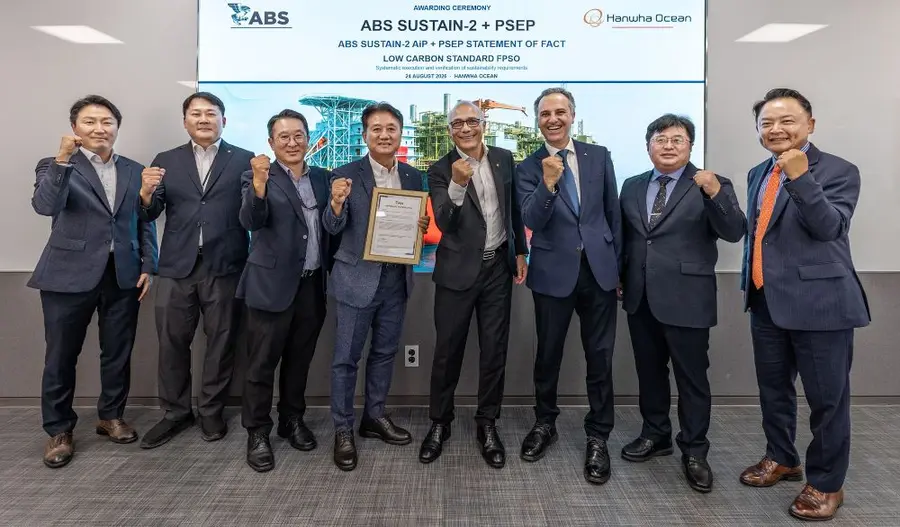
 Philippe Levy, President of Hanwha Ocean EPU (Energy Plant Unit) (the fifth from the left), and Hasan Turkmen, President of ABS Far East Asia (the sixth from the left), along with other officials from both sides, take a commemorative photo after the AIP awarding ceremony. Photo = Hanwha Ocean
Hanwha Ocean will standardize the FPSO design that applies low-carbon technology. The company bundles low-carbon technologies, which had been reviewed separately for each project, into a single design framework and has secured global class society verification, laying the groundwork for repeat application across multiple offshore plant projects going forward.
According to Hanwha Ocean (CEO and President Kim Hee-cheol) on the 25th, the company has obtained concept approval (AIP) from Norway’s class society DNV and the U.S. class society ABS for its “low-carbon standard FPSO” design framework. ABS also provided a certificate proving the Project Sustainability Execution Plan (PSEP).
The certification is meaningful in that it validates both the low-carbon design and the project sustainability management system at the same time.
DNV verified a low-carbon design framework that incorporates low-reduction technologies for major greenhouse gas emission sources into the FPSO design. ABS confirmed a PSEP configured so that sustainability goals such as carbon reduction and improved energy efficiency can be carried out and managed throughout project execution.
Hanwha Ocean is systematizing low-carbon technologies that can be applied based on its existing standard FPSO design. Previously, the company reviewed the technologies required for each project individually. Going forward, it will standardize verified technologies so they can be selected and applied according to each project’s requirements.
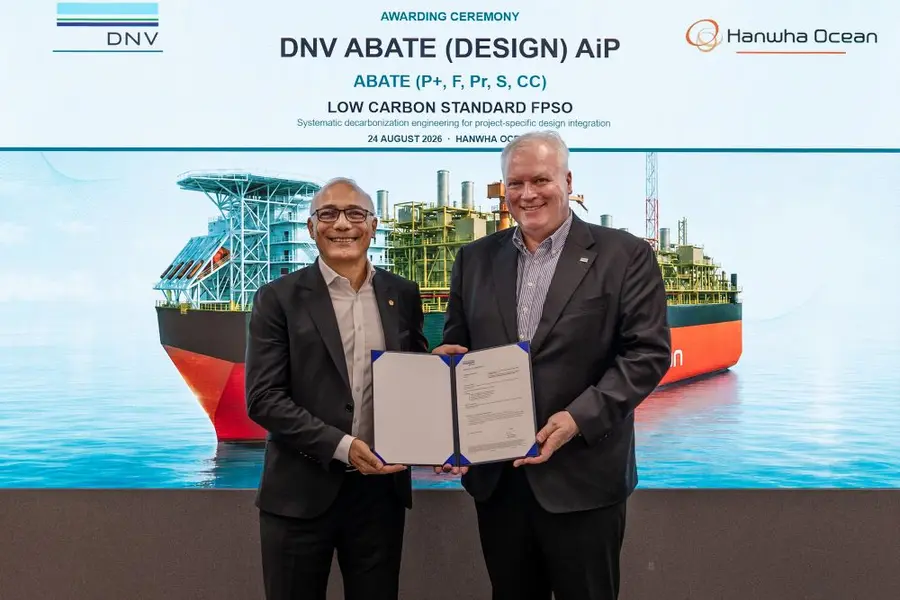 Philippe Levy, President of Hanwha Ocean EPU (Energy Plant Unit) (left), and Vidar Dolonen, CEO of the DNV Korea/Japan office, are conducting the AIP awarding ceremony. Photo = Hanwha Ocean
The verified technologies through this certification will also be used in the actual bidding process in the future. Hanwha Ocean plans to apply the low-carbon design and project execution framework in consultations with customers, in bidding, in basic engineering (FEED), and in project execution.
The low-carbon technologies will be further advanced in the form of reusable “technology packages.” Rather than reviewing the low-carbon technologies required for each project from scratch, the company will be able to apply them by combining verified technologies. The PSEP will also be used as the standard sustainability execution framework for future FPSO projects.
Hanwha Ocean has focused on standardizing FPSO design as well. It developed standard FPSOs that can be applied to the West Africa region in 2024 and received ABS and French class society BV certification, and this year it developed standard FPSOs optimized for the South America region, securing ABS and DNV certification.
A Hanwha Ocean official said, “This certification is meaningful because it has validated both the two pillars—low-carbon design and the sustainability execution framework,” adding, “We plan to develop the results of this verification into low-carbon technology packages and sustainability execution frameworks that can be repeatedly used in future projects, strengthening our competitiveness in winning orders and our capacity to carry out projects.”