
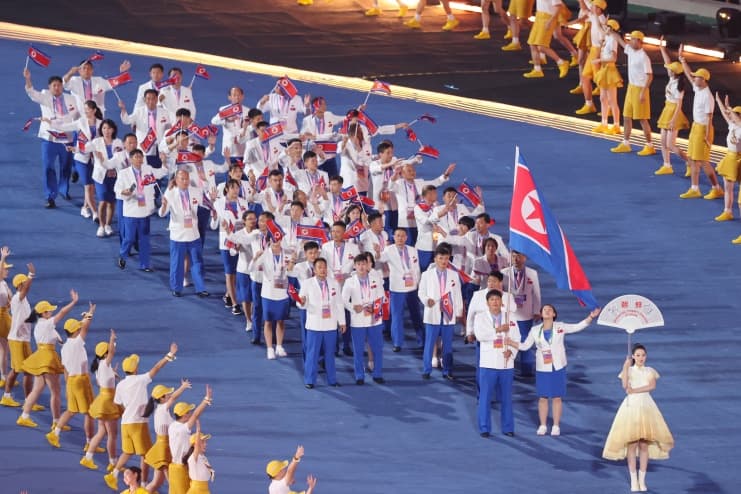
 North Korea’s delegation enters during the opening ceremony of the 2022 Hangzhou Asian Games at Hangzhou Olympic Sports Center Stadium in Hangzhou, China, on Sept. 23, 2023. (Yonhap)
North Korea’s ruling Workers’ Party of Korea has ordered intensive ideological education for the elite athletes it plans to send to the 2026 Aichi-Nagoya Asian Games. The directive is meant to guard against ideological “deviation” during an extended stay in neighboring Japan, according to a source with knowledge of the situation inside the country. Pyongyang has confirmed it will dispatch a delegation to the games, which open in the Japanese cities of Aichi and Nagoya on Sept. 19. The order comes even as North Korean propaganda continues to portray Japan as an enemy state.
A source in Pyongyang told Daily NK on Monday that the party’s Propaganda and Agitation Department, the WPK organ responsible for ideological messaging and internal indoctrination campaigns, issued the order on Aug. 26. It instructed officials to “launch a full-scale, high-intensity ideological education campaign for the elite athletes who will showcase the republic’s standing on the occasion of participation in the 20th Asian Games.”
The source said the directive reflects Pyongyang’s broader strategy of using international sporting events to expand its diplomatic space abroad, even as the country remains largely isolated. It is intended to preemptively block any ideological backsliding among athletes stationed for weeks in Japan, which North Korean authorities continue to describe as hostile territory.
The Propaganda and Agitation Department also renewed its demand for thorough background vetting of athletes in sports considered strong medal prospects. These include weightlifting, wrestling, gymnastics, shooting, table tennis and boxing. It ordered that closed-door ideological screenings be completed at training facilities under the National Sports Guidance Committee, the state body that oversees North Korea’s competitive sports programs, by early September.
Athletes told they are Kim Jong Un’s ‘vanguard suicide squad’
At the center of the directive is an intensive education program meant to instill in athletes the belief that they are not merely competitors but combatants defending the party and its leader on hostile ground. The source said handlers were instructed to impress upon athletes that they are not being sent out as ordinary sportspeople. Instead, they are cast as members of what the directive called the “vanguard suicide squad” of Kim Jong Un, deployed to fight for the party and the supreme leader inside what officials described as the heart of the enemy, Japan.
The directive further instructed handlers to teach athletes that soldiers who brave enemy fire with a “bloodied heart” are heroes in wartime. In peacetime, it argued, the true heroes and suicide squads of the age are athletes who display the nation’s might in the middle of enemy territory. The language appeared designed to stoke the athletes’ fighting spirit to its maximum extent.
The order also laid out explicit behavioral guidelines for athletes’ conduct while in Japan. These include a blanket ban on any individual contact with outsiders, along with instructions to remain silent in the face of what the directive called deliberate provocations from the South Korean delegation, which it referred to using the derogatory term “puppet.” The same silence was demanded toward questions from foreign journalists. Athletes were told to respond, if at all, only with the party’s official position.
The ideological education campaign carried a stark warning for potential offenders as well. Any athlete who so much as glances toward what the directive called the “yellow wind” of capitalism, a term North Korean propaganda uses for foreign cultural and commercial influence, would be branded a traitor to the fatherland upon return. The same fate awaited anyone drawn toward unfamiliar consumer goods, with offenders facing severe punishment after coming home.
The source described a tense atmosphere among the athletes and coaching staff preparing for the games. They feel both excitement and anticipation about competing on the international stage, the source said, along with heavy pressure over the possibility that failing to win a medal could end their careers. Even a minor breach of discipline, the source added, could result in lifelong expulsion from the sports world.
Chongryon mobilized to support delegation’s stay in Japan
Separately, the Propaganda and Agitation Department has reportedly ordered the full mobilization of organizational networks inside Japan to support the delegation. These include the General Association of Korean Residents in Japan, commonly known as Chongryon, and local pro-Pyongyang business figures. Both groups are being tasked with guaranteeing the delegation’s accommodations, security, training logistics and organized cheering support throughout its stay.
According to the source, authorities have also instructed officials to arrange transportation and dedicated food supplies produced specifically for the delegation. Organized cheering squads are also being assembled as part of a broader effort to support the athletes throughout the games.
Reporting from inside North Korea
Daily NK operates networks of sources inside North Korea who document events in real-time and transmit information through secure channels. Unlike reporting based on state media, satellite imagery, or defector accounts from years past, our journalism comes directly from people currently living under the regime. We verify reports through multiple independent sources and cross-reference details before publication.
Our sources remain anonymous because contact with foreign media is treated as a capital offense in North Korea — discovery means imprisonment or execution. This network-based approach allows Daily NK to report on developments other outlets cannot access: market trends, policy implementation, public sentiment, and daily realities that never appear in official narratives.
Maintaining these secure communication channels and protecting source identities requires specialized protocols and constant vigilance. Daily NK serves as a bridge between North Koreans and the outside world, documenting what’s happening inside one of the world’s most closed societies.