
Samsung Electronics and SK hynix gained as investors bet the new model will intensify demand for high-bandwidth memory chips.
OpenAI’s website displays a page promoting the rollout of its GPT-6 Astra model.
SCREEN CAPTURE
The launch of OpenAI’s newest AI model, GPT-6 Astra, has revived the bull case for memory demand, pushing shares of Samsung Electronics and SK hynix higher alongside U.S. chip stocks and indexes.
The latest rally of the Korean memory giants marks a sharp reversal from the downward trajectory of Korean chip stocks in recent months, as concerns over the sustainability of massive AI infrastructure spending had weighed on investor sentiment.
Advanced models like Astra are designed to carry out long, multistep tasks on their own rather than simply answering a question — and that kind of work, widely dubbed agentic workflow in the industry, eats up far more memory than the previous versions.
Samsung Electronics shares gained 2.2 percent on Friday and another 5.68 percent to close at 270,000 won ($200) on Monday following the announcement of the rollout on Thursday in the United States. SK hynix advanced 3.2 percent on Friday and surged 8.26 percent on Monday. Samsung gave back some of its gains on Wednesday, edging down 0.19 percent, while SK hynix inched up 0.56 percent.
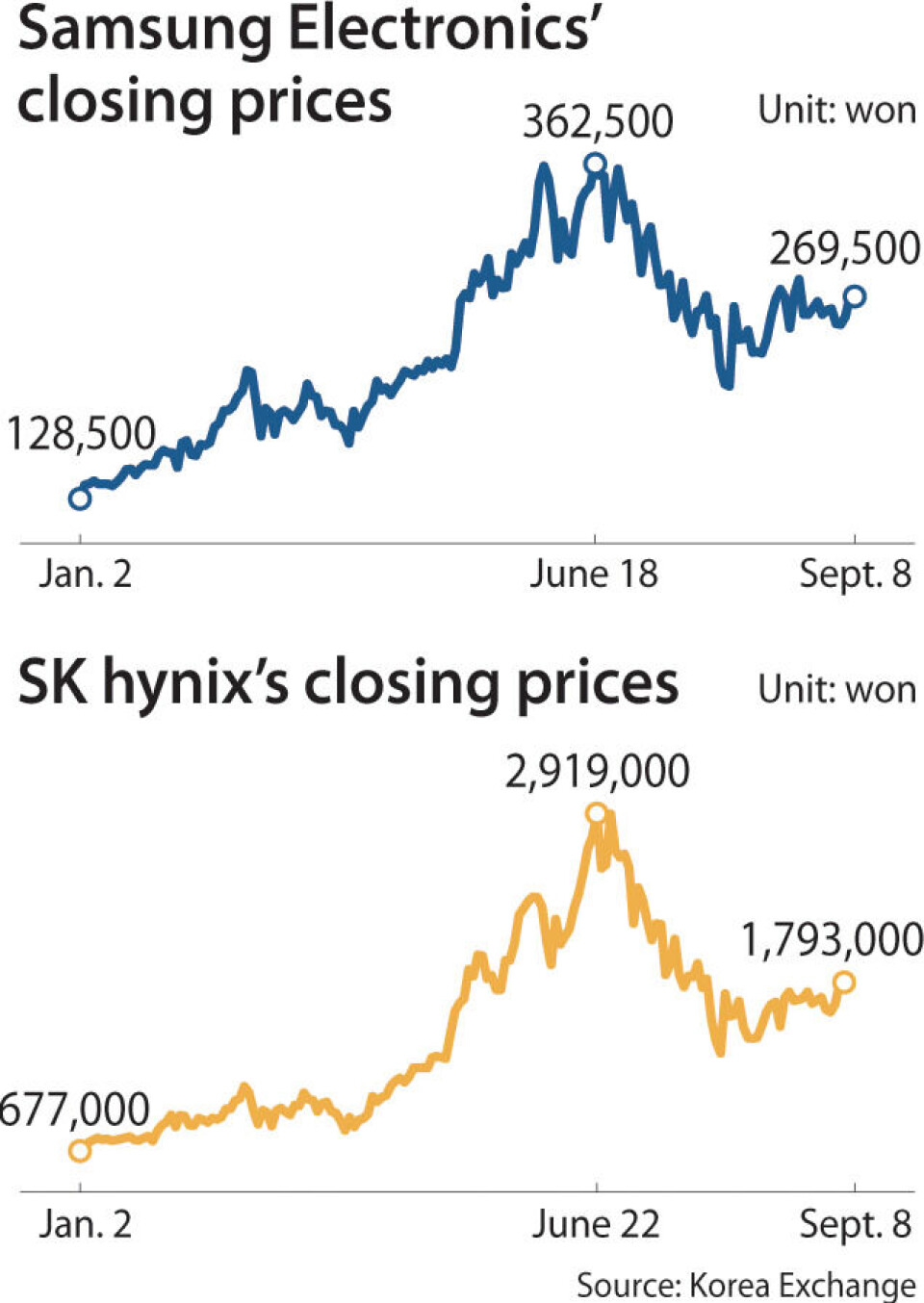
And yet some analysts see that the new model is offering a fresh momentum for memory makers, as they had faced bearish investment sentiment since July compared to June’s record highs.
Son In-jun, an analyst at Eugene Investment & Securities, described Astra as the fourth inflection point for AI advancement, preceded by three earlier breakthroughs: ChatGPT, GPT-o1 and Claude Code.
“ChatGPT brought AI into the mainstream, GPT-o1 pushed the boundaries of reasoning and Claude Code helped commercialize AI agents. Astra represents the next inflection point, enabling AI to take on longer-running, complex tasks from start to finish,” the analyst said in a report released Monday.
“The shift marks a broader transition in AI use, from consuming tokens to delegating an entire task,” he said.
To handle long workloads seamlessly, efficient access to the KV cache — which stores information generated during processing — is critical, requiring greater memory capacity from high bandwidth memory (HBM) chips.
“Longer context windows require the model to read and process much more data at once, increasing demand for memory bandwidth,” said Kim Young-gun, a researcher at Mirae Asset Securities.
“The fact that users pay extra for both speed and longer context suggests that memory is becoming a bigger part of the cost of running advanced AI models,” he said.
OpenAI unveiled the prototype version of its in-house AI chip, Jalapeño, in June, becoming one of the first major AI companies to adopt the latest sixth-generation HBM — HBM4 — in a custom accelerator. Still, it has yet to announce which memory supplier it will work with.
The memory chip shortage will likely last longer than expected as inventories are being depleted faster than anticipated.
Memory chip inventories at Samsung Electronics and SK hynix have already fallen to less than 10 days’ worth as of the third quarter, according to Kim Dong-won, head of research at KB Securities.
“This is moving beyond a simple recovery in demand, with a high likelihood that the amount of memory actually available for supply will become critically limited,” Kim said. “Next year, we could even see available memory supplies effectively run out.”
BY PARK EUN-JEE [park.eunjee@joongang.co.kr]