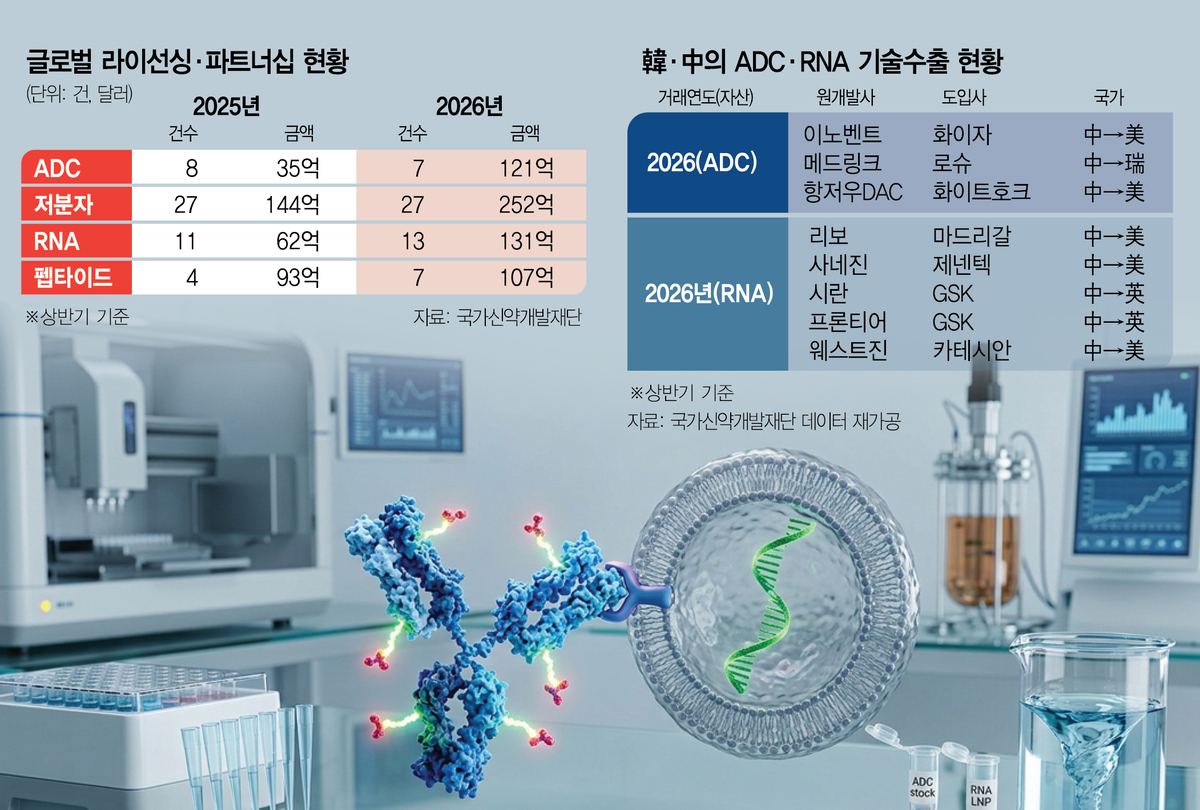

As global pharmaceutical giants place successive bets on antibody-drug conjugate (ADC) and ribonucleic acid (RNA) technologies, Chinese companies accounted for 91% of disclosed ADC licensing value and 62% of RNA licensing value in the first half of this year. Experts said Korean biotech firms must accelerate development in these fields as a new market opens up.
An analysis by The Seoul Economic Daily of monthly data on major drug development licensing and partnership deals from the Korea Drug Development Fund (KDDF) showed that Chinese assets made up $11 billion, or 91%, of the $12.1 billion in disclosed ADC licensing value in the first half. In RNA, Chinese companies accounted for $8.1 billion, or 62%, of the $13.1 billion total.
Korean companies, by contrast, fared relatively poorly over the same period. In the first half of last year, SK Plasma licensed in the ADC candidate AMB303 from domestic firm AimedBio, though the deal size was not disclosed. In the first half of this year, there were licensing-in deals but no licensing-out. In RNA, Olix and Rznomics signed contracts with Eli Lilly in the first half of last year, accounting for 31% of total deal value, but not a single licensing-out contract was concluded in the first half of this year.
Big pharma is focusing on ADC and RNA because next-generation technologies are emerging that address the limits of existing drugs. ADCs use bispecific antibodies and dual payloads to overcome single-target and resistance problems, while RNA therapeutics are expanding beyond rare liver diseases into chronic conditions, alongside advances in delivering drugs to the brain, muscle and fat.
China’s influence is especially pronounced in next-generation ADCs. The U.S. Information Technology and Innovation Foundation (ITIF) said in a June report that Chinese companies held 67% of the world’s bispecific ADC candidates last year. Bispecific ADCs, which target two different antigens simultaneously to address tumor heterogeneity and limits in antigen expression, are considered a next-generation technology. In RNA, licensing-out of Chinese assets rose to five deals in the first half of this year — centered on muscle disease, metabolic dysfunction-associated steatohepatitis (MASH) and obesity — from just one, by Sirius Therapeutics, in the first half of last year.
Experts warned that Korean companies risk missing out on the new market. Lee Seung-gyu, vice chairman of the Korea Biotechnology Industry Organization, said the shrinking share of global deal value held by domestic firms “is less a matter of technological capability than of having few assets that have reached proof of concept (PoC).” Lee stressed that “we need to find ways to advance domestic biotech assets to the PoC stage before big pharma’s technology shopping ends.” In drug development, PoC generally refers to the stage at which a drug is confirmed to work in humans.
For now, Korean pharmaceutical and biotech companies are opting to use China’s development infrastructure. In bispecific ADCs, Samsung Bioepis is conducting preclinical work with China’s Frontline Biotechnologies to identify candidates. ABL Bio, which began a Phase 1 trial of a bispecific ADC early this year, said recently that it is discussing various forms of cooperation with Chinese companies, including joint research, joint development and early-stage clinical trials.
In RNA, Olix expanded its cooperation with China in August by licensing out global development and commercialization rights to two siRNA sequences to Hansoh Pharmaceutical, a major Chinese drugmaker. An industry official said using China’s infrastructure and development capabilities “can be a good opportunity for Korean companies,” but added that “since China’s Ministry of Commerce recently discussed adding next-generation biotechnology to its list of technologies banned or restricted from export, Korea also needs to strengthen the competitiveness of its core technologies on its own.”
Meanwhile, the ADC market, worth $12 billion in 2024, is projected to grow to $57 billion by 2032, according to market research firm Evaluate Pharma. The RNA therapeutics market is also expected to expand to $29.2 billion by 2030, excluding COVID-19 vaccines, from $7.9 billion last year.