
The city will build a defense industry complex to develop domestically made components for the KF-21 fighter jet and K9 howitzer by 2030.
A prototype KF-21 fighter jet takes off during a test flight at the 3rd Flight Training Wing in Sacheon, South Gyeongsang, on May 14.
JOINT PRESS CORPS
DAEJEON — Daejeon is pushing to localize key components for Korea’s KF-21 fighter jet and K9 self-propelled howitzer as it expands its role as a defense industry hub.
The effort will focus on components including high-power radio frequency (RF) transceiver modules for air defense guided weapons and electro-optical detection equipment for missiles and aircraft.
The push comes as Daejeon was selected as one of the areas that will host specialized materials, parts and equipment industrial complexes by the Ministry of Trade, Industry and Resources, the city said Monday.
Daejeon was selected to host a defense industry complex, South Gyeongsang for shipbuilding and North Jeolla and South Chungcheong for semiconductors.
The specialized defense industry complex in Daejeon will span a combined 8.03 million square meters (1,980 acres). The area covers the Jukdong industrial complex, Daedeok Techno Valley, Ansan Advanced National Defense Industry Cluster and the area around Hanwha Aerospace in Yuseong District, as well as the Daejeon Defense Industry Innovation Cluster in Daedeok District.
“The government chose Daejeon for the specialized defense materials, parts and equipment complex thanks to the hard work of the city, research institutes, universities, the military and local companies,” Daejeon Mayor Huh Tae-jeong said. “We will work closely with the central government to make the project a success and turn it into a new engine of growth for Daejeon.”
![허태정 대전시장이 지난 18일 소부장 특화단지에 대해 설명하고 있다. [연합뉴스]](https://www.europesays.com/korea/wp-content/uploads/2026/09/12885597.webp)
Daejeon Mayor Huh Tae-jeong briefs about Daejeon’s plans to create a defense industry complex in the city on Sept. 18.
YONHAP
40 billion won funding
The government will provide each selected region with 40 billion won ($29 million) over five years for research and development (R&D) and other projects.
The Daejeon city government plans to invest another 100 billion won to build infrastructure for the complex.
The complex will focus on localizing key components for advanced guided weapons.
LIG Defense & Aerospace and Hanwha Aerospace will develop precision electronic and optical components, including transceiver modules used in the KF-21 and K9. The companies plan to invest a combined 1 trillion won.
Around 90 percent of RF transceiver modules and similar components are currently imported from the United States, Europe and other countries.
“These advanced components have yet to be produced domestically,” a Daejeon city official said. “Our goal is to localize their production by 2030, building on the designation of the specialized complex.”
The project will also bring companies and local research institutions together to develop the components.
“If research institutions such as the Electronics and Telecommunications Research Institute and KAIST, along with companies in Daejeon, successfully develop the components, they will be tested at the Daejeon Defense Industry Innovation Cluster before being put to use by companies,” the official added. “That is how we plan to build the ecosystem.”
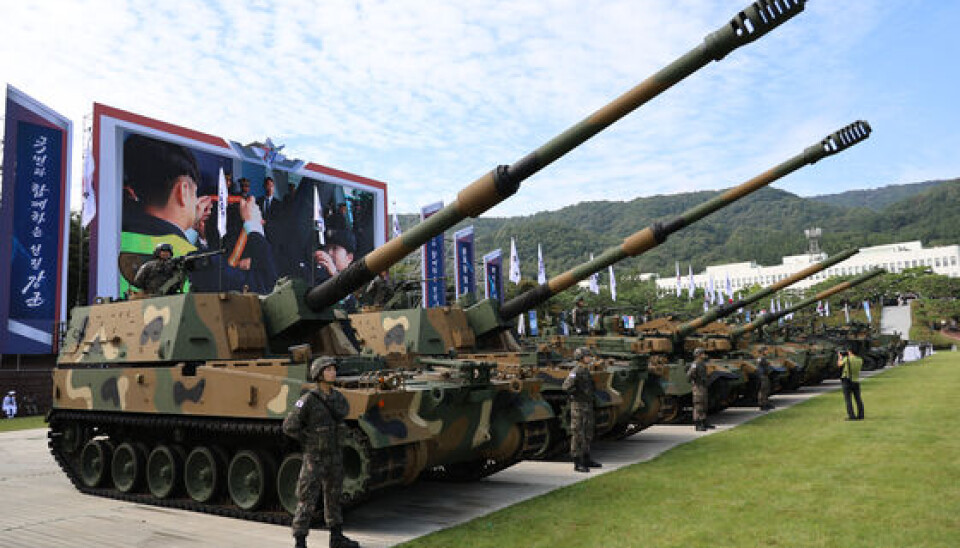
K9 self-propelled howitzers are displayed during the Armed Forces Day ceremony on Oct. 1, 2025.
YONHAP
DAPA making Daejeon its home
Daejeon has spent years building up its defense industry. The city was previously also selected for a defense innovation cluster specializing in drones in 2022.
It was also selected that year as the new home of the Defense Acquisition Program Administration (DAPA).
DAPA broke ground on its new headquarters in Seo District on March 11 last year. The building will have two basement levels and 21 floors above ground, with a total floor area of 59,738 square meters (643,000 square feet).
The 242.4 billion won project is scheduled for completion in 2028. DAPA completed the first phase of its relocation in June 2023, moving 238 employees from its leadership and policy divisions to the former Korea Racing Authority building in Wolpyeong-dong, Seo District.
Once the new headquarters is completed, around 1,600 employees, including those currently based in Gwacheon, Gyeonggi, will work there.
Daejeon also signed a memorandum of understanding with Airbus in December last year to establish an R&D innovation hub.
Under the agreement, Airbus will establish its research and development platform, the Airbus Tech Hub, in Daejeon. It will be the fourth such hub worldwide, following those in Singapore, the Netherlands and Japan.
BY KIM BANG-HYUN [lee.taehee2@joongang.co.kr]
This article was originally written in Korean and translated by a bilingual reporter with the help of generative AI tools. It was then edited by a native English-speaking editor. All AI-assisted translations are reviewed and refined by our newsroom.