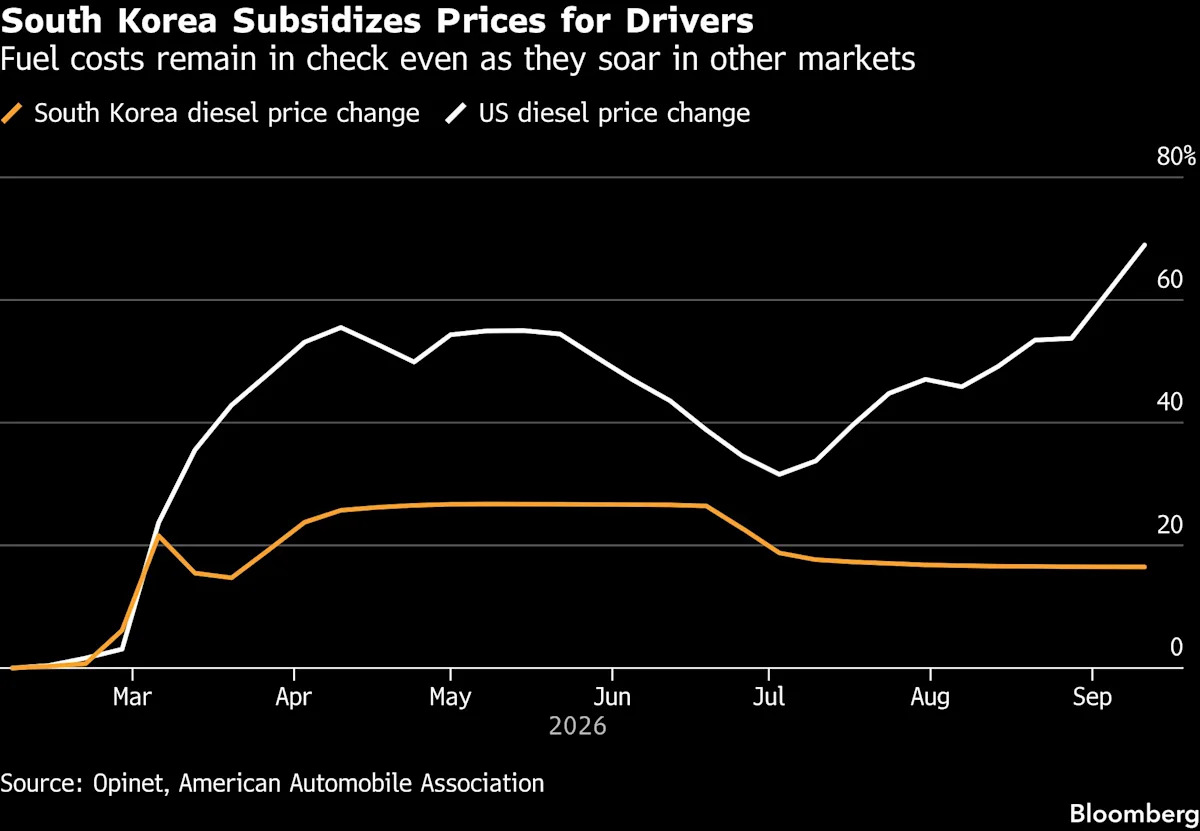
(Bloomberg) — With millions of South Koreans set to hit the road this week during a three-day public holiday, the government is extending fuel-price caps, cushioning households from an energy shock that has pushed global oil prices above $100 a barrel.
Most Read from Bloomberg
But the relief is increasingly coming at a cost.
South Korea is one of the few developed economies to have taken extraordinary steps to shield its motorists from rising oil prices, effectively capping prices for gasoline and diesel at the pump while promising to compensate refiners for their losses.
Imposed in March after the US attacked Iran — the first time in three decades that Seoul used the emergency tool — the measures have stretched beyond the six months initially budgeted, causing growing alarm among economists.
South Korea is effectively “enjoying cheap gasoline but has yet to receive the receipt,” said Lee Hong, an associate research fellow at the Korea Institute for Industrial Economics and Trade.
The Chuseok holiday, which starts Thursday, makes the balancing act even harder. Many South Koreans travel across the country to visit family, adding to household expenses and fuel demand. The government has rolled out extra measures to ease the burden, including discounts at highway gas stations.
But economists are questioning how long the government can keep shielding motorists from expensive oil without straining public finances, distorting the market and delaying an adjustment to higher energy costs.
On Friday, South Korea’s Ministry of Trade, Industry and Resources kept the caps unchanged for another four weeks, citing rising consumer inflation and volatility in oil prices due to uncertainties in the Middle East. The move offers some respite as inflation remains well above the Bank of Korea’s 2% target and households grapple with broader cost-of-living pressures that have pushed President Lee Jae Myung’s approval rating to a record low.
But keeping fuel artificially cheap may also reduce the incentive for consumers to cut back at a time when South Korea, one of the world’s biggest energy importers, remains exposed to a global oil shock. Experts warn that steady prices may be creating a false sense of security.
Story Continues
“If the government keeps forcing markdowns, people won’t be aware that prices are rising for oil,” said Sonn Yang-hoon, professor emeritus of economics at Incheon National University.
Such price caps also favor heavy users, said Sonn, while taxpayers bear the costs. “It requires a massive amount of public funds,” he added.
South Korea isn’t alone in shielding motorists from the global energy shock, but its intervention is among the more direct in the developed world.
In the US and much of Europe, higher wholesale fuel costs continue to flow relatively quickly through to motorists, even as some governments have cut taxes or offered other relief. Other Asian economies like Singapore have allowed prices to rise.
But South Korea has capped the prices refiners can charge distributors and promised to compensate them for the difference, weakening the link between international markets and prices at home. One of the few other countries to intervene so directly is neighboring Japan, which has deployed billions of dollars in subsidies to wholesalers to keep gasoline costs low.
As Brent oil surged within a whisker of $110 a barrel this month, South Korea kept wholesale fuel prices capped at 1,784 won ($1.31) per liter for gasoline and 1,773 won per liter for diesel. Last week, the average pump price for gasoline sank for an 18th straight week. South Korea has also slashed fuel taxes and restricted exports, as governments elsewhere turn to energy-saving measures in a conflict with no end in sight.
The South Korean government has pledged to compensate refiners for their losses. In April, it set aside 4.2 trillion won for the first six months of the price caps and another 1.5 trillion won to cover the extension. Refiners have yet to receive payments, and differences over how losses should be calculated could further delay compensation, which makes it difficult to determine the ultimate cost to taxpayers.
In the early weeks of the war, President Lee exhorted the country to “save every drop of fuel.” Despite re-escalating hostilities, he struck a different tone this month, writing in a social media post that there’s no reason to worry, as export controls, oil-reserve swaps and import diversification will continue to stabilize pump prices.
But such interventions are doing little to change driving behavior. “In the past, a spike in fuel prices would significantly reduce traffic,” said Park Yeong, an office worker fueling up at a self-service station in Seoul.
“Now there’s way too many cars on the road,” he said.
–With assistance from Dan Murtaugh.
Most Read from Bloomberg Businessweek
©2026 Bloomberg L.P.