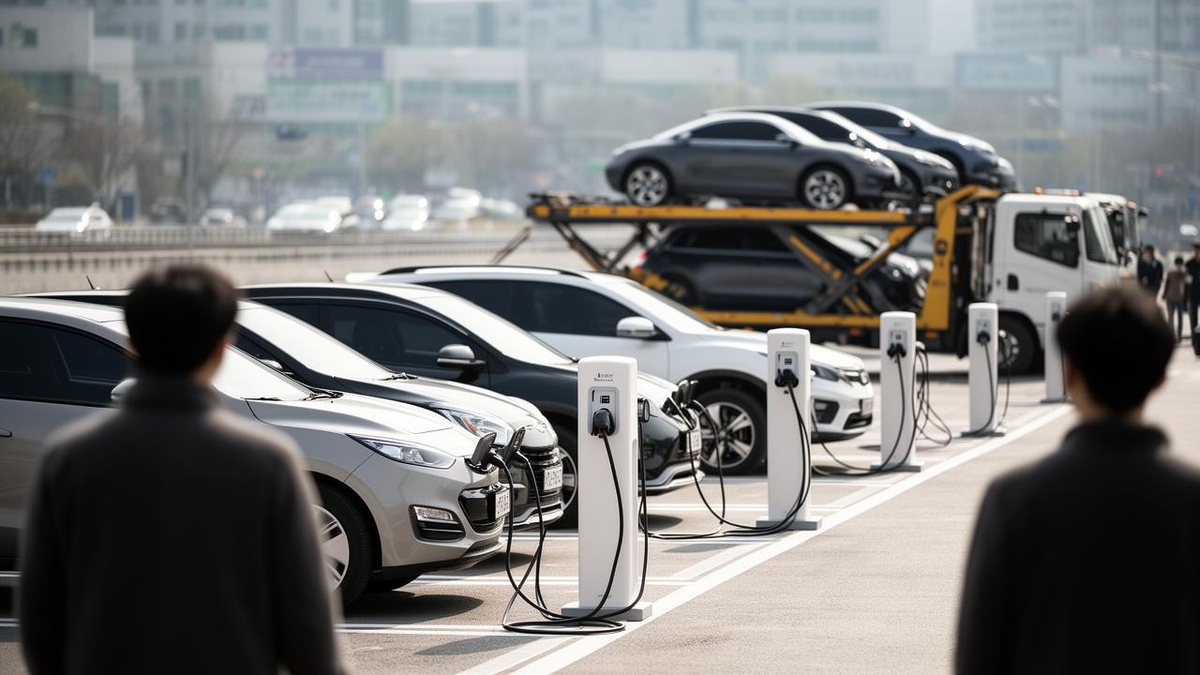
Hyundai Motor Group’s dominance in South Korea’s electric vehicle market is eroding rapidly. In the January-August period this year, South Korean-made EVs held a 57.3% share of the domestic market, down 4.7 percentage points from 62.1% in the same period last year. Sales volume itself surged 75.7% year-over-year to 153,691 units, but imported EVs are penetrating at an even steeper pace.
According to data from the Korea Automobile & Mobility Association, South Korean-made EV sales totaled 15,877 units in August, while imported EVs reached 15,183 units—a gap of just 694 vehicles. The narrowing came as domestic vehicle deliveries declined amid summer vacations and the Hyundai Motor strike, while imported vehicle sales rose. Even accounting for temporary factors, industry observers say a monthly share reversal is only a matter of time given the growth trajectory of imported EVs.
The overall growth of South Korea’s EV market is unmistakable. New registrations through July this year reached 237,032 units, already surpassing the full-year record of 210,177 units set last year. That represents a 103% surge from the same period last year (116,608 units). After two consecutive years of contraction in 2023 and 2024, EV registrations rebounded 50.1% last year and are continuing to grow at a rapid clip this year.
The problem is that the benefits of this growth are concentrating in imported vehicles rather than South Korean-made ones. The best-selling EV in South Korea from January through July was the Tesla Model Y (52,064 units), more than double the second-place Kia EV3 (22,898 units). The Model Y is produced entirely at Tesla’s Shanghai Gigafactory. Tesla sold 66,376 vehicles in South Korea during this period, topping the imported vehicle sales chart and easily surpassing Hyundai Motor (45,881 units). It still trails Kia (85,444 units), but the gap is narrowing quickly.
BYD, which entered South Korea last year as the first Chinese brand, is also gaining momentum. Its January-July sales surged 820.2% from the same period last year (1,578 units), ranking fourth among imported brands behind Tesla, BMW, and Mercedes-Benz. In July’s imported EV model sales rankings, Tesla took first through third place and seventh place, while BYD (Dolphin, Sealion 7, Atto 3) occupied fourth through sixth. The eighth-place Polestar 4 is also produced in China. Among the top 10, only the BMW iX3 50 xDrive and i5 eDrive40 were non-Chinese-made models.
Hyundai Motor Group’s Counteroffensive
Hyundai Motor is focusing on strengthening price competitiveness. The 2027 Ioniq 5, launched in June, restructured the long-range model into five trims—E-Lite, Modern, Premium, Inspiration, and N Line—and priced the Modern trim at 1.6 million won (approximately $1,200) below the previous Exclusive trim. This month, the company rolled out purchase incentives of up to 6.5 million won (approximately $4,700) on the Ioniq 9. The strategy is to capitalize on the window created by Tesla raising prices immediately after subsidy confirmation and BYD being excluded from subsidy eligibility. Hyundai is also broadening its domestic defense line by adding hybrid variants of core volume models such as the Grandeur and Avante.
Kia is countering with an aggressive lineup expansion spanning mainstream models and commercial vehicles. As of the 17th of this month, Kia’s cumulative domestic EV sales reached 100,118 units, up roughly 120% year-over-year. Kia is the first automaker—domestic or foreign—to surpass 100,000 annual EV sales in South Korea. Through the 17th, the EV3 (25,903 units), EV5 (23,591 units), and PV5 (20,030 units) each crossed the 20,000-unit threshold. In August domestic sales, Kia (40,365 units)—whose EV sales surged 69.4%—overtook Hyundai Motor (34,333 units), which saw deliveries decline due to the strike, to claim the top spot in monthly domestic sales for the third time this year.
Purpose-built vehicles (PBVs) are a field Kia is positioning as a new growth axis. Last month, the company began taking orders for five additional PV5 variants, bringing the total lineup to 10 models as it accelerates its push into the commercial EV market.
Genesis plans to debut the GV90, an ultra-large electric SUV, in South Korea before the end of the year, followed by a sequential rollout in the U.S. market. The strategy is to compete head-to-head with imported luxury EVs such as the Mercedes-Benz EQS SUV.
Lack of New Entry-Level Models a Weakness
The absence of new entry-level EVs tailored for the domestic market to counter imported EVs’ price offensive is seen as a shortcoming for Hyundai Motor Group. New entry-level EV lineups are being allocated to overseas plants first. The Ioniq 3, a compact hatchback produced at the Turkey plant, and the EV2, a subcompact SUV from the Slovakia plant, are prime examples. The Ioniq 3 has a starting price of €28,950 (approximately $33,000) in Germany—competitive with the BYD Dolphin—but no domestic launch plans have been set.
An auto industry source said price discounts and a hybrid-centered defense line alone have limits in fending off the aggressive push from imported EVs, advising that efficient cost structure design and timely supply of mainstream EV lineups will be the key tasks for maintaining domestic market leadership.
Chinese EVs’ Global Expansion
The Chinese EV offensive is not limited to the South Korean market. In the first half of this year, six Chinese automakers held a combined 62.3% share of the global EV market (including plug-in hybrids), up 5.1 percentage points from 57.2% a year earlier. BYD maintained the top spot with 2.29 million units, while Geely Group (1.127 million), SAIC Group (752,000), Chery (579,000), Leapmotor (417,000), and Changan Group (339,000) all placed in the top 10. Tesla ranked third with 1.02 million units, Volkswagen Group fifth with 650,000, and Hyundai Motor Group eighth with 358,000.
In the South Korean market, Zeekr—the premium brand of China’s Geely Group—will begin full-scale sales of the 7X in October, while XPeng and Chery are also preparing to enter. Chinese EVs’ encroachment on the South Korean market is expected to intensify further.
An industry source urged automakers and parts suppliers to strengthen cooperation so that the electrification ecosystem can be built out quickly, and called on the government to provide policy support without hesitation, including domestic production promotion tax incentives.