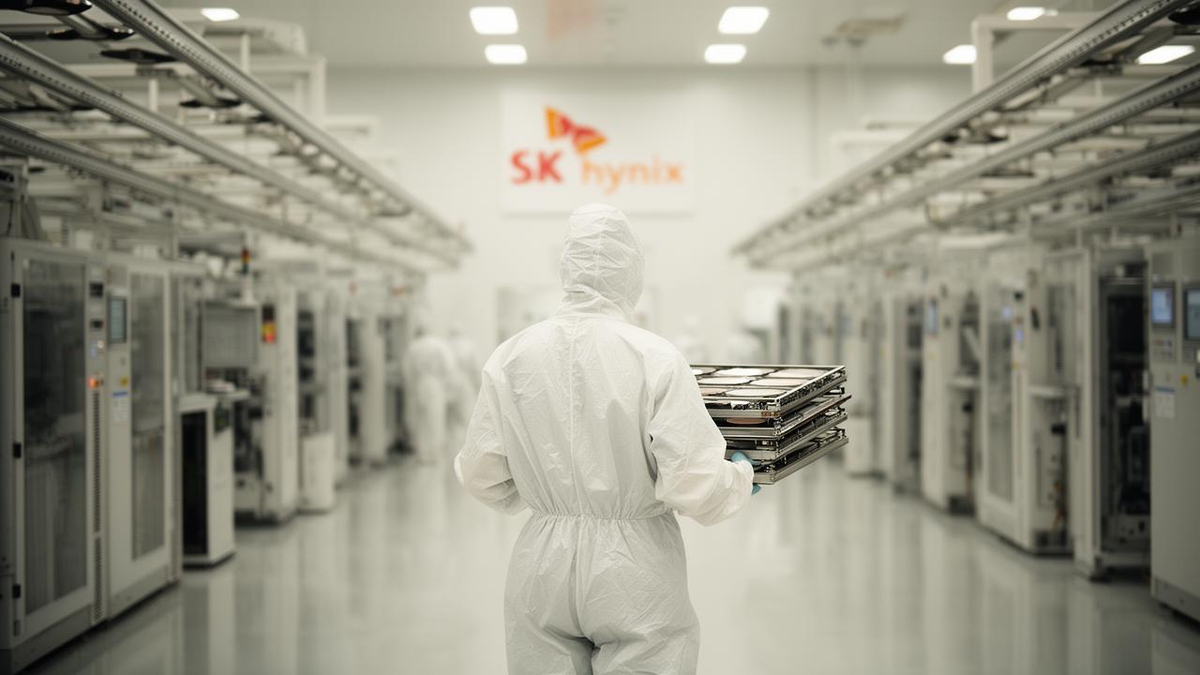
South Korea’s SK Hynix has abruptly withdrawn its plan to list its US NAND flash subsidiary Solidigm on the Nasdaq. The move is seen as a judgment that raising outside capital through a listing could erode existing shareholder value, given widening capital-market volatility and a correction in semiconductor stocks.
In a regulatory filing and a statement on its newsroom on Oct. 23, SK Hynix said it had “decided to halt the review of a pre-IPO (pre-listing equity investment) and initial public offering (IPO) for Solidigm.” The company said “this is not because Solidigm’s growth potential or investment needs have changed,” adding that “considering recent capital-market conditions and share-price trends, we judged it necessary to reconsider whether an IPO now is the most advantageous choice for SK Hynix and existing shareholders.”
Solidigm is a California-based entity in Rancho Cordova that SK Hynix created in 2021 when it acquired Intel’s NAND flash and SSD business for $9 billion (approximately ₩11.9 trillion). As the spread of AI data centers sent demand for high-capacity enterprise SSDs (eSSDs) surging, securing a new US production base became a priority, and SK Hynix had been weighing direct investment alongside bringing in outside capital.
Raising outside capital through a listing was an attractive option because it would increase consolidated cash flow, securing funds for facility investment and for dividends and share buybacks and cancellations at the same time. There was also hope that if Solidigm won a fair valuation through a standalone listing, growth potential that had not been fully reflected in the parent company’s share price could be revalued. SK Hynix had selected Goldman Sachs and Morgan Stanley as lead underwriters and had been pushing ahead with listing work, including a pre-IPO.
But since news of the listing push became public, backlash has intensified, centered on existing shareholders. The concern is that a new share issue would dilute SK Hynix’s stake in Solidigm and that Solidigm’s net profit, currently attributed to the parent, could be distributed to new shareholders. The controversy over a “duplicate listing” — adding yet another listed company to a governance structure that already stacks several listed entities, including SK Square (402340.KS) and SK Inc. (034730.KS) above SK Hynix — also grew louder. The Korea Corporate Governance Forum criticized the move as “an attempt at a five-tier duplicate listing unprecedented anywhere in the world.”
Negative sentiment from politicians and financial regulators also appears to have influenced the decision. South Korea’s Financial Services Commission and the Korea Exchange have since August been enforcing guidelines that ban duplicate listings in principle and allow them only in exceptional cases, and concerns about the Solidigm listing were also raised during a National Assembly audit.
Deteriorating market conditions were the decisive factor. As global semiconductor stocks corrected, SK Hynix shares have fallen more than 30% over the past month, and in early August, right after reports of the listing push, they plunged more than 10% in a single day. SK Hynix said it “comprehensively took into account the widening volatility in financial markets and the broad correction in semiconductor company share prices.”
With the IPO halted, funding for new US fab investment has entered a new phase. SK Hynix is expected to consider alternatives such as using internal retained cash or contributing capital through an affiliated AI investment vehicle. Lee Nam-woo, chairman of the Korea Corporate Governance Forum, said “SK Hynix’s cash holdings will reach ₩132 trillion (approximately $99.9 billion) by the end of this year,” and argued that “if tens of trillions of won are needed, the cash-rich parent company can simply put up the capital.” The company said it will “review the timing and scale of investment and the method of financing, and continue to seek ways to raise both Solidigm’s growth and existing shareholders’ interests.”
Meanwhile, a shift in the fundraising environment is being detected in the AI industry. OpenAI cut its target valuation by more than 10% during its latest fundraising round, from $1.4 trillion (approximately ₩1,850.8 trillion) to $1.25 trillion (approximately ₩1,652.5 trillion). The assessment is that investor demand is weaker than in previous years as talk of an AI bubble spreads. Anthropic, by contrast, is reported to be preparing to file listing documents with the Securities and Exchange Commission (SEC) with a goal of listing as early as mid-next month. The contrasting moves by the two AI developers are expected to serve as a test of investor sentiment toward tech stocks facing overvaluation concerns.