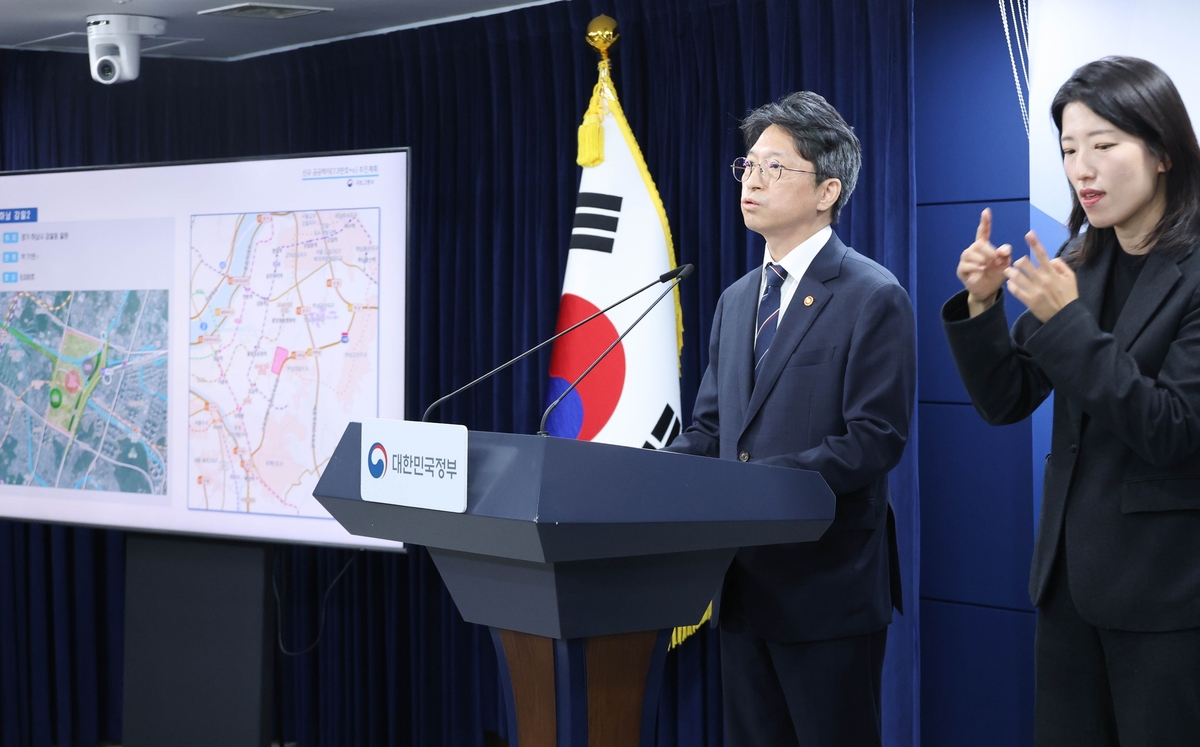
 Land, Infrastructure and Transport Minister Hong Ji-seon (left) announces plans for new public housing sites in the greater Seoul area at the Government Complex Seoul on the 29th. Yonhap News
The Ministry of Land, Infrastructure and Transport on the 29th announced a plan to supply new public housing sites in the Seoul metropolitan area totaling 76,700 units. The ministry will newly designate public housing districts ranging from 4,000 to 37,000 units each in Gimpo, Goyang, Guri, Uijeongbu and Hanam in Gyeonggi Province, with construction to begin by 2030. The step follows an earlier designation of sites for a combined 27,200 units in Seoul’s Gangseo District, central Namyangju and the Gyeonggi Gwangju Station Area District 2 as part of the Aug. 13 policy package.
Thursday’s announcement contained no plan for new housing sites within Seoul. The government is reviewing a plan to supply up to 30,000 public housing units by using part of Yongsan Park, but the proposal is stalled by a disagreement with the Seoul Metropolitan Government. Even if the government pushes ahead with developing Yongsan Park, it faces many hurdles, including revising related laws, negotiating with the U.S. military and managing public controversy. The use of the Tancheon water reclamation center site, which the Seoul city government proposed as an alternative, has gained no momentum amid opposition within the ruling party. In the end, supplying large-scale public housing sites in Seoul in the short term is realistically out of reach.
Whether the Gyeonggi Province site plan will proceed on schedule is also hard to predict. Of the 76,700 units the government announced, the volume that will actually break ground by 2030 remains undetermined. The ministry said the specific construction volume “will emerge through consultations with relevant agencies and the district designation process.” Looking back at past cases, however, the risk of setbacks during this project’s implementation remains. The third-phase new towns the Moon Jae-in administration announced in 2018 still have no residents. Construction was delayed by disputes over land compensation and opposition from local residents and civic groups. The resulting surge in project costs pushed up presale prices for apartments in the third-phase new towns, fueling public distrust of public housing site development.
The government should ask itself whether announcing candidate sites in Gyeonggi Province — without Seoul and without even a confirmed construction timeline — can be effective in stabilizing home prices. If creating public housing sites within Seoul is difficult, the government should ease the way for redevelopment and rebuilding of aging apartment complexes to expand private housing supply. It is also an urgent priority to manage each district with precision so that construction of the existing third-phase new towns is not delayed any further. Expanding wide-area and local transportation networks around each site in a timely manner to prevent traffic chaos is equally pressing. Stopgap measures that, like those of past administrations, announce plans for large new towns while leaving groundbreaking and completion to the next government cannot resolve instability in the housing market.