
 Attendees pose for a commemorative photo at the Samsung Future Technology Promotion 2026 Annual Forum at the Westin Josun Seoul Parnas Hotel in Gangnam-gu, Seoul, on the 5th./Courtesy of Samsung Electronics
“It was a slightly offbeat study. Even so, the Samsung foundation gave me ample opportunity to fully talk about my ideas and research findings.” (Lee Hyun-woo, professor of physics at Pohang University of Science and Technology POSTECH)
“Our computer systems research requires actually building a computer, which takes several years. In a way, it looked like a lab without results. Even so, Samsung waited a long time for the research outcomes.” (Kim Jang-woo, professor in the Department of Electrical and Computer Engineering at Seoul National University)
Researchers who achieved results with Samsung’s support said in unison at the Samsung Future Technology Nurturing Project 2026 Annual Forum, held on the 5th at the Westin Seoul Parnas in Gangnam District, Seoul, that support giving them the chance to try something new and waiting for outcomes became a mainstay for their research.
Since 2013, Samsung has supported challenging research in basic science and materials and ICT, investing about 1.2 trillion won in 916 projects to date. About 17,000 people, including professors and master’s and doctoral researchers, have participated. At this year’s event, Samsung for the first time selected 10 outstanding researchers—four in basic science and six in materials and information and communications technology (ICT)—after reviewing 644 completed projects over about four months. By adding awards to a forum that had focused on sharing results and discussion, Samsung honored the accumulated research achievements and researchers’ contributions over 14 years.
Samsung defines these research support activities as “not charity, but a reciprocal activity for growing together.” The aim is to back even research that is hard to commercialize immediately to broaden the foundation for the growth of academia and industry.
Lee, an awardee in physics, has studied next-generation electronic device technology that uses the orbital motion of electrons. “It went against the current in academia, so it was tough, but the Samsung foundation invited renowned scholars and created a venue,” he said. “Those who attended conducted the experiment I proposed, and later I heard back that it was correct. I was really pleased.”
 Lee Hyun-woo, professor of physics at Pohang University of Science and Technology POSTECH (right), receives an award after being named an outstanding researcher in physics at the Samsung Future Technology Promotion 2026 Annual Forum at the Westin Josun Seoul Parnas Hotel in Gangnam-gu, Seoul, on the 5th./Courtesy of Jeong Doo-yong, reporter
The event drew more than 450 figures from the science and technology community and researchers, including Vice Minister Koo Hyuk-chae of the Ministry of Science and ICT; Rep. Hwang Jeong-a of the Democratic Party of Korea; Rep. Park Chung-kwon of the People Power Party; Rep. Seo Wang-jin of the Rebuilding Korea Party; Rep. Lee Jun-seok of the Reform Party; Park Hong-geun, head of SAIT (formerly the Integrated Technology Institute) at Samsung Electronics; and Jang Seok-hoon, president overseeing Samsung’s social contribution.
Kook Yang, chair of the Samsung Science and Technology Foundation, said, “As researchers’ creative and challenging work has accumulated over the past 14 years, meaningful outcomes are emerging that lead the leap of Korea’s science and technology,” and added, “We will continue to firmly support researchers so they can freely explore new possibilities and broaden the horizons of future science and technology.”
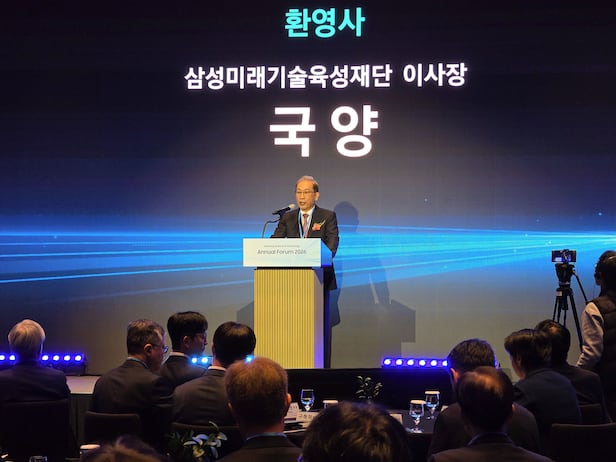 Kuk Yang, chairperson of the Samsung Science & Technology Foundation, delivers a welcome address at the Samsung Future Technology Promotion 2026 Annual Forum at the Westin Josun Seoul Parnas Hotel in Gangnam-gu, Seoul, on the 5th./Courtesy of Samsung Electronics
◇ Expanding research on a foundation of autonomy and trust… taking on battery and math challenges
Choi Jang-uk, a professor in the School of Chemical and Biological Engineering at Seoul National University and an awardee in energy and environment, researched “aqueous batteries” that use water-based electrolytes. The method replaces flammable organic solvents with water to reduce fire risk, but performance easily declined with repeated charging and discharging.
Choi said, “I realized it wouldn’t be easy to solve if we fixated only on water,” and added, “We found new solutions by mixing water with other substances.” He noted, “An environment for carrying out projects based on autonomy and trust helped greatly.”
Oh Seong-jin, a professor at the University of California, Berkeley, and at the Korea Institute for Advanced Study, an awardee in mathematical sciences, identified how solutions to the Yang–Mills equations, which describe interactions between particles, change over time. The research mathematically revealed instabilities inside black holes, and this year he also received the Samsung Ho-Am Prize in Science in the physics and mathematics category. Regarding Samsung’s research funding, Oh said, “We invited many people and created opportunities to exchange ideas,” adding, “What we did then became an important foundation for the research we are doing now.”
Jung Won-seok, a professor in the Department of Biological Sciences at KAIST and an awardee in life sciences, has studied the principles by which synapses that connect nerve cells in the brain are formed and eliminated, and the role of brain immune cells. The work began as basic research to elucidate how the brain works, but by studying how connections between nerve cells are damaged in Alzheimer’s disease, he was able to confirm the potential for developing treatments.
Jung said, “I thought I was doing research far from drug development, but I came to think that drawing that boundary is unnecessary,” adding, “As I worked on Alzheimer’s research, I realized our work naturally connects to developing treatments.”
 Scene from the Samsung Future Technology Promotion 2026 Annual Forum at the Westin Josun Seoul Parnas Hotel in Gangnam-gu, Seoul, on the 5th./Courtesy of Samsung Electronics
◇ Outcomes that led to startups and technology transfer… follow-up research also backed
Kim Jang-woo, an awardee in communications and computing, was selected for Samsung support in 2015 and researched technology to reduce data processing bottlenecks in data centers. The approach distributes data movement and management tasks concentrated on the central processing unit (CPU) to a data processing unit (DPU) to improve server efficiency.
In 2022, Kim founded MangoBoost with his students to implement in an actual product the technology verified in his lab. “The proof was already done through research,” he said. “We thought we’d go to market and try to prove it as a product.” He added, “About 15 students all took a leave of absence the same day and started the company together.” While designing DPUs, MangoBoost is also expanding its business scope by releasing Mango LLM Boost, software that optimizes artificial intelligence (AI) inference.
Kim Bong-soo, a professor of chemistry at Ulsan National Institute of Science and Technology (UNIST) and an awardee in electronic materials, developed a “cross-linker,” an additive that connects materials. The technology delivers a connection effect with a small amount while maintaining the material’s inherent electrical properties. He said, “We successfully completed technology transfer to Samsung Electronics,” adding, “We are still conducting joint research with Samsung Display to make something even better.”
There are also cases where Samsung’s research support led to tech startups and stock listings. Proteina, founded by Seoul National University professor Yun Tae-young, built an antibody new drug development platform based on technology that measures binding and reactions between proteins. Developing technology from the lab into a real business, the company listed on KOSDAQ in Jul. last year.
Samsung plans to support the outstanding researchers selected this time with technical consulting, industry exchange, startup and intellectual property (IP) mentoring, and follow-up research. It will also help host technical workshops that invite researchers in related fields to share results and hold discussions.
※ This article has been translated by AI. Share your feedback here.