
 SK Biopharmaceuticals logo. Image: SK Biopharmaceuticals
SK Biopharmaceuticals’ operating profit for the first nine months of this year topped 300 billion won. Sales of its epilepsy drug cenobamate in the United States continued to grow in dollar terms, while increased service revenue and lower selling and administrative expenses boosted profitability.
SK Biopharmaceuticals, led by President and CEO Lee Dong-hoon, reported consolidated revenue of 258.4 billion won and operating profit of 116.3 billion won for the third quarter, according to results announced Nov. 5. Revenue rose 34.8% and operating profit increased 65.9% from the same period last year. Compared with the previous quarter, the figures were up 4.5% and 19.8%, respectively.
Excluding quarters that included one-time service revenue, it was the first time quarterly operating profit exceeded 100 billion won. Operating profit for the first three quarters totaled 303.1 billion won.
U.S. sales of cenobamate, the company’s flagship product, came to $156.81 million, up 4.9% from the previous quarter and 26.4% from the same period last year. The drug is sold in the United States under the brand name Xcopri.
U.S. sales converted into Korean won, however, fell 0.3% from the previous quarter to 223.6 billion won, reflecting a weaker dollar against the won. They were up 29.9% from the same period last year.
Prescriptions also increased. Total U.S. prescriptions in the third quarter reached about 152,000, up 6.0% from the previous quarter. Average monthly prescriptions exceeded 50,000 for the first time, while new-patient prescriptions averaged about 1,800 a month.
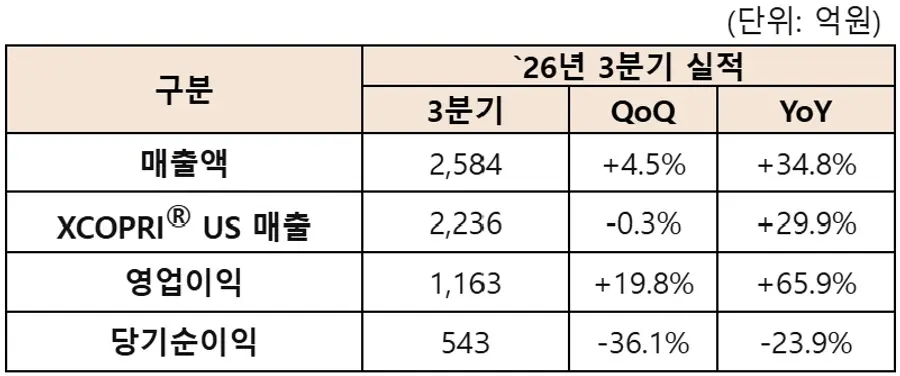 Chart: SK Biopharmaceuticals
U.S. sales for the first three quarters totaled $441.29 million, about 76% of the high end of the company’s full-year sales outlook of $580 million. SK Biopharmaceuticals said it sees a greater likelihood of reaching the upper end of the range, but kept its annual outlook at $550 million to $580 million, citing factors including sales deductions that are concentrated in the fourth quarter.
Service revenue also supported results. Of the 34.8 billion won in third-quarter other revenue, 28.9 billion won came from services and 5.9 billion won from finished and active pharmaceutical ingredients. Service revenue included royalties, revenue recognized as work progressed on clinical trials in Asia, and milestone payments. Selling and administrative expenses totaled 133.1 billion won, down 2.1 billion won from the previous quarter.
SK Biopharmaceuticals plans to invest cash generated through direct sales in the United States in follow-on products and new drug research and development. The company aims to secure products that can use its existing sales network and broaden its R&D portfolio.
As its second product, the company signed an agreement to acquire Biohaven’s epilepsy drug candidate opakalim and is completing the transaction. It expects to obtain the first major results from the pivotal RISE3 clinical trial by the end of this year.
The company is also working to expand the patient population and formulations for cenobamate. After submitting a new drug application to the U.S. Food and Drug Administration (FDA) in March for an oral suspension formulation, it recently filed separate supplemental applications to expand the prescribing age to include pediatric patients with partial-onset seizures and to add an indication for primary generalized tonic-clonic seizures.
Next-generation R&D will focus on small-molecule compounds for central nervous system disorders, radiopharmaceutical therapies and targeted protein degradation. The company plans to submit investigational new drug applications for two to three candidates next year.
“Operating profit is growing rapidly even as we expand licensing and R&D investments, and we are now building cash at a pace that enables substantial investment,” said SK Biopharmaceuticals President Lee Dong-hoon. “We are strengthening a virtuous cycle that goes beyond the success of a single product: extending the value of our direct-sales platform to the next product and reinvesting the resulting returns in R&D for follow-on drugs.”