
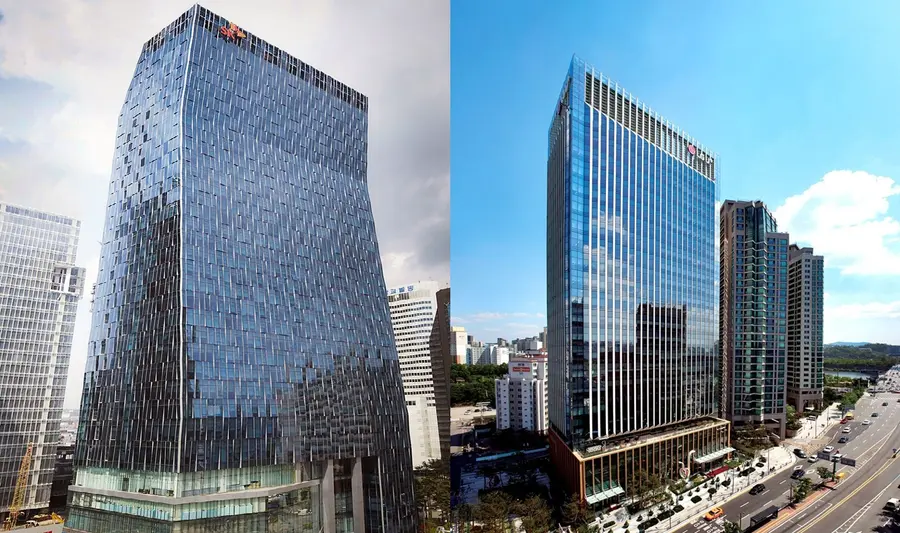
 Exterior of SK Telecom headquarters (left) and LG Uplus’s Yongsan headquarters. Photo: SK Telecom and LG Uplus
SK Telecom and LG Uplus returned to growth in the third quarter, building on their core telecommunications businesses and expanding their AI data center operations. SK Telecom posted operating profit in the 500 billion won range for the third straight quarter, while LG Uplus recorded a sharp increase in operating profit, aided by the base effect from one-off labor costs last year and business-efficiency measures. Both companies are expanding their AI businesses by strengthening their data center construction and operating capabilities.
The companies reported on the fourth that SK Telecom’s consolidated revenue for the third quarter totaled 4.4973 trillion won, with operating profit of 552.3 billion won. LG Uplus posted operating revenue of 3.9813 trillion won and operating profit of 297.6 billion won.
SK Telecom’s revenue rose 13.1% from the same period last year and 3.2% from the previous quarter. Net income was 411.8 billion won. On a standalone basis, the company posted revenue of 3.1563 trillion won, operating profit of 413.5 billion won and net income of 298.9 billion won. Its third-quarter dividend was set at 830 won per share, unchanged from the first and second quarters.
LG Uplus saw revenue and profit move in opposite directions. Consolidated operating revenue declined 0.7% year over year, while operating profit increased 84.1%. Service revenue, excluding handset sales, fell 0.5% to 3.1021 trillion won, affected by lower revenue at subsidiaries. Standalone service revenue, by contrast, rose 0.7% to 2.912 trillion won.
Subscriber growth and a recovery in service revenue continued in the companies’ core telecommunications businesses. SK Telecom, led by CEO Jae-heon Jung, said wireless revenue gradually recovered as it shifted its marketing strategy to focus on customer lifetime value (LTV). Fixed-line telecommunications revenue increased 7.4% year over year, helped by growth in high-speed internet subscribers.
LG Uplus’s mobile revenue fell 0.9% to 1.6867 trillion won. However, mobile service revenue excluding interconnection revenue rose 0.4% to 1.6232 trillion won. The number of mobile lines, combining mobile network operator (MNO) and mobile virtual network operator (MVNO) subscribers, increased 6.2% to about 32.143 million.
LG Uplus’s Smart Home business, which includes internet and IPTV, generated revenue of 665.5 billion won, up 2.9%. Internet revenue rose 5.4% to 328.3 billion won as the number of gigabit internet subscribers and average revenue per user (ARPU) increased. IPTV revenue edged up 0.6% to 337.2 billion won.
AI data centers are a growth area for both companies. LG Uplus increased related revenue and investment, while SK Telecom established a business framework that divides responsibility for business development and infrastructure operations.
LG Uplus’s AIDC revenue rose 27.7% year over year to 131.7 billion won. Revenue grew from colocation, which houses customers’ servers in data centers, and from design, build and operate (DBO) services. Revenue in the company’s Enterprise Infrastructure division, which includes AIDC, increased 10.4% to 472.2 billion won.
LG Uplus is building an AI data center in Paju with a power capacity of 200 megawatts. It plans to bring all four buildings online in stages by 2028. The first building, for which it has already secured a customer, will have a capacity of 50 megawatts and is scheduled for completion and launch in June next year. In line with its expanded AIDC investment, standalone capital expenditures in the third quarter rose 30.1% year over year to 569.8 billion won.
SK Telecom launched SK Hyper in July and SK Horizon in August. SK Telecom oversees strategy, risk management and global partnerships across the AI data center business; SK Hyper handles business development, while SK Horizon is responsible for infrastructure operations and expansion.
SK Horizon is building new data centers with a combined capacity of about 180 megawatts in Ulsan and Seoul, and plans to expand its submarine cable business in stages. SK Hyper is discussing business terms with potential customers, focusing on Ulsan. If the discussions are finalized, it plans to develop infrastructure on sites it has secured.
The companies are also broadening the scope of their AI services. SK Telecom is applying its homegrown AI foundation model to A. dot and workplace AI services, and is taking part in “AI for Everyone” to build a service ecosystem. LG Uplus is expanding its AI Contact Center (AICC) solutions, developed based on its customer center operations experience, with a focus on the financial sector.
“We were able to achieve results in both recovery and growth, supported by the two pillars of telecommunications and AI,” said Jong-seok Park, SK Telecom’s chief financial officer. “We will work to connect our telecommunications and AI businesses under a single growth strategy and amplify synergies.”
“While strengthening the structural competitiveness of our core telecommunications business, we will turn AI service opportunities into tangible results and work to continuously enhance corporate value,” said Yeo Myeong-hee, LG Uplus’s chief financial officer.