
 KT (left) and SK Telecom logos. Photo: KT and SK Telecom
Ahead of the 21st Busan Fireworks Festival, which will be held on the 7th in the Gwangalli area of Busan, KT and SK Telecom are deploying mobile base stations and reinforcing their networks. The measures are designed to prepare for a surge in photo and video sharing as this year’s attendance is expected to exceed 1.2 million.
According to announcements released by KT (CEO Park Yoon-young) and SK Telecom (CEO Chung Jae-heon) on the 6th, the two companies will operate temporary network equipment at Gwangalli Beach and nearby viewing areas and monitor traffic in real time on the day of the event. SK Telecom announced its special network measures on the 5th, followed by KT on the 6th.
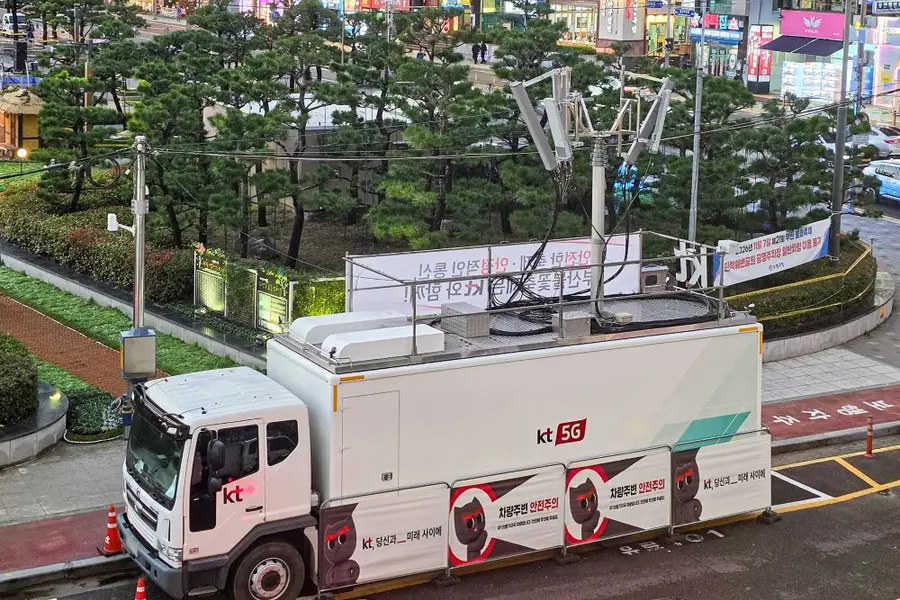 KT has activated special measures to provide stable communications services in anticipation of crowds attending the 21st Busan Fireworks Festival, to be held on the 7th. Photo: KT
KT will operate 19 fixed temporary base stations and mobile base stations at Gwangalli Beach and nearby areas. It has added 5G and LTE equipment at beach entrances and exits expected to draw large crowds. On the day of the event, it will use its wireless network automation technology, “W-SDN,” to distribute data loads concentrated on particular base stations.
Along with communications services for visitors, KT will support the transmission of video for safety monitoring. It will allocate dedicated 5G network resources to 15 wireless CCTV cameras installed at the beach and subway station entrances and exits. Using “network slicing,” a technology that divides a single 5G network according to its intended use, the company aims to ensure that safety-monitoring footage is reliably transmitted to the central operations room even as visitors’ data use increases. This year, KT will extend coverage to the underground transit section connecting Gwangan and Suyeong stations.
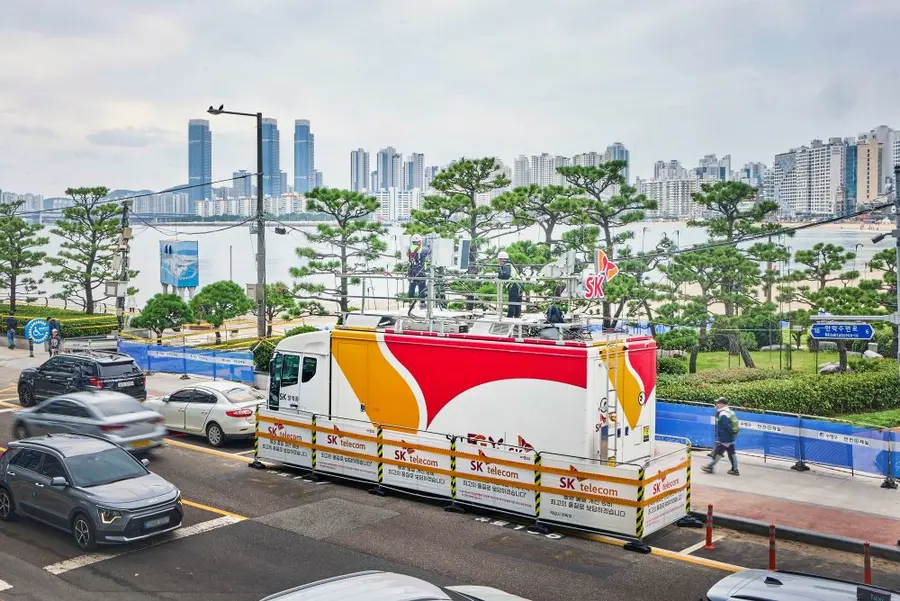 Ahead of the Busan Fireworks Festival, to be held on the 7th at Gwangalli Beach in Busan, SK Telecom has drawn up special measures to maintain stable network quality at the venue, where large crowds are expected. Photo: SK Telecom
To manage network quality, SK Telecom examines real-world usage, including whether web pages load properly and whether social media content or high-definition videos are delayed. It is adding a “customer-perceived quality satisfaction rate”—the proportion of time services maintain quality above a set threshold—to its existing AI monitoring, tracking web, social media, work collaboration and high-definition streaming services separately. It also identifies areas with degraded quality by dividing GPS coordinates into grid cells.
The company uses “A-One,” its AI-powered wireless network operations system, to analyze expected crowd sizes and historical data usage and calculate the capacity needed. Its integrated monitoring system, “Spider,” monitors anomalies in real time. SK Telecom will add mobile base stations or temporary repeaters in Gwangalli and Marine City, and has also included Yongho Bay and Igidae in its priority monitoring areas. More than 100 people, including SK Telecom and partner-company staff, will be on emergency duty from the morning of the event until visitors have dispersed.