
Key Takeaways
The Bank of Korea included Bithumb’s recent Bitcoin payout error in its latest payment and settlement report.
The report adds momentum to calls for stronger crypto exchange safeguards, including measures similar to circuit breakers and tighter balance-verification controls.
The Bithumb incident triggered trading disruption, a regulatory probe and fresh scrutiny of how exchanges handle internal approvals, customer balances and operational risk.
The Bank of Korea has elevated Bithumb’s February Bitcoin payout error into a national policy discussion, using its latest report to highlight the incident and sharpen attention on crypto exchange safeguards in South Korea.
The central bank published its 2025 Payment and Settlement Report on April 13 and said the report includes the recent “Bithumb exchange Bitcoin erroneous payment incident” as a reference case.
The report gives the Bithumb incident formal regulatory significance at a moment when South Korean officials are paying closer attention to exchange controls, internal approvals and asset verification.
The Bank of Korea backed safeguards, such as circuit breakers and supported stronger checks between exchange ledgers and blockchain balances.
Bithumb Incident Enters Official Risk Review
The Bank of Korea’s April 13 release placed the Bithumb case inside a broader review of payment and settlement developments during 2025.
The same release also flagged stablecoin volatility as a reference issue, showing that crypto-related disruptions now sit within the central bank’s formal review of settlement infrastructure and payment-system risk.
That inclusion is likely to feed ongoing discussions in Seoul around operational standards for exchanges.
Once a central bank report singles out an exchange failure, the event becomes part of the policy record and a basis for further supervisory action.
February Payout Error Hit Bithumb Trading
The underlying incident dates to February, when Bithumb mistakenly distributed Bitcoin to 249 users during a promotional event after intending to send 620,000 won.
Some recipients sold the incorrectly credited assets before the exchange froze the affected accounts, and Bitcoin briefly dropped on Bithumb as the error spread through trading.
Bithumb recovered 618,212 BTC immediately and later reclaimed 93% of the 1,788 BTC that had already been sold, leaving 125 BTC unrecovered.
The exchange suspended transactions and withdrawals on affected accounts that evening.
The scale of the error drew attention because it showed how internal exchange records can feed directly into live trading conditions.
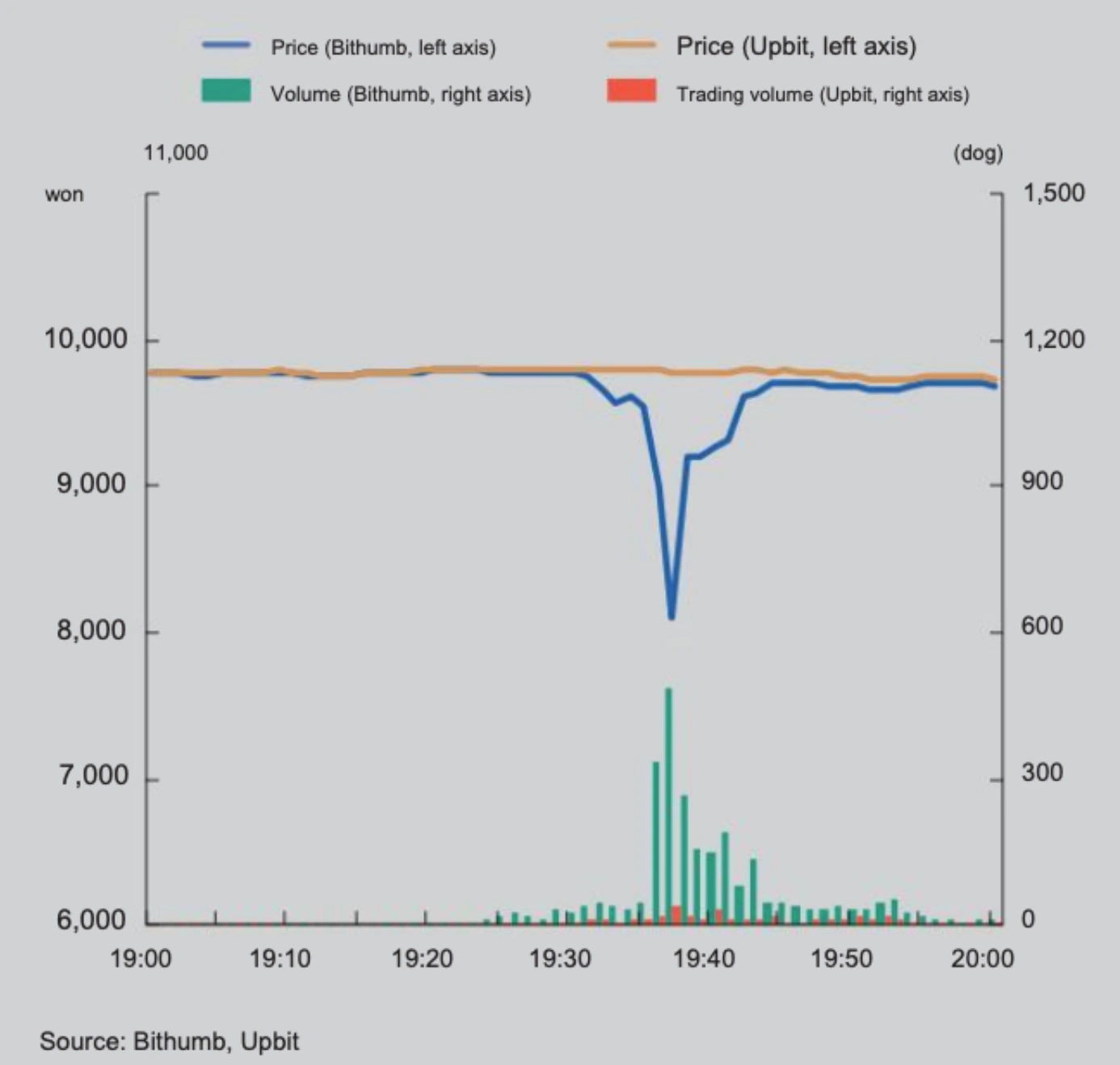 Translated chart showing Bitcoin’s price on Bithumb (blue) versus Upbit (yellow) following Bithumb’s erroneous Bitcoin transfers. Source: Bank of Korea
Customer balances, sell orders and collateral positions were all affected within a short period.
Regulators Tighten Focus on Exchange Controls
South Korean regulators opened a probe soon after the incident.
The Financial Supervisory Service launched an investigation and warned it would respond firmly to conduct that disrupts market order.
At a parliamentary hearing days later, Bithumb CEO Lee Jae-won apologized and said the exchange’s internal control system had failed to detect that more tokens than available had been credited to users.
Local reporting said the incident pushed regulators to examine approval systems, monitoring practices and reserve verification more closely.
South Korean authorities also discussed broader reforms involving the Financial Services Commission, the Financial Intelligence Unit, the Financial Supervisory Service and the Digital Asset Exchange Alliance.
South Korea Weighs Additional Safeguards
The Bank of Korea’s report gives fresh momentum to proposals for emergency trading controls and tighter operational standards at exchanges.
The central bank supported protections modeled on Korea Exchange safeguards, including mechanisms to catch irregularities before they spill into trading.
For South Korea’s crypto market, the Bithumb case has become a reference point for how operational failures can trigger wider disruption.
The central bank’s decision to include it in an official settlement-risk review signals that exchange safeguards now sit firmly inside the country’s mainstream regulatory agenda.
Recommended Secure Partners
The post Bank of Korea Floats Crypto Circuit Breakers After Bithumb Blunder appeared first on ccn.com.