
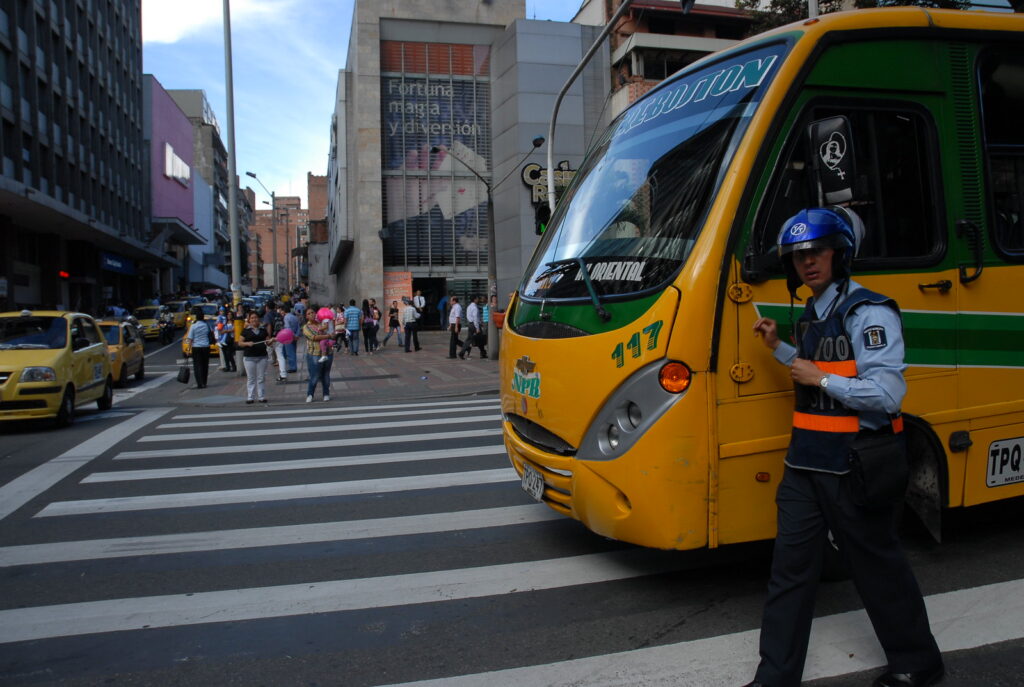
South Korea will invest $3.5 million in Medellín, Colombia, to improve the city’s mobility through intelligent transportation systems. Credit: Secretaria de Movilidad Medellin, CC BY 2.0 / Flickr
The South Korean government will invest US$3.5 million (4.46 billion won) to develop a Smart Transportation Systems Master Plan in Medellin, Colombia, between 2026 and 2028. The initiative aims to modernize the city’s urban mobility through the use of artificial intelligence, real-time monitoring, and advanced digital technologies designed to improve road safety.
The project will be funded by South Korea’s Ministry of Land, Infrastructure and Transport and represents one of the most significant international cooperation programs Medellin has received in the field of mobility in recent years. In addition to introducing cutting-edge technology, the initiative will strengthen knowledge exchange between Colombia and South Korea while positioning Medellin as a regional leader in transportation innovation.
The strategy includes the development of pilot projects in areas considered critical for both vehicle and pedestrian traffic, with the goal of improving traffic management and reducing road accidents through smart mobility solutions.
What technology will South Korea implement to transform mobility in Medellin?
The Smart Transportation Systems Master Plan will focus on deploying technological solutions capable of collecting and analyzing real-time data to optimize the city’s transportation network.
One of the project’s key components will be the installation of smart pedestrian crossings near schools. These crossings will feature dynamic traffic signals designed to improve the safety of students, teachers, and pedestrians during peak travel hours while enhancing interaction between vehicles and pedestrians.
Another major initiative will focus on road underpasses, where sensors will be installed to detect flooding and provide early warnings to drivers and traffic authorities. The system is expected to reduce the risks associated with heavy rainfall while enabling faster emergency response.
The project will also introduce specialized safety systems along steep roadway corridors, a defining characteristic of Medellin’s mountainous landscape. These areas will be equipped with detection and warning technologies capable of identifying potential hazards before accidents occur, particularly in locations where challenging terrain presents additional mobility risks.
All of these solutions will be supported by artificial intelligence, big data analytics, and continuous real-time monitoring, enabling more efficient traffic management across the city.
A smart mobility model for Latin America
Beyond the technological upgrades, the investment seeks to establish a smart mobility model that could serve as a benchmark for other cities across Latin America.
Among the expected benefits is a reduction in traffic accidents at high-risk locations through predictive systems that can identify potential dangers and support faster decision-making by transportation authorities.
Improved traffic flow is also expected to shorten travel times and reduce emissions caused by congestion, reinforcing Medellin‘s long-term commitment to sustainable urban mobility.
The agreement also includes knowledge transfer and specialized training programs for staff at the Integrated Traffic and Transportation Center, strengthening the technical capabilities of the teams responsible for operating the new technological platforms.
Through this initiative, Medellin aims to build a digital infrastructure capable of integrating information from multiple monitoring systems to respond more quickly and efficiently to the city’s mobility needs.
The project also positions Medellin as one of the pioneers in Latin America in adopting smart technologies for urban transportation. By combining artificial intelligence, real-time monitoring, and predictive systems, the city aims to move toward a safer, more efficient, and more sustainable mobility model.