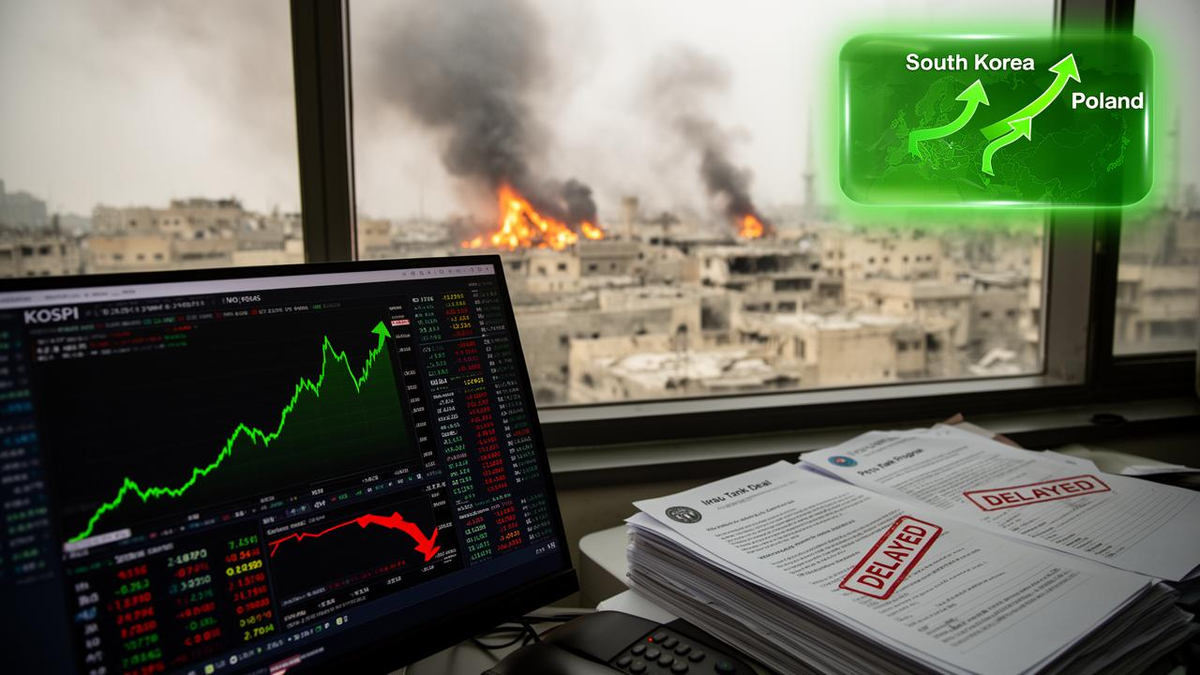
Despite the prolonged geopolitical tensions in the Middle East, the share price performance of South Korea’s major defense contractors has fallen short of expectations. The pace of earnings improvement has been slower than the market anticipated, and delays in securing large-scale overseas contracts have sharply cooled investor sentiment.
According to the Korea Exchange on the 20th, the five major South Korean defense stocks—Hanwha Aerospace (KRX: 012450), Hyundai Rotem (KRX: 064350), Korea Aerospace Industries (KRX: 047810), Hanwha Systems (KRX: 272210), and LIG Nex1 (KRX: 079550)—have posted an average gain of just 22.7% this year. This is less than half the 61.9% surge recorded by the KOSPI index over the same period. The declines have been particularly pronounced amid the recent broader market correction. Hanwha Aerospace has fallen 38.6% from its 52-week high, while Hyundai Rotem has dropped 37.7% from its peak. Hanwha Systems has plunged 59.7%, more than halving its share price.
The biggest factors weighing on defense stocks are a “second-quarter earnings shock” and “uncertainty surrounding large-scale orders.” According to Kiwoom Securities, Hanwha Aerospace’s second-quarter operating profit is estimated to have come in at 947.3 billion won (approximately $639.7 million), below the market consensus of 1.02 trillion won (approximately $686.8 million). Hanwha Systems and Hyundai Rotem are also expected to report operating profits below market expectations. In response, Kiwoom Securities lowered its target price for Hanwha Aerospace from 1.9 million won (approximately $1,283) to 1.72 million won (approximately $1,162), and for Hanwha Systems from 170,000 won (approximately $115) to 140,000 won (approximately $95).
The situation at Korea Aerospace Industries (KAI) is no different. Its second-quarter operating profit is projected at 67.7 billion won (approximately $45.7 million), falling 28.8% short of the market consensus of 95.1 billion won (approximately $64.2 million). Jang Nam-hyun, an analyst at Korea Investment & Securities, analyzed: “Domestic deliveries of the Light Armed Helicopter (LAH) were temporarily suspended, causing delivery volumes to fall short of expectations, while the rising exchange rate increased export cost burdens, compressing profit margins.”
Order delays are also depressing investment sentiment. Hyundai Rotem has corrected nearly 38% from its yearly high as the contract timelines for large-scale projects, including tank programs in Iraq and Peru, have become uncertain. Lee Han-gyeol, an analyst at Kiwoom Securities, diagnosed: “Uncertainty surrounding the order timeline is the core reason for the share price correction.”
Nevertheless, the securities industry is leaning toward the possibility of a second-half rebound. The recent sharp decline has enhanced valuation appeal, and given the nature of the defense industry, the materialization of large-scale orders can simultaneously lift both earnings and share prices.
The key to a rebound ultimately lies in “new orders.” Hanwha Aerospace is expected to see a significant increase in domestic mass production volumes and overseas export shipments, including to Poland, starting in the second half. Analyst Lee Han-gyeol maintained a buy rating, stating: “Considering that this is a period when expectations for second-half earnings improvement and new orders are being priced in, the recent share price correction has increased valuation appeal.”
For Korea Aerospace Industries, the next-generation KF-21 fighter jet is expected to be the centerpiece of new order momentum. Analyst Jang Nam-hyun forecast: “While the pace of profit improvement may be slower than previously expected, expanded new orders centered on the KF-21 will be the key to a share price rebound.”
LIG Nex1 is maintaining a relatively favorable trajectory. This is due to signs of expanding Middle East exports of the Cheongung-II medium-range surface-to-air missile system. Kang Tae-ho, an analyst at DS Investment & Securities, maintained a target price of 1.25 million won (approximately $844), stating: “If Cheongung-II exports expand to Saudi Arabia starting in the second half of next year, following the UAE, the medium-to-long-term export share will rise to 34% in 2027 and 37% in 2028.”
An official in the financial investment industry emphasized: “This is a period where confirmed orders leading to actual contracts are more important than vague expectations of war-related benefits. Whether large-scale orders materialize in the second half will be the watershed moment for a defense stock rebound.”