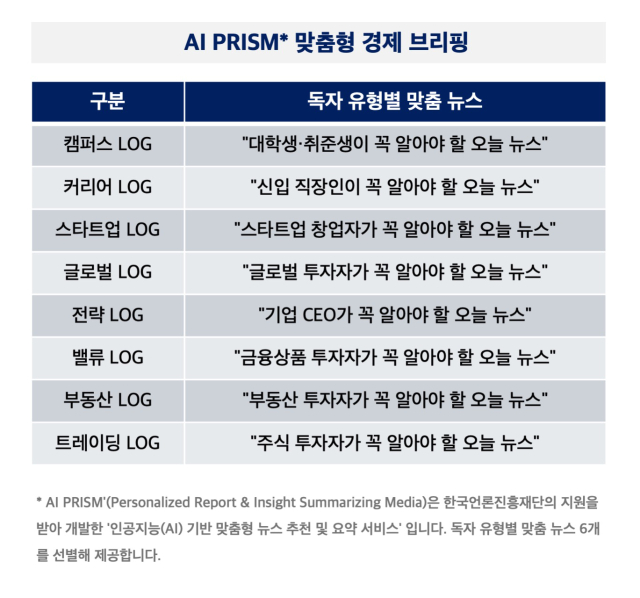

▲ AI PRISM* Personalized Economic Briefing
* Editor’s note: AI PRISM (Personalized Report & Insight Summarizing Media) is an AI-based personalized news recommendation and summary service developed with support from the Korea Press Foundation. It selects and provides six tailored news items by reader type.
■ The won-strength calculus: The won-dollar rate fell to its lowest level since early October last year, as expectations of a September rate hold by the U.S. Federal Reserve combined with foreign stock buying and won-selling by exporters. Barclays noted that the won has been the strongest among major currencies since July, and said the exchange rate is likely to become a more important variable for Bank of Korea monetary policy than before.
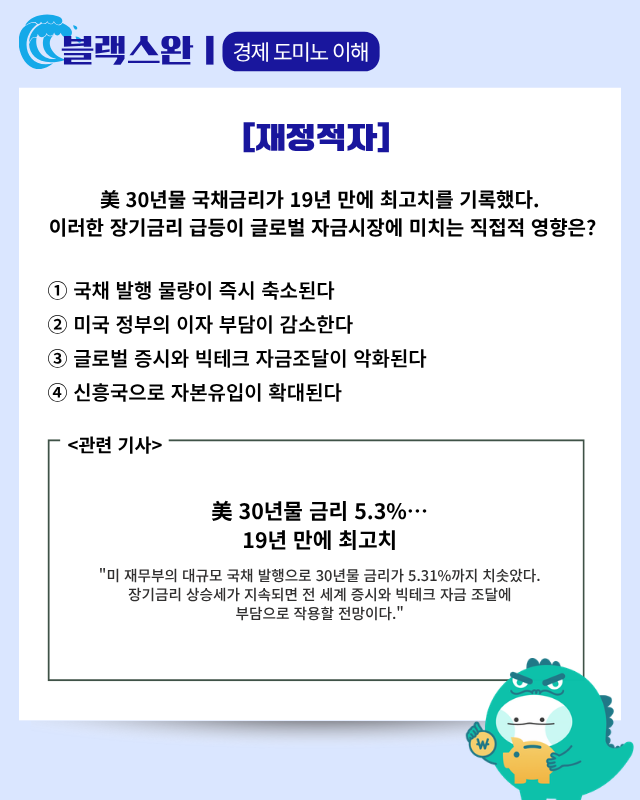
■ The U.S. Treasury yield wall: Positive news arrived at once — the return of foreign investors, a stabilizing exchange rate and improving conditions in the chip sector — but a surge in long-term U.S. Treasury yields and oil-price jitters stemming from the Middle East weighed on investor sentiment. The KOSPI also gave back all of its early gains in the afternoon, in a strong-open, weak-close session, and failed to reclaim the 7,000 mark.
■ AI infrastructure guarantee: A residual-value guarantee agreement between Nvidia and builder SB Energy, covering a data center that OpenAI will lease for 20 years, reignited debate over circular financing. CEO Jensen Huang countered that it was infrastructure secured to underpin long-term demand, but investors’ unease has not lifted.
[News of Interest to Financial-Product Investors]
1. Won Strength Complicates Bank of Korea’s Calculus as Won-Dollar Rate Closes Lower
– Key summary: In the Seoul foreign exchange market on the 18th, the won-dollar rate closed at 1,411.80 won, down 1.20 won from the previous session’s close. The rate opened at 1,417.00 won and fell to 1,408.00 won around 12:06 p.m., marking its lowest in 11 days, while on the 3:30 p.m. benchmark basis it was the lowest since October 2 last year. U.S. retail sales for July fell 0.6% from the previous month, far below the market’s expected 0.1% increase, spreading expectations of a September hold by the Fed. Foreign net buying of 91.4 billion won in the stock market, which produced custody dollar-selling, also added downward pressure. Barclays projected that depending on the exchange-rate level, second-quarter gross domestic income (GDI) growth could be lowered by up to 2.00 percentage points, and that non-IT companies would bear 66% of total third-quarter foreign-exchange translation losses on the KOSPI.
2. Foreign Investors Return Past AI-Peak Fears, but Now Face a U.S. Treasury Yield Wall
– Key summary: The KOSPI closed at 6,869.83 on the 18th, down 108.11 points (1.55%). It opened up 2.15% at 7,127.77 and climbed as high as 7,216.62 intraday, but gave back all its gains in the afternoon, with a daily swing of 427.84 points, the widest in August. The U.S. 30-year Treasury yield rose to around 5.32%, its highest in 19 years since 2007, and a 60-day U.S.-Iran cease-fire deadline ended without result, pushing Brent crude above $91 a barrel. Lee Jin-woo, head of the research center at Meritz Securities, said the rise in Treasury yields signals a worsening liquidity environment, and that as Big Tech capital spending expands through debt financing, sensitivity to interest rates has become far higher than in the past.
3. Reviewing External Soundness and Foreign Reserves
– Key summary: Korea’s ratio of short-term external debt to foreign reserves topped 40%, raising related concerns. The ratio has previously risen as high as 286.1% in the fourth quarter of 1997 and 78.4% in the third quarter of 2008. The biggest factor behind the recent rise is a sharp expansion in foreign investment in won-denominated bonds after confirmation in October 2024 of inclusion in the FTSE World Government Bond Index (WGBI). In the first quarter of this year, foreign reserves fell short of the strictest Bank for International Settlements (BIS) standard but met the Greenspan-Guidotti rule and the International Monetary Fund (IMF) Assessing Reserve Adequacy (ARA) metric, with ARA-based adequacy at 110% or higher. Still, observers say the concentration of dollar funding in the banking sector, the size of total external debt and the share of short-term external debt warrant continued monitoring.
[News for Reference by Financial-Product Investors]
4. Samsung SDI (006400) Tops Retail Net Selling, yet Minority Shareholders Rose 30%
– Key summary: Samsung SDI’s minority shareholders numbered 766,880 at the end of the first half of this year, up 173,195, or 29.2%, from 593,685 at the end of last year. Retail investors, meanwhile, net-sold 2.0343 trillion won of Samsung SDI shares through the end of June this year, and Samsung SDI was the only stock with retail net selling exceeding 2 trillion won. On a closing basis, the share price rose from 269,500 won at the end of last year to 722,000 won on April 29, then fell to 487,000 won on June 30, and the increased volatility is read as producing both an exit of existing investors and new bottom-fishing at the same time. The average target price from the seven brokerages that issued reports this month is 671,286 won, and Mirae Asset Securities (006800) rated the conversion of a joint venture plant with the U.S.-based General Motors (GM) into a wholly owned plant as positive, setting a target price of 1 million won.
– Key summary: Nvidia lowered the guarantee it will provide for OpenAI’s long-term leased data center to up to $105 billion (about 149 trillion won), roughly half the previously expected level. On the 17th local time, OpenAI signed an agreement with SB Energy and Nvidia to secure 8 gigawatts (GW) of infrastructure at the Ports Pike campus in Pike County, Ohio, in the United States, under a structure in which SB Energy builds the data center and OpenAI leases it for 20 years. The $105 billion applies to the initial 4.25 GW, with additional support possible for the remaining 3.75 GW project. Jeffrey Gundlach, CEO of DoubleLine Capital, criticized the arrangement, saying AI chips of uncertain lifespan cannot serve as collateral for long-term debt, and that it amounts to issuing a 30-year asset-backed security (ABS) against a warehouse of bananas.
6. Disagreement Over Shipbuilding Valuations; SB Sunbo Old-Share Sale Falls Short of Target
– Key summary: A pre-IPO sale of shares in SB Sunbo held by Yuanta Investment ended amid weak demand. Yuanta Investment had sought a sale of 80 billion to 100 billion won, but the actual sale was carried out at around 30 billion won, with most of the stake reportedly acquired by brokerages’ proprietary investment desks. Financial investors (FIs) estimated the company’s value at around 600 billion won, against figures cited in the market of as much as 1.3 trillion won, reflecting a wide gap in views on shipbuilding valuations. Last year’s revenue rose to 214.7 billion won, more than double the 101.2 billion won of 2024, and the acquisition of Daesun Shipbuilding is also under way, but the listing timeline has been pushed from the end of this year to the first half of next year.