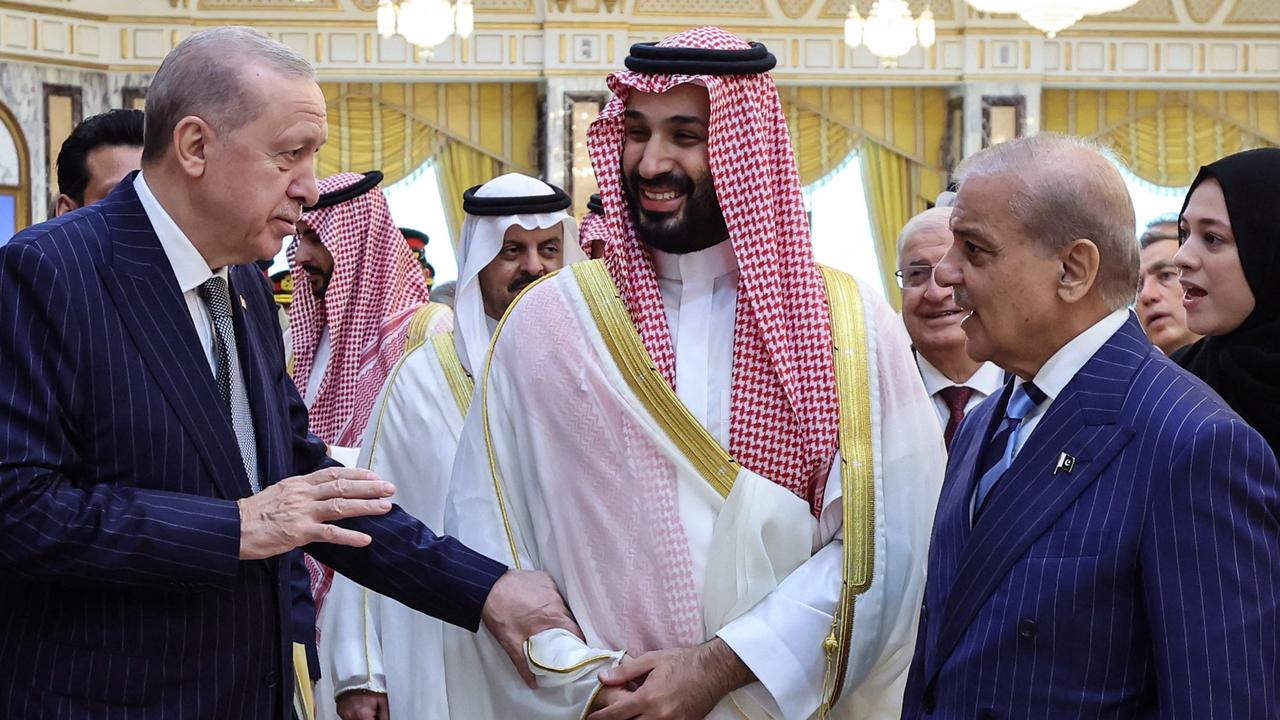
Is the new trilateral mutual defence pact committing Saudi Arabia, Pakistan and Turkey to have each other’s backs the beginnings of a Muslim NATO or the end of an era in which the US is the sole security guarantor?
Pakistan and Turkey have certainly invited NATO comparisons since the Mecca Joint Defence Agreement was signed in the Saudi holy city on Friday, enshrining an ambiguous commitment that an armed attack on one member state would be considered an attack on all three.
The agreement between Muslim US allies comes amid escalating Iranian aggression against Gulf oil exporters.
“I think that, along the lines of NATO, Muslim countries should put their own differences aside … and stand together on this one platform,” Pakistan defence minister Khawaja Asif said on Monday (local time), calling for other Muslim nations to join.

His Turkish counterpart has encouraged similar comparisons by insisting the agreement’s framework would function “like NATO”, with a minister’s committee, political and military committees, and a permanent secretariat based in Saudi Arabia.
Turkey has already floated Egypt’s possible membership signalling grand expansionist plans for a pact which builds on the September 2025 bilateral Saudi-Pakistan Strategic Mutual Defence Agreement.
But Cairo has so far opted not to join, despite being a party to the year-long talks.
Some suggest it did so for fear of upsetting Gulf States, or that it could end up a member of a perceived anti-Israeli axis. For other potential candidates, the more powerful concern will be angering Tehran.
On paper, the three influential Muslim nations are a formidable alliance; Pakistan’s nuclear arsenal and military manpower, Turkey’s drone-led defence industry and NATO-standard military doctrine with Saudi Arabia’s financial and energy resources.
But a major operability gap – between Pakistan’s largely Chinese-made arsenal, Saudi’s US military equipment and Turkey’s indigenous defence matériel – will need to be breached for the pact to be of any real value as a genuine deterrence.
For now, the pact’s greatest significance is its tacit acknowledgment that sole reliance on US security is no longer feasible.
If that wasn’t already clear, the penny certainly dropped for Riyadh in February when the US-Israeli strikes on Iran brought Tehran’s fury down on Saudi Arabia and its Gulf neighbours.
For the Saudi kingdom the Iran war and subsequent blockade of key maritime choke points has exposed the limits of Washington’s security umbrella and the need to lay the foundations for a more autonomous regional security order.
“It is, in effect, an insurance policy against a world where the US is less present and less predictable,” Khalid al-Jaber, executive Director of the Middle East Council on Global Affairs, wrote this week.
“This is not a defection from the American camp to the Chinese, Russian, or Turkish one. It is an attempt to move past the logic of camps altogether. It is also a reflection of a region preparing itself for a likely US withdrawal in the future.”
All three parties say the agreement is “purely defensive” and not directed at any one country, though neither Iran nor Israel is buying that.
Tehran has dismissed the pact as symbolic, and put its mutual defence aspect to the test at the weekend through deadly attacks by Iran-backed Houthis on a two Saudi oil facilities, in Jazan and in the Red Sea port of Mocha.
The absence of a Pakistani or Turkish military response was duly noted, though Tehran’s use of proxies suggests the agreement may have already raised the risk calculation for direct confrontation with Saudi Arabia.
“The designers of this want it to be seen as a game changer but there is a big element of virtue signalling,” cautions Australian Strategic Policy Institute senior fellow Adul Abdul Ghafar.
“Is Saudi Arabia really going to defend Turkey against the Greeks? If Pakistan has a broader skirmish with India, are the Turks and Saudis going to help out?”
“At best I think it will be intelligence sharing, a mechanism for sharing radars, and military co-operation.”
For Turkey, the prospect of pushing Israel’s hopes for normalisation with Riyadh through the Abraham Accords further out of reach while offering Gulf countries who signed up to the Accords before the Gaza and Iran wars an alternative indigenous framework is a powerful incentive.
Of all three, Pakistan – newly out of the US diplomatic freezer after mediating US-Iran peace talks – may have most to gain from the agreement which gives enough wriggle room to sit out any Middle East conflict, as it did after Iran first attacked Saudi Arabia earlier this year, while providing diplomatic cover via two influential regional powers.
An added benefit, as always, is the heartburn it will cause regional rival India, which may look to strengthen ties with the UAE and Israel in response.
 Amanda HodgeAsia-Pacific correspondent