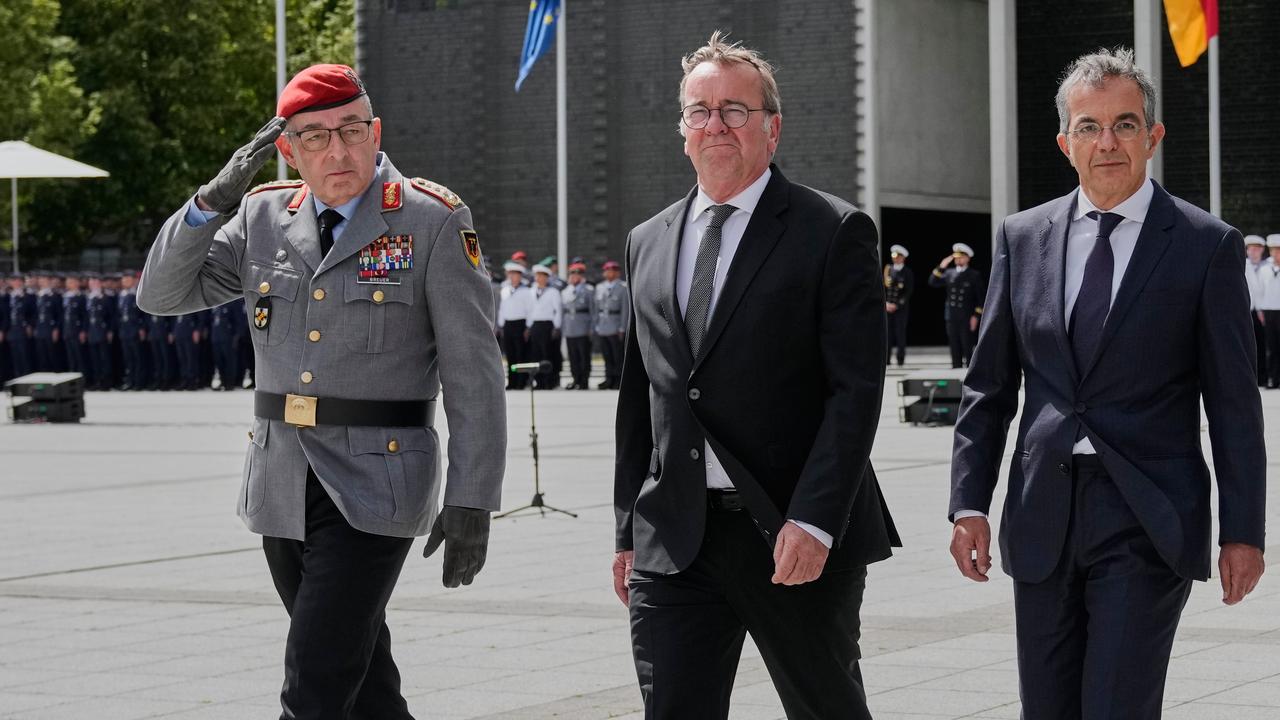
Russia has been systematically using drones to probe air defences in Europe, looking for weaknesses to exploit, Germany’s top military officer said, amid what he called an intensifying gray-zone campaign aimed at destabilising the continent’s governments and institutions.
“Hybrid attacks are taking place every day in NATO countries,” especially those on the alliance’s eastern flank, Gen. Carsten Breuer said in an interview with The Wall Street Journal. “Russia is testing us and looking at how we respond” so it can refine its tactics for a future conflict.
Gen. Breuer, who is leading a major defence revamp aimed at turning the German military into a powerful, combat-ready force after years of underinvestment, said Russia is “already shifting its economy and military to prepare for a wider conflict with the West,” even as it fights a war in Ukraine.
This assessment of the threat posed by Russia is the starting point for Germany’s new military strategy – the first the country has produced since the end of World War II. A declassified summary was published by Berlin in April. It asserts broader German leadership for European security.
On Thursday, German police disarmed an explosive-laden drone discovered near a Ukrainian cargo plane at an airport in the country’s east. Authorities said they were investigating the drone’s origin, which Germany’s interior minister said represented “a new level of danger.” The Journal reported last week that U.S. intelligence assessments say Russian President Vladimir Putin could seek to test the resolve of the North Atlantic Treaty Organisation with a limited attack on one of its members in coming years.
Germany massively boosted its defence budget after Russia’s 2022 invasion of Ukraine. Berlin and other European capitals have also been under pressure from President Trump to spend more and take greater responsibility as Washington fights Iran and seeks to give priority to Asia and the Americas.
“Washington is perceiving China as its first strategic priority,” Gen. Breuer said. “For us, for geographical reasons, Russia is our first priority.” Given its location and the size of its economy – Europe’s largest – Germany should take a leadership role, Gen. Breuer argues. He says Germany aims to provide the “strategic glue” aligning the Baltic, Nordic and eastern front-line states with the rest of Europe.
Gen. Breuer is a leading candidate to become the next chair of the NATO’s military committee in September. The chair, who serves as principal adviser to the alliance’s secretary-general, is elected by national defence chiefs.
In a sign of Germany’s changing role in European defence, Poland and Germany in June signed a new military cooperation agreement that will further strengthen the NATO allies’ ability to fight together, while expanding joint work on cybersecurity and space.
That Poland, which has been invaded and occupied by Germany, is deepening military ties with Berlin shows how seriously both countries take threats from Russia.
A Russian cruise missile in July crashed in eastern Poland. The missile was likely targeting Ukraine, roughly 60 miles away, but NATO officials suspect Moscow has been testing alliance defences with stray drones and missiles in recent years.
Germany’s defence plans have also received positive reviews from Washington. Undersecretary of War Elbridge Colby wrote on X about Berlin’s “historic, highly laudable new military strategy and program.” Among Germany’s spending priorities are intelligence, surveillance and reconnaissance capabilities; space systems and air defence, all things for which NATO has long relied primarily on the U.S. Unmanned air, sea and land drones are also critical, Gen. Breuer said.
Germany’s defence minister, Boris Pistorius, has pledged to spend 30 billion euros, equivalent to about $35 billion, by 2030 on satellites and other space assets. And Germany recently signed a deal with the U.S. under which it will produce Tomahawk missiles – important for long-range precision strikes.
“We have the resources. We are building a deterrent that will be powerful,” Gen. Breuer said.
For short-term needs, the German military and others on the continent will have to buy weapons that are available off-the-shelf. But Europe also needs to expand its defence industrial base, Gen. Breuer said. “We need to make ourselves more independent and sustainable.” Write to The Wall St Journal