Russia has installed secret bases capable of firing high-powered drones deep into Nato territory.
A Telegraph investigation can reveal 10 Kremlin bases with newly built launch pads for Moscow’s most advanced long-range suicide drones.
Some of the bases are already being used to pummel Ukraine, with their proximity to the border helping with mass aerial attacks launched past Kyiv’s diminishing air defences.
But they also offer a long-term threat to Nato allies, placing them within reach of Vladimir Putin’s hi-tech attack drones.
Analysts warn that the rapidly evolving technology could also be turned on Europe in the event of a war, with some of the bases putting Russia’s most powerful drones in range of Warsaw.
European and US intelligence officials believe Russia is considering an armed provocation on Polish soil, missile or drone attacks against critical infrastructure, or false-flag attacks blamed on Ukraine.
A Nato official told The Telegraph that the military alliance was “ready to defend every inch of allied territory” and would continue to “enhance our readiness to deter and defend against any threat, including from drones”.
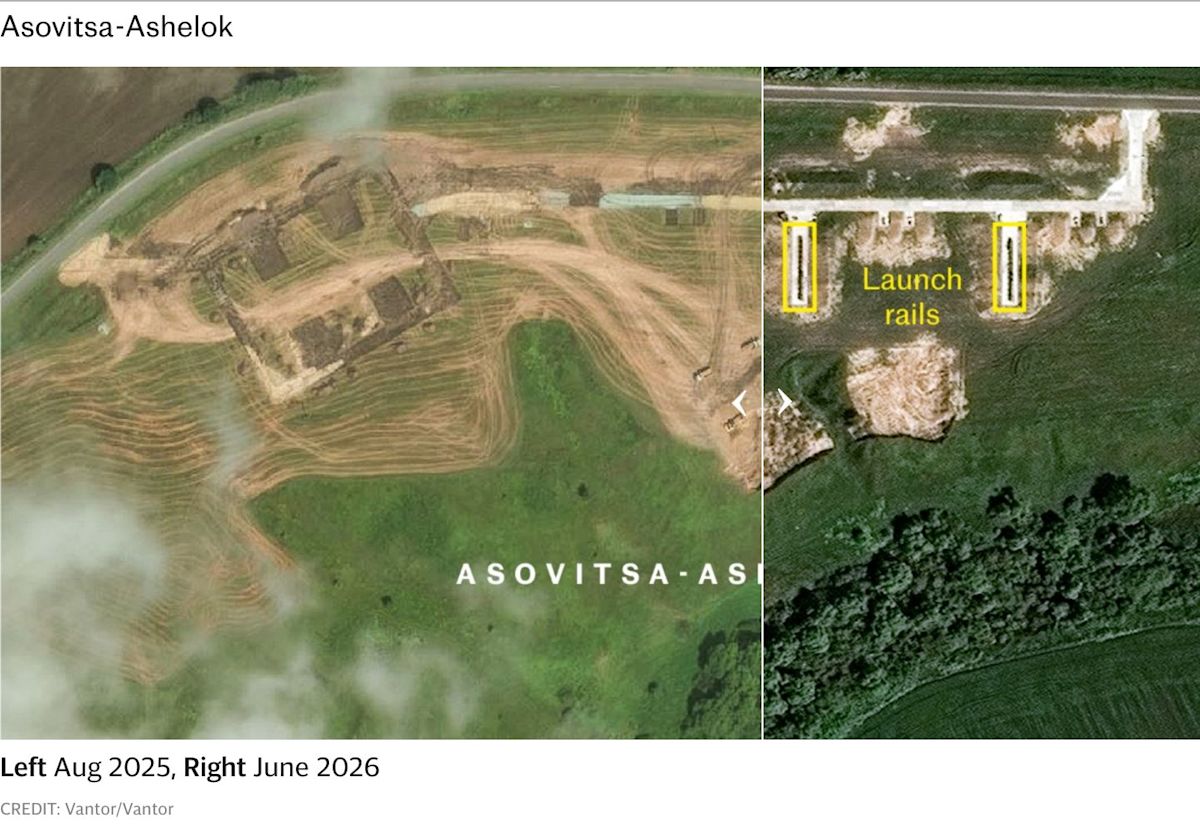
Using leaked documents and satellite images, The Telegraph identified at least 59 new launch rails – mechanical guide tracks used in the takeoff of fixed-wing drones in lieu of a traditional runway – along Russia’s border with Belarus and Ukraine.

Some of the drone hubs have been repurposed from military bases and civilian airports, while additional launch pads have been carved out of Russia’s countryside.
Imagery analysed by DroneSec, a drone intelligence firm, found that about 20 of the newly fitted rails appeared to be of an extended length, indicating their ability to launch the Kremlin’s latest long-range attack drones.

A Russian serviceman launches a drone – Russian Defense Ministry Press Service via AP
Moscow has been upgrading its version of the Iranian Shahed drone at pace, deploying newer high-speed jet variants capable of reaching targets almost 620 miles away. Using new variants from the bases identified would put strikes against Poland’s capital within Putin’s reach.
There is no suggestion Russia is planning such an attack, but Nato leaders are preparing for a future conflict.
The Kremlin claims that slower, more dated variations of the drones could also reach UK shores, but it is highly probable that any attempt to strike Britain from the bases would be intercepted.
The latest variations, named Geran-4 and Geran-5, can fly fast enough to evade air defence systems while carrying a 90kg payload, according to Ukrainian government documents leaked online. Ukraine’s military intelligence agency, the GUR, has also warned that Russia is arming Geran drones with air-to-air missiles to attack aircraft protecting Kyiv.
The imagery revealed a significant increase in the presence of the hi-tech drones, with enough storage at one base for more than 1,000 drones to be kept on site at one time. At a number of key sites, further launch rails are under construction, highlighting Moscow’s ambition to increase its drone threat.
The Telegraph understands the bases have been supplied by a number of munition factories dotted around the country, including the Alabuga special economic zone – a Russian drone-building campus producing 6,000 units a year.
The Kremlin has “significantly expanded” its drone network in an effort to “attack Ukraine and to hold Nato states at risk of such attacks”, according to Mike Monnik, the chief executive and founder of DroneSec who analysed the satellite imagery.

Vladimir Putin at a drone production facility in St Petersburg – Valery Sharifulin/via REUTERS
Mr Monnik added: “This launch site expansion shows how Russia has expanded its ability to launch greater numbers of drones while at the same time using technology to make the types of drones used more difficult to intercept.
“These two elements combine to enable a growing number of total unmanned aircraft systems Russia can use to attack Ukraine and increase the difficulty facing Ukrainian forces in intercepting newer Russian drone designs.”

The Kremlin has ‘significantly expanded’ its drone network – Russian Defense Ministry Press Service via AP
A Nato official told The Telegraph: “Drones have fundamentally altered the character of modern warfare and have become a decisive factor on the battlefield.
“We are rapidly expanding our ability to produce, operate and neutralise drones at scale.”
The Telegraph’s investigation details the Kremlin’s rapid expansion of its drone capabilities, and poses worrying questions about Putin’s ambition to raise threats against Nato allies.
Open-source tracking data show that seven of the 10 sites identified by The Telegraph were used during some of Moscow’s recent bombardment of Kyiv.
