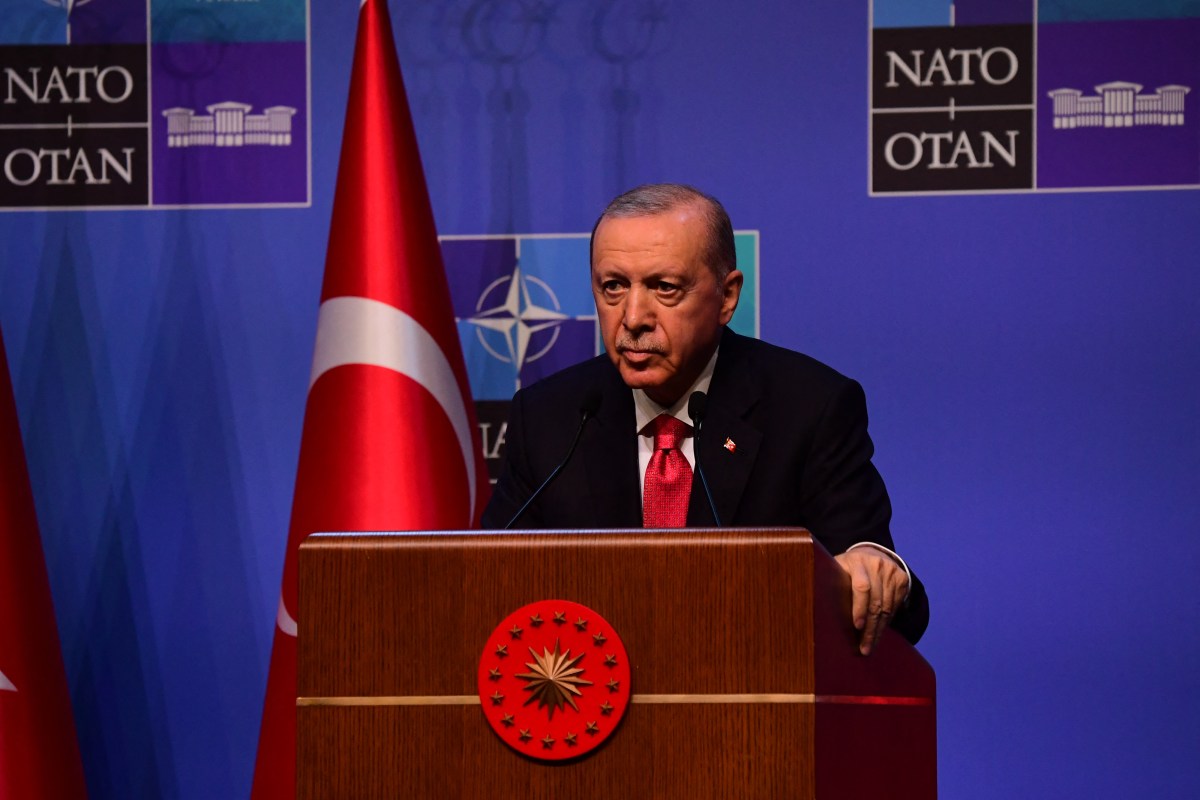
For more than 75 years, NATO has operated on a simple premise: its members share one collective defense system. Turkey has now signed a second.
In November 2024, NATO Secretary General Mark Rutte praised Turkey’s “strong defense capabilities,” highlighting its position as NATO’s second-largest military and emphasizing that a strong Turkish defense industry contributes to a stronger alliance. Turkey has long been one of NATO’s most important military powers.
Now Ankara has signed a mutual-defense pact with Saudi Arabia and Pakistan that Turkish Foreign Minister Hakan Fidan described as “technically the same” as NATO’s Article 5: an armed attack on one is to be treated as an attack on all. Turkish officials insist the new pact complements NATO rather than competes with it.
Read More on Opinion
Perhaps. But alliances are not tested in peacetime. They are tested when obligations pull allies in different directions. The question is no longer whether Turkey remains an important NATO ally. It is what happens when one NATO member assumes obligations under two different collective-defense agreements—and when those obligations begin to conflict.

This agreement may mark the beginning of a new phase in Middle Eastern security. For decades, regional power was projected largely through proxy organizations. Turkey now appears to be advancing a different model—one built on cooperation among sovereign states.
Saudi Arabia contributes financial resources and energy influence. Pakistan adds one of the world’s largest militaries and nuclear capabilities. Turkey brings NATO’s second-largest army and an increasingly sophisticated defense industry. Egypt, if it joins, would add another major military power.
Unlike proxy organizations, sovereign states cannot simply be designated as terrorist groups, sanctioned into isolation or treated as international outcasts. They negotiate treaties, build defense industries, conduct joint military exercises and reshape regional balances of power.
That shift raises a more immediate question: what exactly has Turkey promised Saudi Arabia and Pakistan?
On paper, the agreement commits its members to collective deterrence, mutual defense and closer military cooperation. But its strategic implications remain deliberately vague. NATO’s Article 5 rests on decades of integrated military planning, common institutions and a shared understanding of the threats facing the alliance. Turkey’s new agreement reaches into a region where those assumptions do not exist.
It also creates overlapping security commitments. The question is not whether Turkey can belong to two defense arrangements in peacetime. It is what happens when those commitments begin pulling in different directions.
Consider three entirely plausible scenarios.
Another India-Pakistan war could draw Turkey into a conflict under its new commitments. A major Iranian attack on Saudi Arabia could prompt Riyadh to invoke the agreement. Or a military confrontation between Turkey and Israel could place Washington in the unprecedented position of managing a crisis involving both a NATO ally and one of America’s closest strategic partners in the Middle East. None of these scenarios automatically triggers NATO’s Article 5. But each raises difficult questions about how overlapping security commitments would shape allied decision-making during a regional crisis.
The rhetoric surrounding the agreement makes those scenarios harder to dismiss. Shortly after the agreement was signed, Pakistani Defense Minister Khawaja Asif described Israel as an “illegitimate” state, called it a threat to the Muslim world and urged the creation of a “united military front” against it. In a recent interview with CNN Türk, Fidan described Israel as “a burden that humanity can no longer bear.” President Recep Tayyip Erdogan has repeatedly used inflammatory rhetoric toward Israel, including statements that Israeli Prime Minister Benjamin Netanyahu has said Israel takes “very seriously.”
None of this means the agreement is destined to become a military bloc directed against any particular country. Nor does it mean NATO would automatically become involved in a regional conflict. It does mean that one of NATO’s most powerful members has accepted new collective-defense commitments whose future implications remain undefined. That uncertainty alone deserves far greater attention than it has received.
The issue for NATO is not that Turkey has partnerships beyond the alliance. Many NATO members do. The issue is that Turkey has accepted collective defense obligations under a second security arrangement whose future demands may not always align with those of NATO itself.
The dispute over Turkey’s acquisition of the Russian S-400 air-defense system demonstrated Ankara’s willingness to accept friction within NATO when it believed its strategic interests required it. Turkey’s new defense pact raises a more consequential question: What happens if future disagreements concern collective defense itself?
Whether this agreement ultimately proves symbolic or transformative remains to be seen. But NATO was created to provide clarity in moments of crisis. It now faces a question its founders never anticipated: how should the alliance respond when one of its own members undertakes Article 5-style commitments outside NATO? That question should not be answered by events. NATO should clarify now how overlapping collective defense commitments would be managed and how potential conflicts between parallel defense arrangements would be addressed. Alliances are strongest when their commitments are clear. The time to establish those rules is before—not during—the first crisis that puts them to the test.
Dr. Liram Koblentz-Stenzler is the head of the Global Extremism and Antisemitism Desk at the International Institute for Counter-Terrorism (ICT) at Reichman University, Herzliya, and a visiting scholar at Brandeis University. Follow her on LinkedIn. Bradley Martin is the Executive Director of the Near East Center for Strategic Studies. Follow him on Facebook and X @ByBradleyMartin
The views expressed in this article are the writers’ own.