Russia has built at least 10 secret sites capable of firing long-range drones into NATO territory, according to a new report, following alliance officials’ warning that Moscow could launch a limited attack on alliance soil as early as this fall.
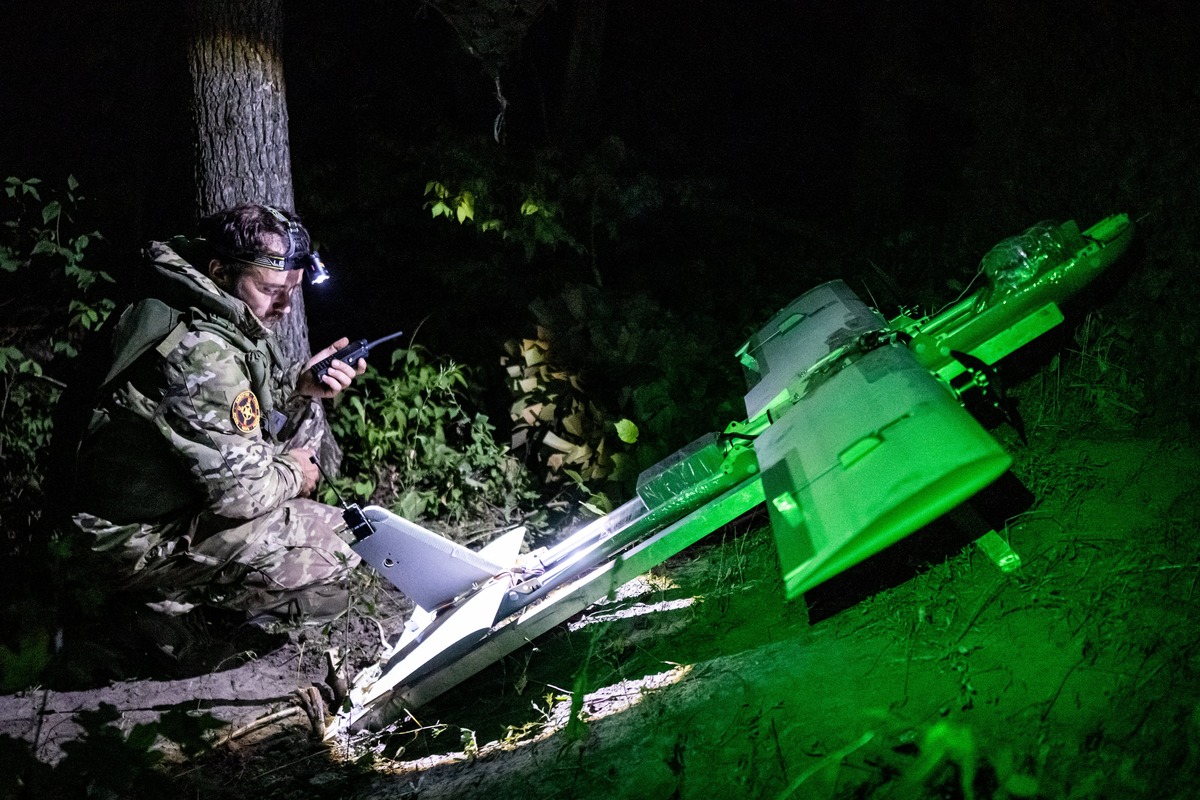
Russia has installed dozens of new “launch rails,” which troops can use to get fixed-wing drones airborne for missions or attacks, at bases along the Russian border with Belarus and Ukraine, British newspaper The Telegraph reported on Sunday.
At least 20 of the new “launch rails” would be able to fire Russia’s most sophisticated long-range attack drones, said analysts with the intelligence firm DroneSec, which studied satellite imagery of the sites.
Read More on World
The majority of the 10 sites, which are described as set up in the remote countryside or built into military bases or airports, were used to attack the Ukrainian capital, Kyiv, in recent weeks, according to the newspaper.
Russia has repeatedly denied planning to attack NATO territory and dismissed the claims as “nonsense.”
Newsweek has contacted the Russian Defense Ministry for comment via email.
 How Drone Warfare Has Changed
Drone warfare has been transformed by nearly four and a half years of full-scale war in Ukraine, with Kyiv and Moscow battling not only for territory but also for an advantage in the drone race—a contest NATO countries are studying closely.
Russia is notorious for wielding Iranian-designed Shahed drones against Ukraine, including the domestically produced Russian version dubbed the Geran-2.
But Ukrainian intelligence says the Kremlin is rushing to produce jet-powered variants able to hit targets much further away, with Russian industry now able to pump out roughly 3,000 upgraded Geran-4 and Geran-5 attack drones each month.
Most of these sophisticated drones are made in a plant in Yelabuga, in Russia’s Tatarstan region, where Moscow has established a drone hub, according to Ukraine’s GUR military intelligence agency.
Russian and Ukrainian sources say the Geran-5 can travel about 1,000 kilometers, or just over 600 miles. If launched from Russia’s territory close to Ukraine or Belarus, this could put NATO soil hundreds of miles from the alliance’s eastern edge within range.
“This launch site expansion shows how Russia has expanded its ability to launch greater numbers of drones while at the same time using technology to make the types of drones used more difficult to intercept,” DroneSec CEO Mike Monnik said in a statement.
Drones and missiles have frequently breached NATO airspace since Russia launched a full-scale invasion of Ukraine in February 2022, often forcing fighter jets stationed in border countries to scramble and even shoot down unmanned vehicles spilling over from the conflict.
When at least 20 drones crossed into Poland in September 2025, NATO officials accused Russia of trying to test the alliance’s response to an attack.
These concerns deepened when a Russian cruise missile crashed in eastern Poland last month, close to the country’s border with Ukraine.
Russia’s Hybrid War With NATO
These airspace violations come at an uncomfortable time for Europe, as it questions the U.S.’s commitment to protecting the Continent.
U.S. President Donald Trump and his administration have berated Europe for decades of low defense spending and a dependence on the tens of thousands of U.S. troops in Europe, as the Pentagon reviews how it deploys its forces on the Continent.
Germany’s most senior soldier, General Carsten Breuer, said Moscow was using drones to gauge how NATO air defenses react to these breaches.
“Hybrid attacks are taking place every day in NATO countries,” he recently told The Wall Street Journal.
A “hybrid attack” is a catch-all term for operations that stop short of open fighting—including cyberattacks, information campaigns, arson incidents or the targeting of vulnerable infrastructure, such as undersea cables.
NATO says Russia has been waging a hybrid war with the alliance for years, but a large-scale attack on NATO is considered extremely unlikely.
Alliance officials say Russia would instead execute a smaller, probing military operation against one of the Baltic states or Poland to see how the rest of NATO responds or intensify its hybrid assaults.
The Kremlin could try to seize a limited chunk of NATO territory or carry out more powerful hybrid attacks on the alliance as early as September this year, the Journal reported earlier this month, citing U.S. intelligence analysis.
But NATO countries are also rehearsing how they would respond if Russian tanks rolled over into a Baltic state.
Contact Newsweek editors on this story: John Fitzpatrick and Shakeema Edwards.