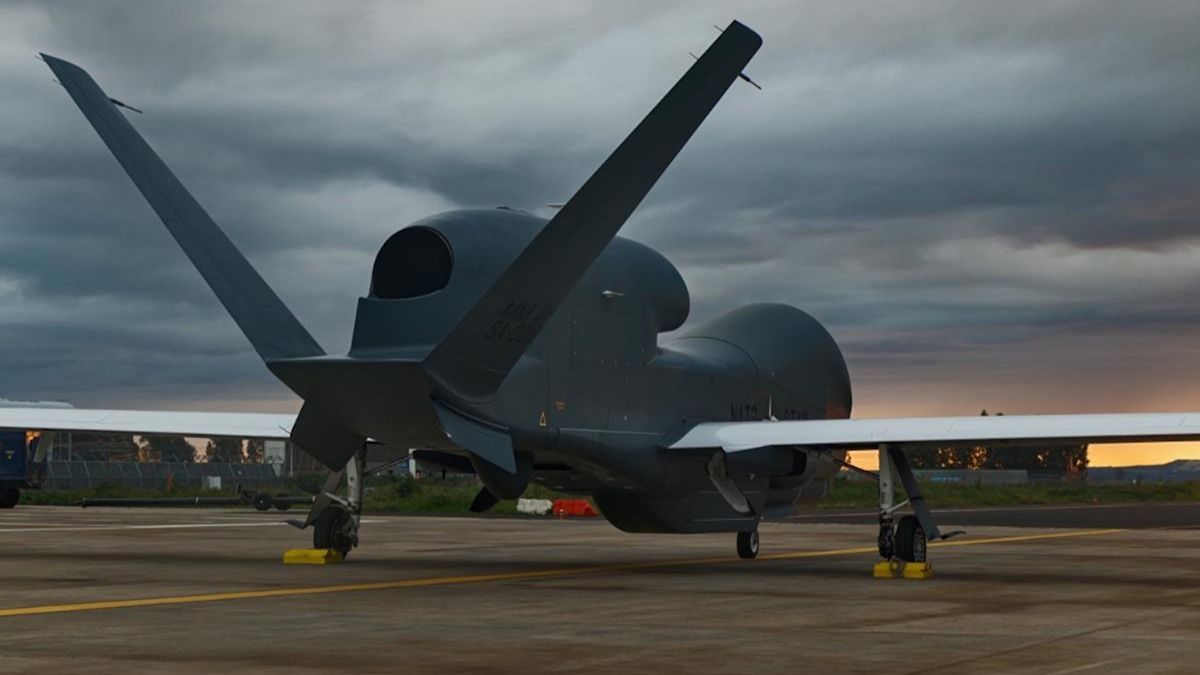
NATO’s only aircraft it owns and operates on its own flew a surveillance mission this week. The flight covered one of the North Atlantic’s most strategically sensitive corridors, feeding targeting data to allied warships positioned far beyond their own sight lines. A NATO-owned RQ-4D Phoenix drone supported Exercise Northern Viking 2026, helping naval forces track surface threats across the Greenland-Iceland-United Kingdom Gap.
The exercise, led jointly by the United States and Iceland, brought NATO and allied forces together around Iceland to sharpen readiness and interoperability across the North Atlantic. The Phoenix operates as the alliance’s only organic intelligence, surveillance, and reconnaissance capability. That means NATO owns and operates the aircraft directly, rather than relying on a member nation’s assets.
Targeting beyond horizon
During its mission, the Phoenix contributed to what NATO calls a surface picture, tracking vessel positions and movements across a wide stretch of ocean. That picture supported over-the-horizon targeting for naval combatants operating in the GIUK Gap. The corridor connects North Atlantic approaches between North America and Europe and has carried outsized strategic weight since the Cold War.
Brigadier General John B. Creel, commander of the NATO Intelligence, Surveillance and Reconnaissance Force, said Northern Viking demonstrates how NATO’s own ISR capabilities can contribute directly to allied maritime operations. He said operating the Phoenix in support of naval forces in the High North strengthens shared situational awareness. That awareness, along with interoperability, is what allied forces need to operate effectively together.
Five aircraft, one fleet
NISRF operates from Italian Air Force Base Sigonella in Sicily, managing a fleet of five alliance-owned RQ-4D Phoenix aircraft. Each aircraft carries Multi-Platform Radar Technology Insertion Program sensors alongside synthetic aperture radar for wide-area surveillance. A communications suite spanning both line-of-sight and beyond-line-of-sight wideband data links rounds out the package.
That high-altitude, long-endurance design lets the Phoenix remain airborne over large areas for extended periods, sharing surveillance data with other forces in near real time. NISRF combines information gathered by the Phoenix fleet with data from other sources, processed by multinational personnel. Together, that builds a broader operational picture for NATO commanders and decision-makers across the alliance’s full area of responsibility.
One mission, a message
The Northern Viking mission demonstrated how sensor data collected far beyond a ship’s own detection range can still feed directly into naval decision-making. It can also support real-time targeting decisions in the process.
That capability matters most in a corridor like the GIUK Gap. Surface vessels there may need to act on threats well outside what their onboard systems alone could ever detect.
The RQ-4D Phoenix belongs to Northrop Grumman’s broader family of high-altitude autonomous aircraft, which also includes the RQ-4 Global Hawk and MQ-4C Triton. Northrop Grumman continues working with NATO on further technology development, as the alliance looks to expand its ISR force in the years ahead. That expansion would build on a fleet that has already logged missions stretching from the Mediterranean to the High North since NISRF’s founding.