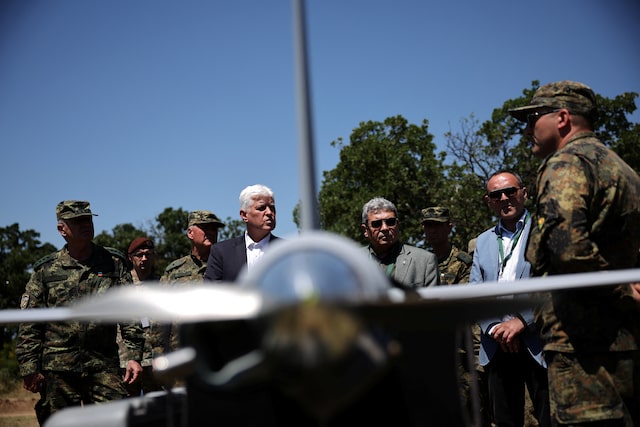
The decision, announced on October 16, 2026, reflects growing concerns that drone warfare associated with the Russia-Ukraine conflict is threatening international maritime trade and the security of NATO’s southeastern flank.
Bulgarian Defence Minister Dimitar Stoyanov confirmed that Sofia had submitted requests to NATO Secretary General Mark Rutte and the alliance’s Supreme Allied Commander, seeking additional military capabilities and deployments on Bulgarian territory.
The appeal followed several incidents involving commercial ships near the Bulgarian and Romanian coasts. On October 13, a drone attack sank a cargo vessel off Bulgaria, while two other ships caught fire following attacks near Romania earlier this week.
Bulgaria has also proposed a moratorium on attacks against civilian shipping in the Black Sea and expects to join a NATO counter-drone initiative before the end of October.
News.Az examines the reasons behind Bulgaria’s request, the growing threats to maritime security, NATO’s possible response and the implications for regional stability and international trade.
Why has Bulgaria formally requested additional NATO military protection?
Bulgaria has requested NATO assistance following a series of drone attacks that have exposed vulnerabilities in the country’s maritime and aerial defence capabilities.
On October 16, Defence Minister Dimitar Stoyanov announced that Sofia had formally asked the alliance to deploy additional combat aircraft and counter-drone systems to Bulgarian territory.
The request was submitted to NATO Secretary General Mark Rutte and the Supreme Allied Commander, with Bulgaria awaiting a response.
Stoyanov explained that the proposed reinforcement would strengthen national defence capabilities and improve protection against aerial threats approaching from the Black Sea.
The decision follows attacks on commercial shipping that have raised questions about the ability of coastal states to detect and intercept drones operating near their territorial waters.
Bulgaria’s security concerns are particularly significant because the country forms part of NATO’s southeastern flank and shares the Black Sea with Romania, Turkey, Ukraine, Russia and Georgia.
The proximity of military operations associated with the Russia-Ukraine conflict has increased the risk of dangerous incidents involving civilian vessels.
Sofia is also seeking closer cooperation with neighbouring NATO members to improve regional surveillance and defensive coordination.
However, the deployment of additional alliance forces has not yet been approved.
Bulgaria’s request represents a preventive security measure intended to strengthen deterrence, improve response capabilities and reduce the risks facing commercial shipping and coastal infrastructure.
What happened to the commercial ships attacked by drones in the Black Sea?
The latest security concerns intensified after several commercial vessels were attacked by drones near the Bulgarian and Romanian coasts during October.
On October 13, the Guinea-Bissau-flagged cargo ship HS Dignity sank near Krapets, a Bulgarian coastal settlement close to the Romanian border.
Eleven crew members were reported missing following the incident, prompting search and rescue operations.
Another vessel, the Malta-flagged Chelsea-3, was also struck, although all 15 crew members survived.
Additional attacks occurred near Romania, where two commercial vessels caught fire after being hit by drones on October 15.
The incidents have raised concerns about the safety of merchant crews operating in waters previously considered relatively distant from the principal naval confrontation between Russia and Ukraine.
Bulgarian authorities summoned Russia’s ambassador following the sinking, reflecting Sofia’s concerns about the possible origin of the attacks.
However, the precise responsibility for the incidents has not been conclusively established through publicly available evidence.
Bulgarian officials have suggested that Russia could benefit strategically from disruptions to Black Sea shipping, while Moscow’s diplomatic representatives have denied knowledge of the attacks and raised the possibility of third-party provocations.
The incidents illustrate the vulnerability of commercial vessels to relatively inexpensive unmanned systems.
They have also increased pressure on regional governments to strengthen maritime surveillance, improve emergency response coordination and develop effective protection measures for civilian shipping.
How could NATO strengthen Bulgaria’s air defence and counter-drone capabilities?
NATO could respond to Bulgaria’s request through additional aircraft deployments, counter-drone equipment and closer coordination of existing regional defence systems.
Modern counter-drone operations require several interconnected capabilities, including early detection, identification, tracking and interception.
Radar systems can help detect approaching unmanned aircraft, while electronic warfare equipment may disrupt certain drones’ communications or navigation systems.
Other defensive options include interceptor drones, ground-based air defence weapons and specialised systems designed to engage smaller aerial targets.
Combat aircraft could provide additional surveillance and interception capacity, particularly when threats approach NATO-controlled airspace.
However, the effectiveness of these measures depends on the type of drone, its flight characteristics, the operating environment and the rules governing military responses.
Bulgaria expects to join NATO’s counter-drone initiative before the end of October, potentially improving access to shared technologies, operational expertise and coordinated defensive arrangements.
The alliance has increasingly prioritised protection against unmanned aircraft because of lessons emerging from the war in Ukraine.
Drone warfare has demonstrated that relatively inexpensive systems can threaten valuable military assets, critical infrastructure and commercial vessels.
NATO members are therefore seeking ways to integrate counter-drone technologies into wider air defence networks.
For Bulgaria, additional capabilities could improve both national protection and cooperation with neighbouring allies.
Nevertheless, any new deployment would require coordination within NATO and consideration of operational requirements, available equipment and the broader regional security situation.
Why is Black Sea maritime security becoming a major concern for NATO?
The Black Sea has become an increasingly important security concern for NATO because of its role in regional trade, energy transportation and the ongoing Russia-Ukraine conflict.
Three NATO members — Bulgaria, Romania and Turkey — have coastlines along the sea, placing the alliance directly alongside a region affected by sustained military operations.
Since Russia launched its full-scale invasion of Ukraine in February 2022, Black Sea shipping has faced threats involving naval mines, missiles, drones and attacks on port infrastructure.
The latest incidents near Bulgaria and Romania suggest that commercial vessels may face risks even when operating away from the most heavily contested maritime areas.
This creates challenges for regional governments seeking to protect economic activity while avoiding a wider military confrontation.
The Black Sea is particularly important for transporting grain, petroleum products and other commercial cargoes.
Disruptions to shipping routes can affect exporters, importers, port operators and international insurance companies.
Attacks near NATO members also raise questions about the alliance’s responsibility to protect its territory and respond to threats.
However, incidents occurring in international waters or exclusive economic zones do not automatically trigger NATO’s collective defence provisions.
Any decision concerning collective defence would depend on the circumstances of the incident and consultations among alliance members.
Bulgaria’s request for stronger protection therefore reflects concerns about deterrence, maritime safety and preventing further escalation.
Maintaining secure shipping corridors remains a shared interest for regional states, even as their security priorities differ.
Could Bulgaria’s NATO request lead to stronger regional cooperation and new maritime security measures?
Bulgaria’s request could accelerate discussions about a more coordinated NATO approach to countering drone threats in the Black Sea.
Defence Minister Dimitar Stoyanov has announced plans to meet his Romanian and Turkish counterparts to discuss joint action and develop a common response to the deteriorating security environment.
The three countries already cooperate on maritime security matters, including efforts to address risks created by naval mines and other hazards associated with the Russia-Ukraine war.
Expanded cooperation could involve additional information sharing, coordinated aerial surveillance, maritime monitoring and joint defensive exercises.
Bulgaria has also proposed a moratorium on attacks against civilian vessels, emphasising the need to separate commercial shipping from military confrontation.
Such an arrangement would require cooperation from the relevant parties and credible mechanisms to monitor compliance.
The involvement of NATO could strengthen regional defensive capabilities, but it would not necessarily eliminate the risk of further attacks.
Drones can approach from different directions, operate at low altitudes and present identification challenges, particularly in congested maritime environments.
Another consideration is the potential economic impact of continued insecurity.
Repeated attacks could increase insurance costs, disrupt shipping schedules and discourage vessels from using certain Black Sea routes.
For NATO, the challenge will be to strengthen deterrence and protect member states without unnecessarily expanding the military confrontation.
The alliance must also consider the safety of commercial crews and the importance of maintaining international maritime access.
Ultimately, Bulgaria’s appeal for NATO combat aircraft and anti-drone systems highlights the changing security environment in the Black Sea. As unmanned weapons increasingly threaten civilian shipping, effective regional cooperation, stronger defensive infrastructure and measures to prevent escalation will be essential to protecting maritime trade and maintaining stability along NATO’s southeastern flank.