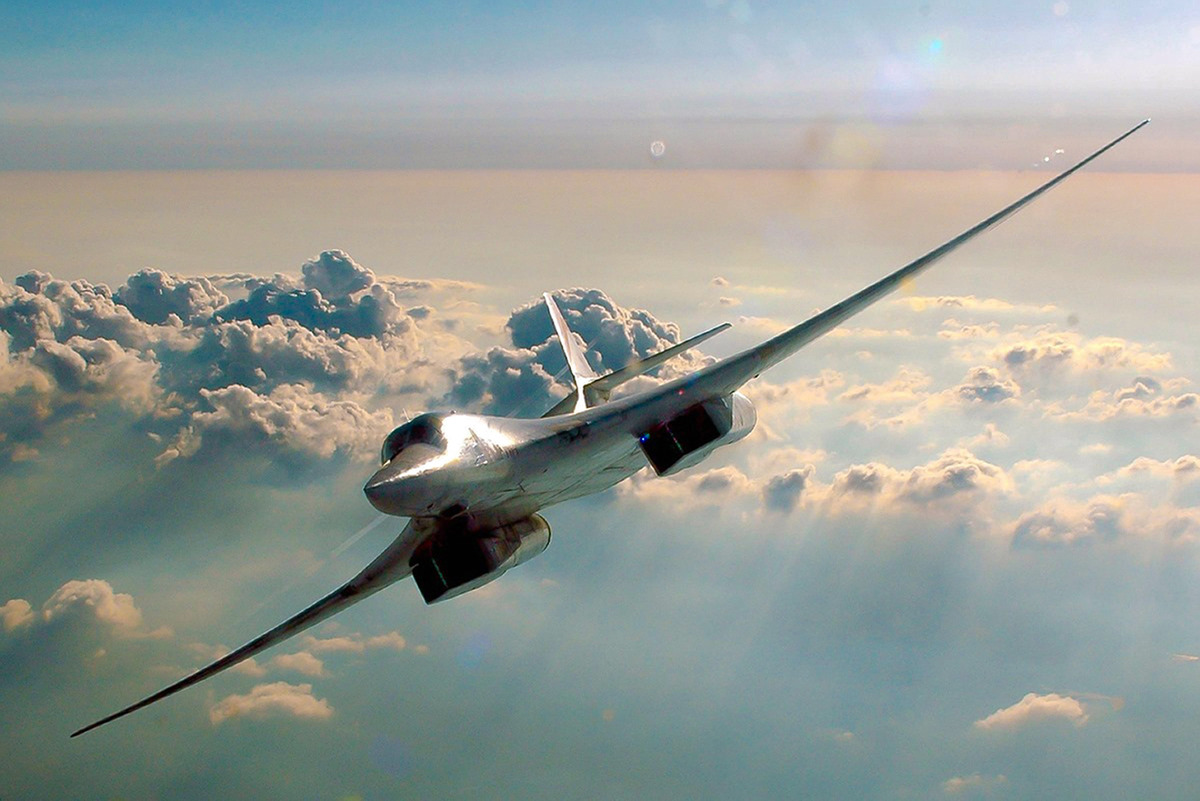
Two advanced NATO fighter jets shadowed Russian bombers capable of carrying long-range nuclear weapons during what Moscow called a scheduled training flight in the closely-watched Arctic region on Monday.
Although NATO countries frequently scramble jets when they detect Russian aircraft flying close to alliance airspace, nuclear-capable bombers skirting near NATO territory is generally seen as an intimidation tactic—particularly in the Arctic, where NATO is concerned about an increasing Russian and Chinese presence.
Russia‘s defense ministry said several of its Tu-160 supersonic bombers carried out a practice flight over the Barents and Norwegian Seas on Monday.
The strategic bombers were accompanied by Russian MiG-31 fighter jets on the 16-hour flight through international airspace, Moscow said.

In this undated photo released on April 13, 2021, by the Russian Defense Ministry Press Service, a Tu-160 strategic bomber of the Russian air force is shown on a training mission over an undisclosed location in Russia.
“At certain stages of the route, the strategic bombers were escorted by fighters from foreign countries,” the Russian government said, without specifying further.
A senior NATO military official told Newsweek two Norwegian F-35s responded to the incident.
Footage published by Russian authorities appeared to show at least one F-35 alongside the Russian aircraft.
Norway, a NATO member, has more than 50 F-35s, a handful of which are based at the Evenes Air Station in the north of the Nordic nation, looking out onto the Norwegian and Barents Seas.

Norwegian F-35 Lightning fighters are seen during the Arctic Challenge Exercise at Orlandet air station, Norway, on June 1 2023.
Norway shares about 120 miles of land border with Moscow, with Norwegian soil stopping not far west of major Russian military bases clustered around the Arctic cities of Murmansk and Severomorsk, which are home to the all-important strategic nuclear submarines the Kremlin would deploy in a nuclear conflict.
Norway has long had what it calls a “quick reaction alert,” meaning Oslo always has a pair of F-35s ready to scramble at any moment if they detect an unfamiliar aircraft.
The Norwegian military says it typically carries out around 40 quick reaction alert missions each year on NATO’s behalf, and the two F-35s are ready to be in the air within 15 minutes.
F-35s are American-made fifth-generation fighter jets, which is currently the most sophisticated type of jet in operation. Jets known as sixth-generation aircraft—which will be harder for enemies to pick up on radar systems, have more up-to-date systems and build drones closely into how they work—are still in the early development stages.
Roughly a third of NATO’s member countries have bought or ordered F-35s.
The Arctic is the region of the world most impacted by climate change, with melting ice opening up new routes for both military and civilian traffic.
Most of the eight Arctic states are NATO members, but Russia is the region’s dominant nation. Moscow is well-accustomed to operating in the austere, unforgiving conditions of the Arctic; it has built cities with a significant civilian population, rather than just remote, military-focused outposts, above the Arctic Circle.
The Kremlin has been busy reopening Soviet-era bases and building new facilities in the Arctic, while China has declared itself a “near Arctic” state.
Contact Newsweek editors on this story: Frances Mao and Tony Phillips
Related Articles