
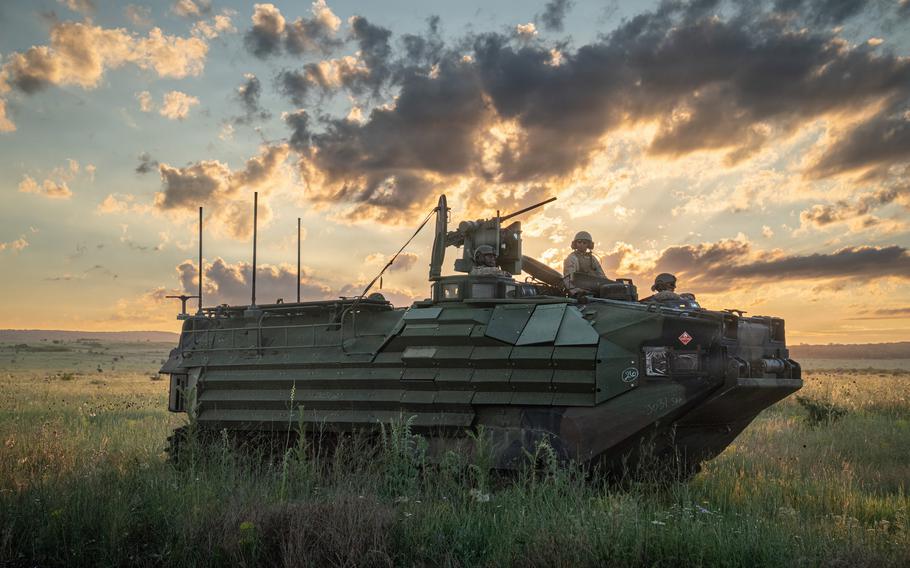
A U.S. Marine Corps assault amphibious vehicle is seen at Babadag Training Area, Romania, on June 15, 2026. The vehicle, known as Trax, will soon be retired after more than 50 years of service. (Noah Masog/U.S. Marine Corps)
An iconic tracked amphibious vehicle that has carried Marines ashore from Lebanon to Iraq made a final Corps appearance recently in Romania.
The battle-tested combat vehicle known as Trax will soon be retired after more than 50 years of service and handed to allies with a new mission: defending the Black Sea region from Russia.
Exercise Sea Breeze 26, which wrapped up in late June, marked the vehicle’s last operational use, Marine Corps Forces Europe and Africa said in a statement Thursday.
For the Marines who have trained and fought in the vehicle over the decades, the Romania drill was a bittersweet sendoff.
“This has been my home since I started in the Marine Corps… 22 years I’ve lived on this vehicle,” Master Sgt. Daniel Porter said in the statement.
The Assault Amphibious Vehicle-P7/A1 entered Marine Corps service in 1972. Over the years, it has received modifications but largely remained the same, the Corps said.
The AAV has long served as the backbone of the Marine Corps’ ambitious assault mission, seeing combat in Lebanon in 1982 and during the Iraq War.
At Sea Breeze 26, the AAV took part in a wide range of missions and was tested against the realities of modern warfare. The vehicle maneuvered through a drone-saturated battlefield, facing threats unrecognizable to earlier generations of Marines known as “Amtrackers.”
“We want our adversaries to see the very distinct fact that we can pull seven nations together overnight, create a battalion staff, integrate, and start executing missions within hours,” said Lt. Col. Nishan Campbell, the battalion commander of 4th Assault Amphibian Battalion.
The Marine Corps’ amphibious mission will soon employ a new combat vehicle designed to better serve the evolving nature of warfare, the Corps said.
But Trax will live on with a new mission in the Black Sea region as the Marines hand the vehicle off to NATO counterparts from multiple nations.
“The smell of the ocean prior to doing amphibious ops is intoxicating,” Campbell said. “I’m going to miss hearing that heater fire up while the infantry are freezing outside.”