
If politics makes strange bedfellows, then surely trade policy creates its own weird pairings. Restrictions to market access in the form of tariffs and other levies have given a unique advantage to those with production capacity in the United States. Unsurprisingly, Stellantis continues to be the most polyamorous of automakers.
The Morning Dump is starting off with a stretch, albeit a small one. JLR and Stellantis have signed a deal to discuss co-developing cars in the US, giving the former access to un-tariffed production. Stellantis has also started a JV with Chinese automaker Dongfeng, which will help Stellantis use its underutilized factories in Europe.


Not like having a factory is easy. In South Texas, an independent analysis claims to have found potentially carcinogenic chemicals in a drainage ditch used by Tesla’s battery facility. In Hungary, a new government has found that BYD might have transported toxic soil against regulations in the building of its factory there.
Can’t life just be easier? Perhaps it will be one day. “Hey, Google, can I park here?” is the question you might be asking your Volvo soon to help make parking simpler.
Stellantis And JLR Sign An MOU for US Something, Something
 Photo credit: Land Rover
Stellantis has to convince investors it continues to be a good bet after all the, you know, Carlos Tavares (not pictured) drama. It’s going to be a tough market for cars, and the timing of the turnaround is bad, so one way to cover for this is to help show that the company can make deals to help use all of its plants and lower its development costs.
Let’s start with the big one, via Bloomberg:
Stellantis NV plans to develop cars with Jaguar Land Rover in the US, the latest step in a deep overhaul for the maker of Jeep sport utility vehicles and Ram trucks.
Both companies will explore opportunities to collaborate on product development in the country, they said Wednesday. It’s the first deal Stellantis Chief Executive Officer Antonio Filosa is striking in the US, a lucrative market the company is prioritizing.
But why, tho?
The latest deal may eventually give JLR, which is owned by India’s Tata Motors Passenger Vehicles Ltd., access to Stellantis factories in the US. That would allow the British luxury-car maker to sidestep import tariffs in its largest market.
Neither JLR nor Stellantis are commenting further, but it makes a lot of sense. The UK has a decent trade agreement with the United States, but if Land Rover wants to expand its product lineup it’s going to have to find somewhere to build more cars and who knows where else is going to work. With the US being a huge market for JLR it is logical to do something here, and not having to develop an entirely new facility makes sense.
Could we get the return of the Freelander? Could Discover production move here on a platform shared with Jeep? Is this just about powertrains? It’s not clear that Stellantis or JLR even have an answer these questions. Of all the brands, though, it seems like Jeep maybe has the most potential capacity. Could Warren–which builds the Jeep Grand Wagoneer–be used to also make Discovers?
Over in Europe, Stellantis is tying up with Chinese automaker Dongfeng, as Reuters reports:
Stellantis NV and China’s Dongfeng plan to form a joint venture in Europe, including potential production in France, the companies said on Wednesday, offering another glimpse into the French-Italian automaker’s longer-term strategy.
The two groups signed a preliminary agreement that will cover sales and distribution, manufacturing, purchasing and engineering activities focused on Dongfeng’s new energy vehicles. The JV will be owned 51% by Stellantis and 49% by Dongfeng.
Huh. Stellantis has a JV with Leapmotor to build small EVs in Europe, right? Dongfeng has a deal to make Nissan products. Everyone is in bed with everyone until all of this gets worked out, I guess.
Tesla And The Drainage Ditch
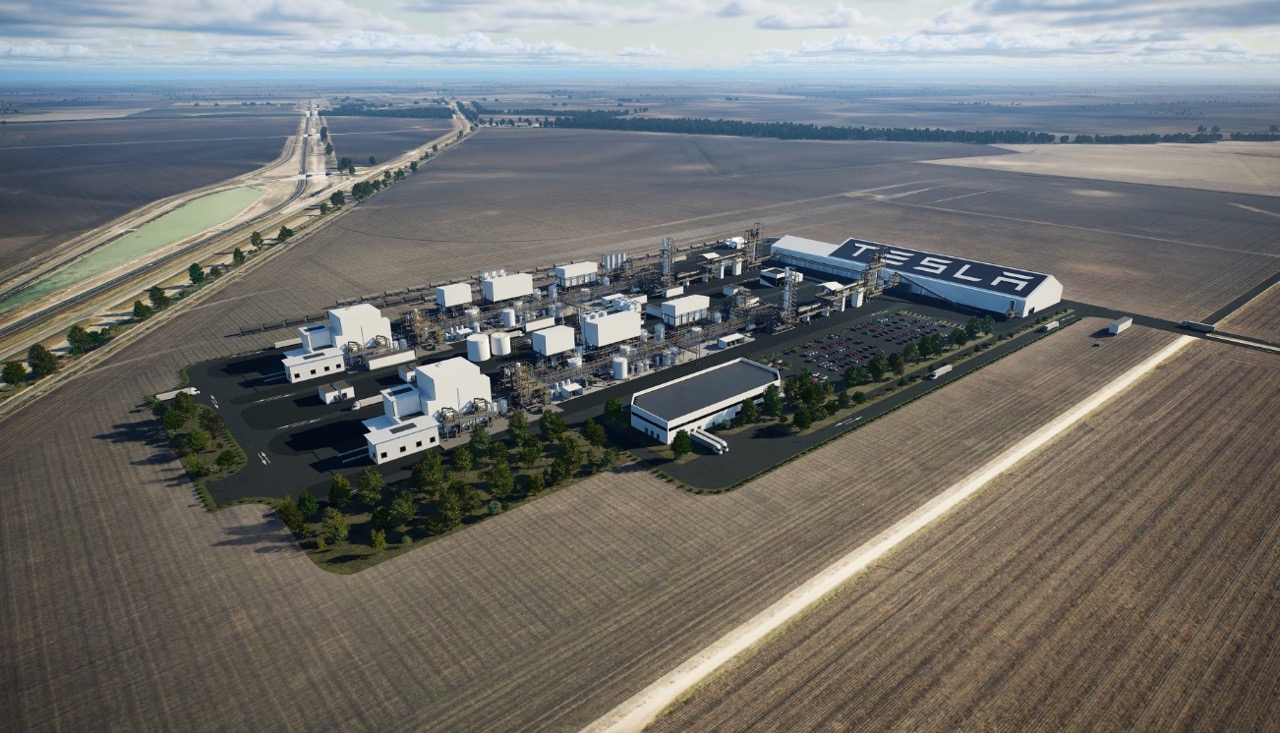 Source: Tesla
The rendering above of Tesla’s Lithium Refinery in the far western suburbs of Corpus Christi hits me hard. That’s where I’m from. That’s where I have my first memories. That endless, low sky and corn tortilla flat plain is forever the landscape of my mind.
When I heard that Tesla was opening up a facility to source lithium down there I thought it was generally not a bad thing. South Texas is almost indefinitely short on industry and the US is desperately behind in producing both the anode and cathode precursors necessary for modern battery manufacturing.
The situation in Corpus is quite desperate as they’re running out of water, which is a thing necessary to keep people alive. Some of this is just drought and some of it, maybe, is data centers. Either way, it’s bad. Water is precious, as you need water to make the aforementioned tortillas.
So this, via the Texas Tribune, ain’t great:
After Texas regulators said Tesla’s lithium refinery near Corpus Christi wasn’t violating its permits by discharging what local officials reported as black wastewater into a drainage ditch, independent water testing there this month found two toxic metals and other contaminants.
Eurofins Environment Testing, an accredited lab with locations across the globe, reported traces of hexavalent chromium, a well-known carcinogen, and arsenic, an environmental poison. Nueces County Drainage District No. 2, which manages the ditch, commissioned the test.
Neither hexavalent chromium nor arsenic is included as an allowable discharge pollutant in Tesla’s wastewater permit.
The Nueces County Drainage District No. 2 sent a cease and desist letter to the company, though so far nothing has changed and the state agency responsible for monitoring this sort of thing hasn’t done anything. Here’s a line that’ll make you less nostalgic:
Nueces County groundwater is known to contain some arsenic, said Chris Cuellar, a retired chemical plant worker who spent 10 years managing wastewater operations at one of the region’s largest industrial facilities. Eurofins tested the wastewater from the ditch, rather than from Tesla’s outfall pipe, so it’s possible there was residual arsenic from a nearby pond overflow that leached into the ditch, for example, rather than coming from the industrial process itself, Cuellar said.
Yikes. Lithium production is incredibly important and in a normal place, various agencies would investigate it, figure out what’s going on, and then the company would mitigate the issue if one existed. Something like this happens with basically every car-related manufacturing facility at some point.
Texas isn’t a normal place politically speaking and Tesla in general is averse to doing things the regular way. How this gets resolved, or if this gets resolved, is unclear, but Autonocion does frame the central question pretty well:
None of this is illegal as currently constituted, because the permit that was written does not require monitoring for the things the independent lab found.
What it should do, for any American driver whose next EV is going to be built around domestically refined lithium, is force a real conversation about what “clean lithium” actually means and who gets to define it.
Is Clean Lithium the new Clean Coal?
Hungarian Police Are Investigating BYD Over Environmental Issues
 Source BYD
BYD is sure having a hard time building plants outside of China. In Brazil, the company got in a spot of bother of the implication that it was forcing people to work in terrible conditions. And now, in Hungary, the company is in trouble for potentially not following environmental regulations.
The probe relates to the movement of toxic soil from BYD’s construction site in the southern city of Szeged to an outside location, the police said in a statement on Wednesday, according to the MTI state news service.
The move suggests Prime Minister Peter Magyar’s administration is taking environmental concerns in the country’s burgeoning EV industry seriously after they were relegated under his predecessor Viktor Orban. Battery makers Contemporary Amperex Technology Co. Ltd. and Samsung SDI have also faced scrutiny.
The police action was announced a day after newly installed Environment Minister Laszlo Gajdos said BYD was in “serious breach” of its environmental permit and called on the company to “immediately stop” polluting activities. The new Hungarian government has vowed to make the enforcement of green regulations a priority for the EV industry.
Elections have consequences.
Google And Volvo Might Help You Park Your Car
 Image: Volvo
Google had its big series of announcements this week, and most of it had to do with more AI. If you love AI and would like for more websites to die, this is great news for you (if you enjoy TMD, please become a member).
Volvo’s CEO mentioned in a chat earlier this week that I attended that he was looking forward to a new tool being announced by Google and Volvo that could, eventually, read road signs and help you figure out where you can park:
As part of a world first, Volvo Cars and Google will demonstrate Google Gemini vehicle camera integration in the EX60, at Google I/O conference (May 19-20). This paves the way for a future where, with the driver’s permission, Gemini will be able to see and understand its surroundings from the perspective of the car in real time.
This will enable a more helpful driving experience for things like recalling a road sign, making sense of lane markings or simply asking for more information about a landmark or a restaurant.
Take parking as an example. By reading and interpreting parking signs in real time, the system helps drivers quickly understand restrictions, time limits, permit requirements or charging rules. Instead of second-guessing whether a space is valid, drivers receive clear guidance exactly when and where they need it.
Who will be the first person to blame a parking ticket on AI? I can’t wait.
What I’m Listening To While Writing TMD
It’s Skin Cancer Awareness Month and our friends at XPEL are celebrating with National Don’t Fry Day, so I’m going to do a week of beach songs. Today, it’s Lana Del Rey’s cover of “Doin’ Time.”
Observed annually on the Friday before Memorial Day, National Don’t Fry Day raises awareness about the dangers of ultraviolet (UV) radiation and promotes sun-safe habits as Americans head into summer. In recognition of the occasion, XPEL is offering 15% off automotive window tint installations at participating authorized dealers and company-owned stores across the U.S. on May 22 only.
The Big Question
What should Land Rover build here next?
Top photo: Stellantis