
Stellantis’ 2026 Annual General Meeting (AGM) wasn’t just another corporate update—it was a moment of reflection, accountability, and recalibration. After a year marked by financial losses, internal restructuring, and a shifting global strategy, the company’s leadership laid out a clear narrative: Stellantis lost its way, especially in key markets such as North America, and is now working to get back on track.
The tone from both Chairman John Elkann and CEO Antonio Filosa was notably candid. There was no attempt to spin 2025 as anything other than what it was—a difficult year that forced the company to rethink how it operates, what it builds, and who it’s building for.
Elkann: A Year That Forced Stellantis To Look Inward
 Stellantis Chairman John Elkann. (Stellantis).
John Elkann opened with a straightforward acknowledgment of how difficult 2025 was for Stellantis, framing it as a year that forced the company to confront both internal issues and external pressures head-on.
“The past year was a very difficult one for Stellantis,” Elkann said. “In the face of internal and external issues, we took decisive steps to simplify our organization, reconnect with customers, and position the Company for more durable, profitable growth in a rapidly evolving industry.”
He explained that during his time as acting CEO in the first half of the year, the company operated at an intense pace to stabilize operations and refocus priorities.
“I spent the first half of the year serving as acting Chief Executive Officer, working at a demanding yet energizing pace alongside all colleagues across the Company,” he noted.
Elkann emphasized that Stellantis had to address internal inefficiencies while also navigating external challenges such as tariffs, regulatory complexity, and intensifying competition.
“Together, we focused on addressing our own strategic and operational challenges while also responding to external pressures,” he said.
He also highlighted the leadership transition, noting that Antonio Filosa’s appointment reflects a focus on execution and operational expertise.
“In May 2025, our Board of Directors unanimously selected Antonio Filosa as CEO, reflecting his deep understanding of the Company,” Elkann said.
Under this leadership, Stellantis is shifting toward a more balanced product strategy. Elkann pointed to the launch of 10 new vehicles across multiple powertrain types as evidence of a broader “freedom of choice” approach.
“With this team in place, we are laying the foundation for renewed momentum… giving customers true freedom of choice across gas, battery-electric, and hybrid powertrains,” he explained.
He reinforced that these changes are rooted in customer feedback.
“We also listened closely to our customers and acted,” Elkann added.
Looking ahead, Elkann struck a balanced tone between realism and confidence.
“Stellantis enters 2026 with humility about the challenges ahead and confidence in our capabilities,” he concluded, emphasizing a focus on “transparent, credible targets” and disciplined execution.
Filosa: A Blunt Assessment and a Clear Reset
 Stellantis CEO Antonio Filosa. (Stellantis).
Antonio Filosa’s remarks focused on accountability and the steps Stellantis is taking to realign the business. He made it clear that the company’s reset is centered on putting customers back at the core of every decision.
“The past year has been one of important change and decisive action for Stellantis,” Filosa said. “And one principle has guided every decision we have made: putting our customers and their real-world needs back at the heart of everything we do.”
He described 2025 as a turning point shaped by both external pressures and internal challenges, as Stellantis worked to reposition itself for long-term growth.
Filosa directly addressed Stellantis’ biggest misstep—overestimating EV adoption—and how it created a disconnect with buyers.
“We must have the humility to recognize that we significantly overestimated the pace of adoption of this new technology… and, in doing so, distanced ourselves from the needs, means, and desires of too many of our customers,” he said.
He also acknowledged that execution issues made the situation worse.
“The impact of this overestimation was also compounded by poor operational execution,” Filosa added.
To fix that, Stellantis conducted a full review of its operations and strategy, leading to a company-wide realignment.
“We went deep into every corner of our business… realigned our Company with customer preferences and market realities, and began addressing those execution gaps,” he explained.
Those changes came at a significant cost. Stellantis recorded approximately €22 billion (about $26.4 billion USD) in restructuring charges—something Filosa described as necessary to reset the business.
“These were the cost of the painful yet necessary changes we made to return our Company to long-term profitable growth,” he said.
Despite that hit, Filosa pointed to early signs of progress. In the second half of 2025, Stellantis returned to growth, driven by stronger demand and improved product quality.
“We returned to volume and net revenue growth… with increases in customer and dealer orders, as well as promising initial improvements in product quality,” he noted.
He also highlighted structural changes, including giving regional teams more authority to respond to local markets—something especially important for North America.
“We re-empowered regional teams to make decisions closer to the customers they know and serve best,” he said.
Looking ahead, Filosa made it clear that 2026 will be about execution and measurable improvement.
“In 2026, we aim to improve Net revenues, margins, and cash flows while maintaining our balance sheet strength,” he stated.
He closed with a message of unity and confidence:
“We are one team, and together we will win.”
North America: The Core Market Under Pressure
 Stellantis 2026 Annual General Meeting Presentation. (Stellantis).
North America remains Stellantis’ most important region by a wide margin, both in revenue and strategic importance. But it’s also where the company saw some of its biggest challenges in 2025.
The numbers reflect that clearly. Stellantis generated €60.9 billion (about $66.5 billion USD) in revenue from North America in 2025, down from €63.4 billion ($69.2 billion USD) in 2024. At the same time, adjusted operating income dropped sharply into the negative at €1.9 billion (-$2.1 billion USD), compared with €2.7 billion ($2.9 billion USD) the year prior.
Shipments, however, told a slightly different story. Volume actually increased to 1.472 million units, up from 1.432 million in 2024.
That contrast—higher volume but lower profitability—is key. It suggests Stellantis had to rely more heavily on incentives, pricing adjustments, or a less favorable mix to move vehicles in the region.
From a broader perspective, North America highlights the core issue Stellantis leadership addressed during the AGM: execution and alignment with customer demand. The company still has strong volume and scale here, but profitability took a hit, reinforcing why this region is central to the turnaround strategy.
Key Takeaways:
€60.9B ($66.5B USD) revenue, down year-over-year
-€1.9B (-$2.1B USD) operating income (major swing from profit)
1.472M shipments, showing stable demand
Enlarged Europe: Stable Volume, Profitability Pressure
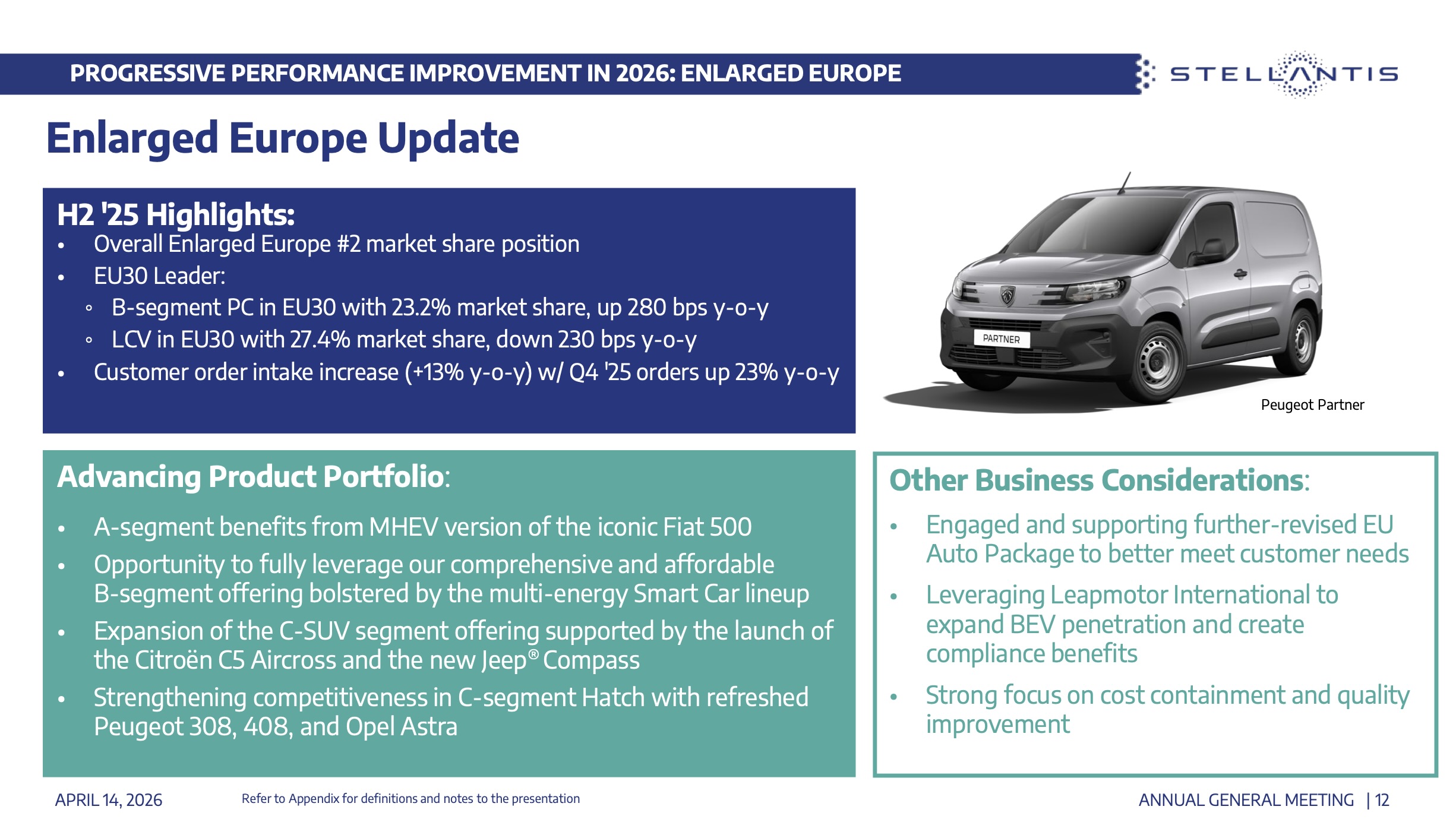 Stellantis 2026 Annual General Meeting Presentation. (Stellantis).
Europe remains Stellantis’ second-largest region, and while the company maintained a strong competitive position, financial performance declined in 2025.
Net revenues came in at €57.8 billion (about $63.1 billion USD), down from €59.0 billion ($64.4 billion USD) in 2024. Adjusted operating income also fell into negative territory at -€651 million (about -$710 million USD), compared to €2.4 billion ($2.6 billion USD) the year before.
At the same time, shipments decreased slightly to 2.49 million units from 2.576 million.
From a market standpoint, Stellantis held its position as the second-largest automaker in the EU30 with a 16% market share.
This region shows a similar pattern to North America—solid scale and competitive positioning, but pressure on profitability. The difference is that Europe’s challenges are more tied to regulatory complexity and competitive pricing environments.
 Stellantis 2026 Annual General Meeting Presentation. (Stellantis).
South America: A Consistent Bright Spot
South America continues to stand out as one of Stellantis’ most stable and profitable regions.
Revenue increased slightly to €16.2 billion (about $17.7 billion USD), up from €15.9 billion ($17.3 billion USD) in 2024. Adjusted operating income remained strong at €2.0 billion (about $2.2 billion USD), even though it dipped slightly from €2.3 billion ($2.5 billion USD) the year prior.
Shipments rose to 1.0 million units, up from 912,000.
On the market side, Stellantis maintained a dominant position, with a 22.6% market share across the region and nearly 1 million vehicles sold.
South America shows what Stellantis can achieve when its strategy aligns well with market demand—strong share, solid profitability, and steady growth.
Middle East & Africa: Modest Growth, Slight Share Decline
The Middle East & Africa region delivered modest gains in 2025, though with some pressure on market share.
Revenue came in at €9.7 billion (about $10.6 billion USD), down slightly from €10.1 billion ($11.0 billion USD) in 2024. Adjusted operating income remained positive at €1.4 billion (about $1.5 billion USD), though lower than €1.9 billion ($2.1 billion USD) the previous year.
Shipments increased to 453,000 units from 423,000.
Regionally, Stellantis sold 541,000 vehicles and held a 12.2% market share, slightly down from 12.4% in 2024.
The report notes that the slight decline in share was driven by factors like production changes in Turkey and ramp-up challenges in Algeria, despite overall industry growth.
China, India & Asia Pacific: Small but Stable
This region remains a relatively small part of Stellantis’ global footprint.
Revenue totaled €1.87 billion (about $2.0 billion USD), slightly down from €1.99 billion ($2.2 billion USD). Adjusted operating income improved to €74 million (about $80 million USD), compared to a loss the previous year.
Shipments held steady at 61,000 units.
While small in scale, this region shows signs of stabilization rather than major growth or decline.
Big Picture: North America Drives the Turnaround
 Stellantis 2026 Annual General Meeting Presentation. (Stellantis).
Looking across all regions, the takeaway is clear: Stellantis’ global business is still anchored by North America, but that’s also where the company has the most work to do.
North America delivers the most revenue, but lost profitability
Europe remains large but under margin pressure
South America is the most consistent performer
MEA shows steady but modest gains
Asia Pacific remains small and stable
Everything ties back to what leadership emphasized during the AGM. Stellantis doesn’t necessarily have a demand problem—it has an execution and alignment problem, especially in North America.
And that’s exactly where the turnaround will be won or lost.
Shareholder Support and Leadership Stability Reinforce the Reset
 Stellantis 2026 Annual General Meeting Presentation. (Stellantis).
Beyond the strategy shifts and regional performance, Stellantis also used the AGM to solidify its leadership structure—and importantly, it did so with overwhelming shareholder support.
The company confirmed that shareholders approved, by a large majority, all resolutions submitted at the Annual General Meeting. That level of backing is significant, especially given the challenges Stellantis faced over the past year. It signals investor confidence as the company works through its reset.
As part of those approvals, John Elkann was re-elected as an Executive Director, while Robert Peugeot and Henri de Castries were re-elected as Non-Executive Directors. Stellantis also appointed Juergen Esser as a new Non-Executive Director. All members will serve a two-year term, reinforcing continuity at the board level during a critical period for the company.
The Board of Directors also reaffirmed its leadership structure. Elkann will continue as Chairman, Robert Peugeot remains Vice Chairman, and Henri de Castries continues in his role as Senior Independent Director, acting as Chair of the Board.
In addition, Stellantis confirmed the structure of its key governance committees.
The company also highlighted shareholder feedback on executive compensation, noting that the advisory vote on the Remuneration Report received 93.17% support under Dutch AGM regulations.
Taken together, these outcomes reinforce a key theme from the 2026 AGM: while Stellantis is in the midst of a major transformation, it has both leadership stability and strong shareholder backing as it executes its turnaround—especially in North America, where the stakes are highest.
Like this:
Like Loading…