
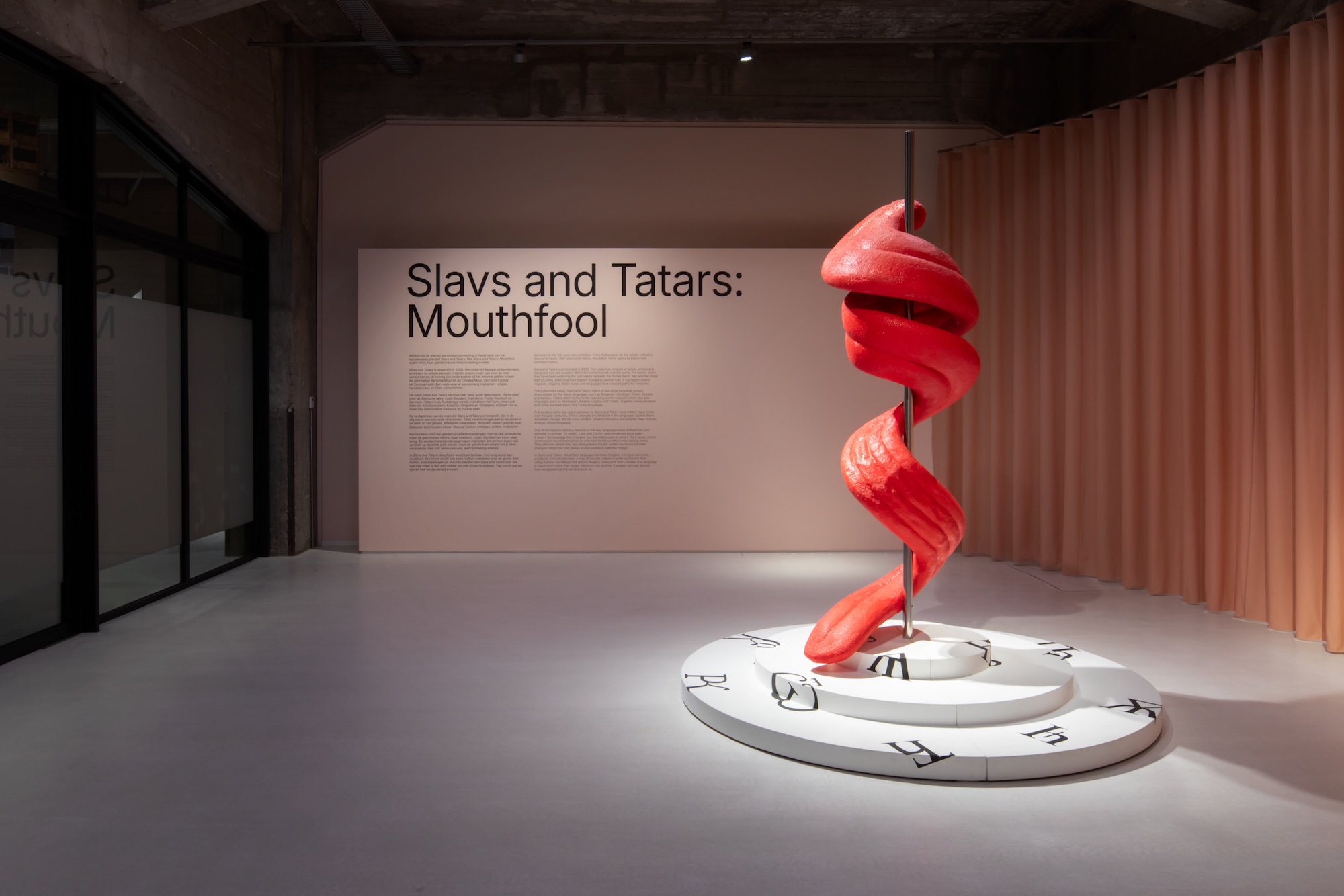
 Installation view of Slavs and Tatars, Mouthfool at Fenix, Rotterdam. Photo by Eddo Hartmann
What’s in a language? The way it’s written and spoken is often the only link back to the country where someone’s parents or grandparents were both born, giving extra weight to the term “mother tongue”. Yet it’s also a weapon used in colonialism to divide and forcibly assimilate people into empires. It’s these important questions that the collective Slavs and Tatars take on in their exhibition ‘Mouthfool’ at the Fenix Museum in Rotterdam, an excellent museum about migration.
There’s a playfulness to the exhibition as the first work that confronts us is a pole-dancing tongue. The tongue and mouth are what we use to eat, speak, kiss and emote. Similarly, migration is a story that can be told through speech, food, and love. The tongue sits at the centre of this concept and it ‘dances’ on a platform featuring letters from different alphabets, with the sounds of these letters being articulated in the space.
These letters also reference the impacts of Russian colonialism, which changed the alphabets of the Muslim countries it colonised, though it didn’t do so in the Christian countries; hence why Georgia retains its unique alphabet, while all the countries that used Arabic scripts now use either Latin or Cyrillic alphabets. The Russians didn’t have letters that corresponded directly to these Turkic languages, so they had to invent new letters to accommodate these sounds; these letters can be found at the base of the pole.
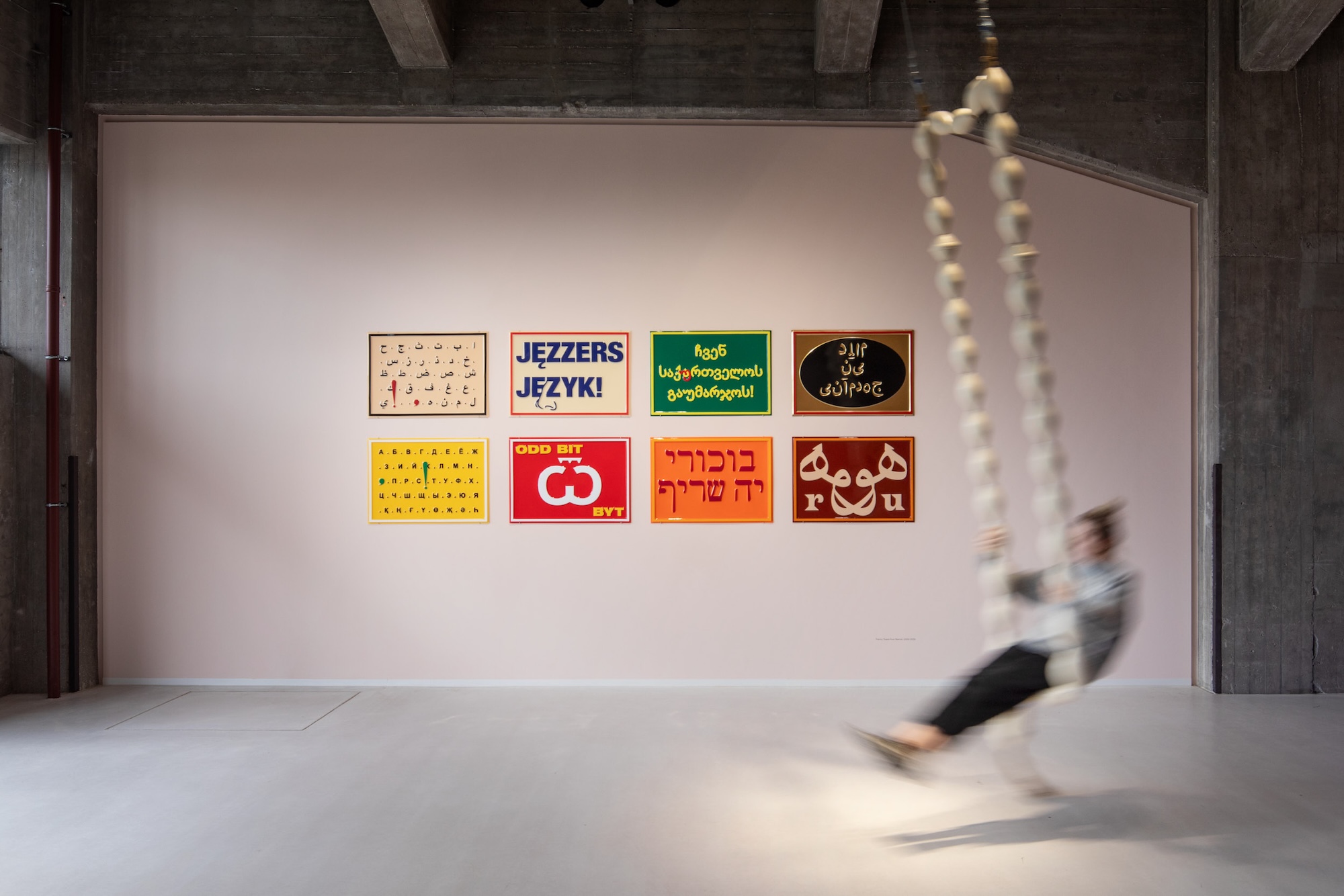 Installation view of Slavs and Tatars, Mouthfool at Fenix, Rotterdam. Photo by Eddo Hartmann
A textile work shows the parts of the lips, tongue, mouth, and throat required to enunciate certain letters, and a work with the Biblical verse ‘in the beginning was the word’ written in Arabic reminds us that religion isn’t tied to a specific language.
The play on words continues with the kitab kebab, where books are pierced, with kitab meaning “books” in many Indo-Turkic languages, and the fact that we digest the knowledge in books, much like we would the meat on a kebab. We get to swing on a giant set of prayer beads, and one work reads ‘to beer or not to beer’ in Arabic, relaying the difference in how this would carry much more weight in the Islamic world, where alcohol is largely forbidden, than it would with Westerners who would simply consider it a play on words.
The most fun is reserved for an experience in a separate installation, away from the main exhibition, where people can drive pedal-operated Ferraris through a maze while facing the wrong way; it takes a while to get the hang of it. It’s based on the humorous, folkloric character Nasruddin, who is common across many Central Asian cultures and is often depicted riding a donkey backwards. Just like that ‘wise fool ’, we’re invited to make a fool of ourselves in a playful experience.
 Slavs and Tatars, Molla’s Reverse Ride (2026). Mouthfool at Fenix, Rotterdam. Photo by Eddo Hartmann
The exhibition is fun and light-hearted, yet it manages to convey important elements of history that may not be so well-known in Western circles, which is the aim of the collective Slavs and Tatars: to draw more attention to the history and culture of the area East of the former Berlin Wall and West of the Great Wall of China.
After the enjoyment had subsided, it made me think about the power of language and how it has shaped the world around us. I remember as a child being confused by the many spellings of the name Muhammad (Mohamed, Mahomet, Mohammed), and not appreciating that it’s an Arabic name being forced into an alphabet that was never designed to accommodate it.
The museum also has a superb permanent collection filled with works that make us question how the world has been shaped by migration, and Slavs and Tatars is a fitting first-ever temporary exhibition for this excellent museum.
Slavs and Tatars: Mouthfool – 9th May 2027
Fenix, Rotterdam
CategoriesTagsAuthor 
Art Critic for both FAD and Londonist. See as many exhibitions as possible and write reviews, opinion pieces and a weekly top 5 for FAD.