
US Vice President JD Vance said Thursday that preventing a nuclear Iran was Washington’s second priority, with the first being to “keep oil and gasoline cheap for Americans.”
“That’s goal number one,” Vance told told Fox News. “And then, obviously, goal number two is ensure that Iran never gets a nuclear weapon.”
“I feel confident we’re accomplishing both of those goals, but it’s inherently an unpredictable thing, because the Iranians themselves are unpredictable, and they sometimes don’t honor the commitments they’ve made to us,” he added.
Asked on Fox News what the endgame with Iran looks like, Vance replied: “The thing I can say with confidence is I think this ends with the United States in a stronger position, with Iran not having a nuclear weapon, and with the Strait of Hormuz returned to a place where oil and gas prices are stable for the American people.”
“Sometimes we’re focused on the energy piece of it because we want Americans to be able to afford the price of oil and gas. Sometimes we’re obviously focused on the military nature of it. Sometimes we’re focused on the nuclear program,” said Vance.
Get The Times of Israel’s Daily Edition
by email and never miss our top stories
By signing up, you agree to the terms
The Strait of Hormuz had carried about a fifth of the world’s commercial oil shipments until the US and Israel launched the war on Iran on February 28, with the stated goal of destroying Iran’s nuclear program. Iran blockaded the waterway since early in the war, sparking a global rise in energy prices. The US responded in April with its own blockade on Iran-linked shipping.
Vance: That is goal number 1, keep oil and gas cheap for Americans all over our country. Goal number 2 is to ensure Iran never gets a nuclear weapon. I feel confident we are accomplishing both of those goals. pic.twitter.com/5terG0opqs
— Acyn (@Acyn) August 13, 2026
Bessent, Hegseth pledge continued blockade, despite reported sailor burnout
Vance’s comments came as other members of US President Donald Trump’s cabinet said Washington would punish Tehran with economic measures “never seen before,” and could keep blockading the Strait of Hormuz indefinitely, despite a planned military personnel swap there amid reports of sailor burnout.
On Newsmax, US Treasury Secretary said: “Watch this space for more announcements coming next week because we are going to apply measures like have never been seen in the history of economic isolation on a country.”
“It will be a combination of economic isolation like the world has never seen before, and the continued blockade in the Strait of Hormuz that will keep anything from going in or out of the Iranian ports,” Bessent said.
NEW: Bessent on Iran:
Watch this space for more announcements coming next week, because we are going to apply measures like have never been seen in the history of economic isolation on a country. pic.twitter.com/3JQvUocipH
— Clash Report (@clashreport) August 14, 2026
Echoing Trump’s own comments from the day before, US Defense Secretary Pete Hegseth told reporters in Panama that “indefinitely, the United States Navy can maintain a blockade like that because we’ll rotate ships in and out, as we have, and we’ll continue to.”
He added that reports about poor conditions aboard the aircraft carrier USS Abraham Lincoln, which has played a key role in the war with Iran, were “completely misrepresented.”
“We make sure every ship, every crew, every captain has everything we can provide them at every single moment,” Hegseth said. “Some deployments are longer than others, and I have more respect and gratitude for those sailors than anybody. What they do in those high seas, in those austere conditions, with less port calls — it’s incredible.”
The USS Abraham Lincoln has been deployed since November and was directed to the Middle East in January, amid simmering tensions with Iran.
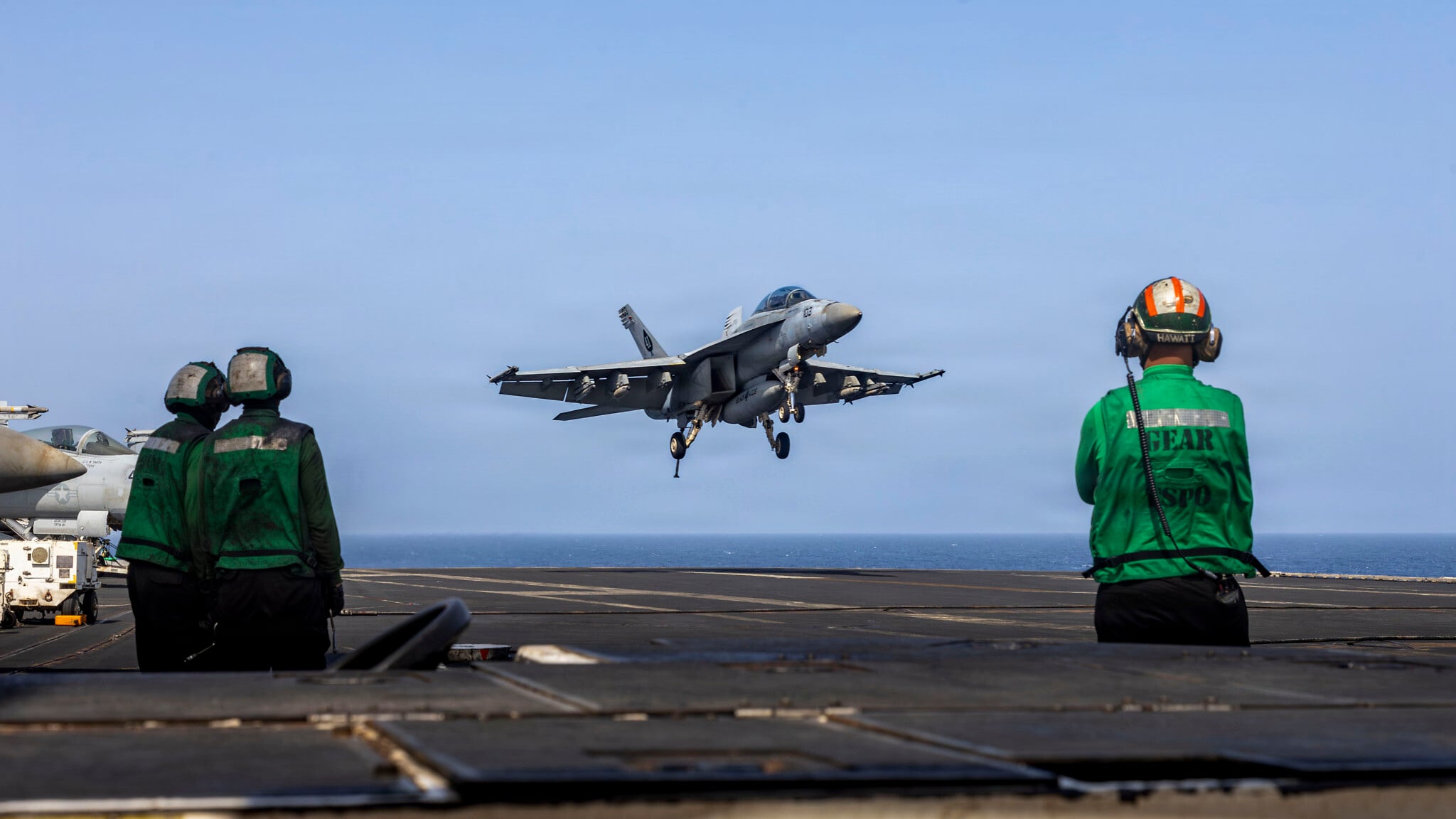
An F/A-18E Super Hornet lands on the flight deck of Nimitz-class aircraft carrier USS Abraham Lincoln (CVN 72), May 25, 2026, in the Middle East. (US Navy photo)
The aircraft carrier has reportedly not made a port call in over 200 days. Military Times, an independent news outlet that covers the US military, on Wednesday quoted families who said their loved ones aboard the USS Abraham Lincoln had tried to go overboard because of the strain.
With US lawmakers from both parties raising concerns about conditions on the USS Abraham Lincoln, The Wall Street Journal reported Thursday that the US was planning to replace it with another carrier, the USS George Washington.
However, US officials cited by the Journal said conditions aboard the USS Abraham Lincoln were not unusual for wartime, and that the swap with the USS George Washington was part of a previously scheduled rotation.
Iran demands compensation for oil spill from tanker it apparently attacked
Meanwhile, Tehran on Thursday demanded compensation for environmental damage in the strait following an oil spill from a tanker that was apparently attacked by Iran.
Iran has already demanded full compensation from the US for war damages to reopen the Strait of Hormuz, among other conditions Tehran unveiled on Saturday that punctured mediators’ hopes an agreement could be reached last week.
Iran’s foreign ministry spokesman Esmaeil Baghaei warned Thursday of environmental degradation to the Strait of Hormuz after an oil spill reached Iran’s southern Qeshm island.
The slick had “degraded the waters” of the Gulf and Sea of Oman, and “preliminary evidence indicates a foreign bulk carrier as the source,” Baghaei said.
But TankerTrackers, a US-hosted website that monitors shipping movements worldwide, said the spill seemed to derive from an Iranian attack on bulk carrier Minoan Pioneer in Omani waters on August 3.
“The spillage then drifted across the strait over to Iran,” the website said.
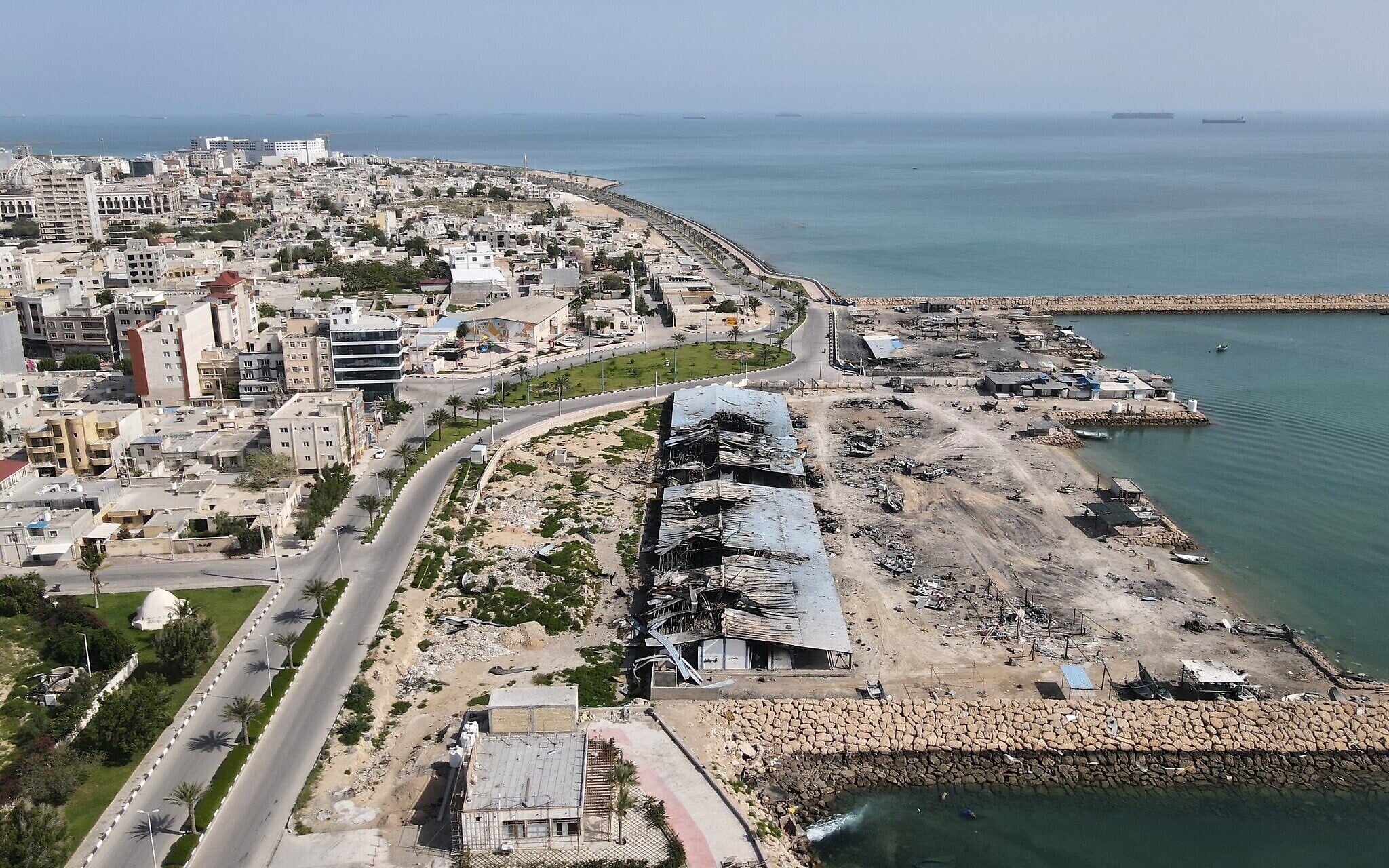
Backdropped by ships in the Strait of Hormuz, damage, which according to local witnesses caused by several recent airstrikes during the US-Israel military campaign, is seen on a fishing pier in the port of Qeshm Island, Iran, April 13, 2026. (Asghar Besharati/AP)
According to Habib Masihi, head of the environmental protection department in Iran’s southern province of Hormozgan, the spill that reached Qeshm island was “almost completely cleaned up by Wednesday evening.” About 32,000 square meters of coastal area were affected, along with waters covering 90,000 square meters, he said.
Baghaei, the foreign ministry spokesman, said such spills have in “recent decades imposed trillions of dollars in damage on Iran’s coastal areas.” He demanded compensation.
“Every party that benefits from commercial shipping through the Strait of Hormuz carries both a legal and a moral obligation to remediate the environmental harm inflicted,” said Baghaei.
Another slick has spread dramatically in recent days from a tanker that was damaged by explosions and has run aground near Oman’s southwestern Al-Qibliyyah island, according to satellite images.
The tanker, dubbed Caroline Bezengi, has been stranded since it was damaged in early June by explosions of unknown origin. It was previously sanctioned by the UK for involvement in shipping sanctioned Russian oil. Its cargo has been estimated at over 800,000 barrels.
Satellite images have shown that the tanker is increasingly submerged, and experts have warned of an unprecedented environmental disaster if the vessel sinks or breaks open and leaks its entire cargo.
Oil spill from shadow fleet tanker spreading off Oman, satellite images show https://t.co/0gC40gXFZt https://t.co/0gC40gXFZt
— Reuters (@Reuters) July 31, 2026
On Thursday, UK-based maritime risk and response company Ambrey said it had been hired to salvage the grounded Russian shadow fleet tanker.
The company’s statement, which did not identify the employer, said Ambrey personnel boarded the Caroline Bezengi with help from the Omani air force to assess the ship’s condition before stabilizing it.
“This is an extremely challenging situation, compounded by adverse weather conditions associated with the Khareef monsoon,” Ambrey’s global response director Ed Wollaston said in the statement, referring to the regional monsoon season that peaks in July and August.
The company did not immediately have any estimates of how long the salvage operation would take or cost.
Oman’s Environment Authority said Wednesday that the oil spill from the Caroline Bezengi has reached the shores of Ras Madrakah, more than 200 kilometers (120 miles) north of Al-Qibliyyah. Authorities say they estimate the spill could reach more than 100 kilometers (60 miles) farther north, to Masirah Island.
Meanwhile, the United Arab Emirates on Friday condemned what it said was a “hostile Iranian attack” in the Strait of Hormuz overnight on two vessels linked to the state-owned Abu Dhabi National Oil Company.
The situation was “brought under control,” and no injuries were reported, according to the company and the UAE foreign ministry.