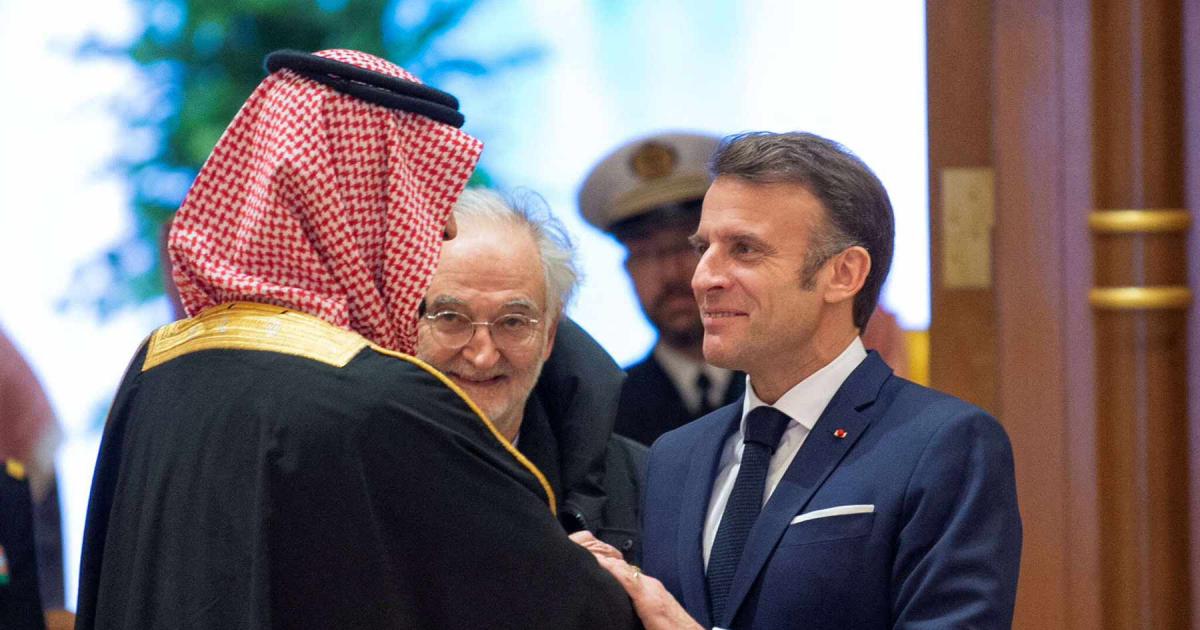
PARIS – French President Emmanuel Macron will host Saudi Crown Prince Mohammed bin Salman on August 23 and 24, the Elysee Palace said on Thursday, with the two leaders expected to discuss escalating tensions in the Middle East and efforts to prevent the conflict from widening.
The visit comes as Western and Middle Eastern leaders seek a diplomatic path out of the war involving Iran and amid continuing conflict between Israel and the Palestinians, with growing concern over the security of Gulf states, energy supplies and shipping through the Strait of Hormuz.
“The two leaders will discuss the main topics of regional importance, within a framework of close collaboration between France and her partners in the Gulf with a view to backing stability and peace in the Middle East,” Macron’s office said.
The two leaders will also convene the first meeting of the Franco-Saudi Strategic Partnership Council, established to give greater structure to political, economic and security ties between the two countries.
The council is expected to provide a framework for discussions on what the Elysee described as the major economic and strategic issues shaping the partnership, alongside regional security.
For Paris and Riyadh, the meeting comes at a particularly sensitive moment. The war involving Iran has expanded beyond a confrontation between Washington and Tehran, threatening Gulf security, energy markets and international shipping, while repeated setbacks to diplomatic efforts have raised fears of a return to open-ended hostilities.
Macron and Prince Mohammed are expected to discuss ways of maintaining regional stability and supporting diplomatic efforts to contain the conflict. France’s relationships with Washington and the Gulf states, combined with Saudi Arabia’s political and economic weight in the region, could give both countries a potentially important role in efforts to push the parties towards a settlement.
The discussions are also expected to cover a broad economic and strategic agenda, building on the strategic partnership announced in 2024 and cooperation spanning energy, industry, technology, defence and transport.
Energy is likely to feature prominently, with cooperation extending from oil, gas, refining and petrochemicals to renewable energy, clean hydrogen, energy storage, electricity interconnections and emissions-reduction technologies.
For Saudi Arabia, closer ties with France offer opportunities for technology transfer, industrial localisation and support for the goals of its Vision 2030 economic transformation programme.
For France, Saudi Arabia represents a major market for its companies in renewable energy, civil nuclear power, infrastructure and transport, as well as an important source of investment and a strategic partner in the Gulf.
Defence and aviation are also expected to figure prominently in the talks as Riyadh seeks to develop a more autonomous defence industry and diversify its military partnerships.
France, meanwhile, has sought to strengthen its strategic and commercial presence in one of the Gulf’s most important defence markets. Existing cooperation includes military training, exercises and capability development, while the civil and military aviation sectors offer opportunities for French companies in aircraft, helicopters, engines, maintenance, airport management and air navigation.
The visit follows Macron’s trip to Saudi Arabia in December 2024 and reflects what the Elysee described as the vitality of political dialogue between Paris and Riyadh.
The leaders had also discussed regional developments and diplomatic efforts earlier this month, underscoring continued coordination between the two governments as the regional crisis has intensified.
The talks in Paris are likely to take place against the backdrop of deep disagreements between Washington and Tehran over the terms of any ceasefire and subsequent negotiations. Iranian officials have warned of a more aggressive response if diplomacy collapses, while Western and regional governments have sought to prevent another escalation.
For Saudi Arabia, the conflict has direct implications for national security and economic stability. Any prolonged disruption around Hormuz could affect oil exports, energy prices, trade flows and investor confidence across the Gulf.
The strategic stakes also extend beyond the immediate confrontation. Riyadh has sought to diversify its international partnerships while pursuing a broader regional diplomatic role, while Paris has positioned itself as a European power capable of maintaining dialogue with Gulf states and engaging on regional security issues.
The two countries are also using sport and culture as part of their expanding relationship. Prince Mohammed is due to attend the closing ceremony of the Esports World Cup in Paris on August 23, alongside Macron.
The event is being held in Paris for the first time outside Saudi Arabia since its creation. It was originally scheduled to take place in Riyadh but was relocated to France amid the conflict involving Iran.
The Elysee said the event demonstrated France’s appeal as a destination for major international sporting events following the success of the Paris 2024 Olympic and Paralympic Games, while reflecting a shared ambition to use sport and culture to deepen ties.
The Saudi Public Investment Fund has committed billions of dollars to the gaming and esports sector as part of Riyadh’s broader drive to diversify the economy beyond hydrocarbons.
Prince Mohammed is also due to meet French officials at Les Invalides on Monday.
His Paris visit therefore brings together two strands of the Franco-Saudi relationship: an increasingly ambitious economic and strategic partnership, and a shared interest in containing a regional crisis that threatens to undermine security and economic transformation across the Middle East.