
Gov. Gavin Newsom signed numerous housing laws recently that may speed up residential construction in some parts of San Diego County.
Many of the laws are aimed at areas of California where building can be the most difficult so their impact in the city of San Diego — often considered an easier place to build compared to other parts of the state — may be somewhat minor.
However, it is often hard to predict how new housing laws may work until put into practice. In 2021, the governor signed Senate Bill 9, which made it legal to build up to four homes on properties that had previously only permitted one. Many experts said some of the bill’s requirements, and financial constraints of demolition and construction, would make the new law useless.
The year after passage, just 300 people in the state had taken advantage of the law and none in San Diego County The law is now considered a policy failure.
On the flip side, many of the laws designed to speed up construction of accessory dwelling units, or ADUs, have exceeded authors’ expectations. San Diego City Council passed incentives to encourage ADU construction in 2020, and it led some builders to go hog wild. One developer was responsible for spearheading two separate projects that each put more than 100 ADUs on a single site. City officials later scaled back the incentives.
Here’s a look at laws recently signed by the governor:
Lowered ADU fees (SB 1117)
 A 720-square-foot accessory dwelling unit in El Cajon. A new state law would lower fees on ADUs larger than 750 square feet. (Raylene Brundage)
This law will lower the fees, perhaps by thousands of dollars, for an ADU if it is larger than 750 square feet.
Under a previous statewide law, builders (from large developers to individuals) would not be charged impact fees on an ADU that did not exceed 750 square feet. Impact fees are expenses a city requires to improve infrastructure needed for a new property, such as updates to roads, water and sewer systems.
To encourage more ADUs, the previous law prevented cities from charging impact fees — but there was a catch. If a builder went over 750 square feet, they would be charged all the impact fees for the original structure plus whatever they went over.
The new law now means that a builder will not have to pay anything on the first 750 square feet, even if they go over. Instead, they must only pay for anything more than 750 square feet.
One thing the law won’t do is create massive ADUs the size of high-rises because most jurisdictions have size limitations to begin with. Most communities in San Diego County limit the size of ADUs to 1,200 square feet. Still, it is possible the average size of ADUs could creep up.
It is difficult to say across the whole region what cost savings the new law will bring because impact fees are different from city to city. Also, some cities have a host of exemptions for fees that further complicate an estimate. For example, the city of San Diego actually doesn’t charge any impact fees for the first two ADUs regardless of size.
One city with a more straightforward fee structure is La Mesa. If someone built a 1,200-square-foot ADU, under the new law, they would save around $2,800, based on current impact fees that are listed on its website. However, fees can change frequently.
Saad Asad, communications manager for pro-housing group California YIMBY, said it’s fair to say the law would likely save a builder “thousands of dollars” in fees.
Townhouses in single-family neighborhoods (SB 1116, AB 1751)
 Townhouses in El Cajon in March. A new law tries to make it easier to build townhouses in urban areas. (Zoë Meyers / For The San Diego Union-Tribune)
Senate Bill 1116 is designed to make it easier for owners of residential lots to build for-sale townhouses or condos on smaller vacant lots. However, the rules for who qualifies are very narrow, and early indications point to it not making a huge difference in San Diego County.
A single-family home would qualify if no one has lived there in the last five years. That seems unlikely in San Diego County, where rents are higher than the national average and even selling the home as a fixer-upper seems more plausible. There’s no time specified for how long land has to be vacant — with no home on it — to qualify but a vacant lot in expensive San Diego is rare and usually is that way for a reason, such as geographic challenges.
The intent of the law is to create starter homes, like townhouses, on single-family lots that are vacant in urban areas. If a lot has been vacant for years in an area zoned for single-family housing (or multi-family), the idea is that builders should be able to easily put up townhouses. The law has various tools to require cities to speed up approvals.
Asad said previous state laws already allowed this, but the update is mainly focused on requiring jurisdictions to automatically approve projects if they meet the requirements. This law is merely an update to the Starter Home Revitalization Act passed in 2021, which had amendments in 2023 and 2024.
“They are all tiny, incremental changes to this existing law,” Asad said, “that just makes it easier to use.”
One thing that makes the law unique: it allows a builder to construct multiple townhouses in an area zoned for single-family homes. Roughly 75% of San Diego County is zoned only for single-family homes, said a UC Berkeley study, so this law is a small way that state law can supersede local zoning.
Bo Peterson, a San Diego-based land use attorney at Allen Matkins, said this law differs from most new California housing laws because it encourages for-sale housing, as opposed to rentals.
He noted another law was signed at the same time, AB 1751, that allows some townhouse projects to be automatically approved if they meet strict requirements, such as leaving 10% of the project for low-income housing. That’s different than current law, which only allows automatic approval for some rental projects.
Similar to the Senate bill, the Assembly bill seems to face some hurdles in implementation in San Diego County. To use it, a developer would likely face financial challenges in dedicating housing to low-income buyers; municipalities can still deny projects if they deem it a public safety risk; and it cannot be used in high or very high fire hazard severity zones (which is around 45% of the region, the latest local estimates show).
Housing near transit (AB 2074)
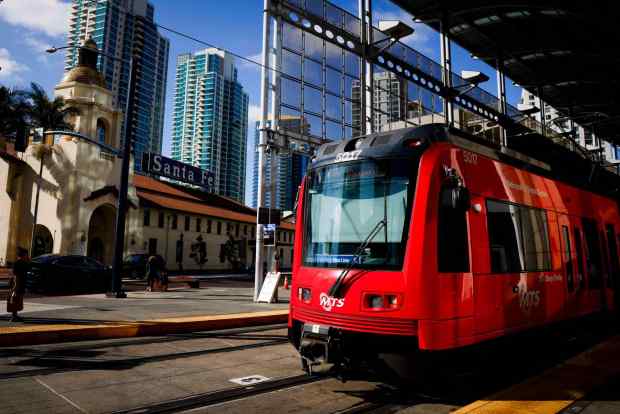 A new state law aims to make it easier to build housing near transit. Pictured: San Diego Trolley loads passengers downtown in mid-September. (Meg McLaughlin / The San Diego Union-Tribune)
This one only applies to the city of San Diego because this law is for cities that have populations of more than 400,000 people.
Under this legislation, San Diego must designate at least a 1-square-mile area as a “transit-hub district.” In the district, cities must speed up approvals and allow for building heights of 450 feet in 25% of the area.
San Diego already has many laws making building easier near public transit, and this is another case where America’s Finest City will probably be minimally affected.
San Diego has a program called Complete Communities that automatically approves residential projects if they meet certain requirements, such as building near public transit stops. It also has many community plan updates in place that increased density around trolley stops, including the newest Blue Line that ends in University City.
Peterson said this law was mainly aimed at the San Francisco Bay Area and its lack of housing around its rail system, the Bay Area Rapid Transit, or BART.
“A lot of these laws are coming out to take the bat out of the hands of jurisdictions,” Peterson said, “where there have been local fights to stop densification around those BART stations.”
The law originally created a $500 million state loan fund that would have given low-interest loans for high-rise developments — something that would have likely made a large difference in downtown San Diego. However, that provision was removed before passage.
Making fees more transparent (SB 1014)
 A new state law aims to make fees more transparent for developers of residential housing. Pictured: Workers putting finishing touches on an apartment building in San Marcos in December. (Hayne Palmour IV / For The San Diego Union-Tribune)
This law asks cities to provide developers with cost estimates for infrastructure, like upgrades to sidewalks, new traffic signals or utility upgrades, before construction begins.
Builders already pay infrastructure fees, but Asad said this law is a reaction to surprise costs after construction starts. He said it’s not unheard of in the state for a builder to pay all the permits and fees, and start putting a structure up, only to get a new request from a city to make a major infrastructure improvement.
Asad said unexpected infrastructure costs can torpedo a project, leaving a half-complete building in the middle of a downtown.
The law is not as strict as one might imagine. Municipalities must come up with non-binding “good faith” estimates in the first 30 days after an application, but there’s no penalty in the law if the estimate is wrong. Also, there is a fairly large carve-out.
Cities can still come up with new infrastructure requirements if they deem they are needed for public safety, if something changes with the project design or scope and for environmental reasons.
Peterson said the law will probably have a bigger impact in smaller San Diego County communities that are more prone to passing significant infrastructure demands on to a developer.
He said he has seen smaller governments require something extensive later in the process, like substantial sewer and stormwater improvements, that would benefit much more than, say, a 12-unit apartment building. If a developer knew that up front, there is a good chance the project would not move forward.
Midway Rising (SB 344 and 958)
 A rendering of a 2.32-acre neighborhood park and housing at Midway Rising. Construction is now expected to start next year. (Midway Rising)
These laws effectively remove legal obstacles that had dogged the multibillion-dollar Midway Rising development for years.
SB 344 will create a special statute specific to Midway Rising and establish that the project, upon certification of its environmental impact report, will have fully satisfied the requirements of the state’s environmental law. SB 958 prevents increased building heights from being considered as significant impacts under California environmental law.
The San Diego Union-Tribune has already written about the signing of these bills, but they are included on this list because of their housing elements. The new laws, which could lead to construction starting next year, are likely the most impactful residential legislation in San Diego signed by the governor. Plans for the megaproject, which includes a 16,000-seat sports arena, include a record-breaking amount of housing.
Plans call for 4,254 apartments, which would be the largest rental complex in San Diego County. Casa Mira View in Mira Mesa has 2,410 apartments and holds the current record. Casa Mira View’s complex is spread across multiple buildings, similar to plans for Midway Rising.
Out of those 4,254 apartments, Midway Rising developers have said 2,000 would be subsidized housing. That would be bigger than the county’s largest affordable housing complex, the National City Park Apartments, which has 456 deed-restricted units.
The National City complex was built in 1968, so a better comparison to what Midway Rising might aim for is St. Teresa of Calcutta Villa in East Village. That complex has 407 units and opened in 2022. The project cost $145 million and used dozens of state, federal and private funding sources.