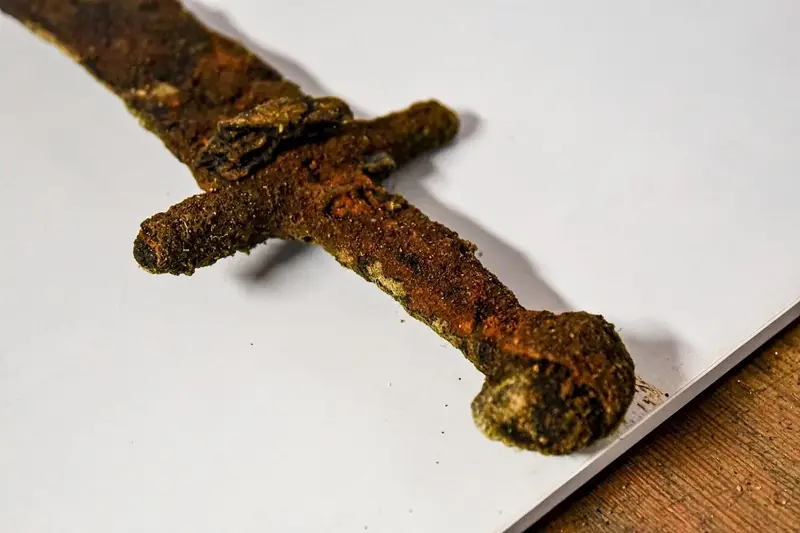
An exceptionally well-preserved medieval sword dating to the 11th century has been recovered from the Warta River near Wronki in western Poland. Archaeologists view the find as one of the region’s most important recent medieval discoveries.
 11th-century sword found in Poland’s Warta River. Credit: Muzeum Ziemi Wronieckiej
Local resident Mirosław Tucholski found the weapon and promptly reported the discovery to authorities. Staff at the Museum of the Wronki Region praised his actions, noting that responsible reporting helps protect archaeological heritage and allows specialists to examine artifacts under proper conditions.
After an initial assessment, archaeologist Ryszard Pietrzak confirmed the sword’s authenticity and dated the weapon to the early Middle Ages. Researchers believe the sword was produced during the 11th century, a period linked to Poland’s first ruling dynasty, the Piasts. At the time, warfare and political struggles were common across Central Europe.
The sword survived in unusually good condition after spending centuries beneath the river. Such preservation offers researchers an opportunity to study medieval weapon manufacturing, metalworking techniques, and patterns of use.
Archaeologists do not know how the weapon reached the riverbed. One possibility is that a warrior lost the sword during travel or conflict. Another explanation relates to ritual practices recorded across Europe. During the medieval period, and in earlier pagan traditions, people sometimes placed valuable objects, including weapons, into rivers and lakes as offerings.
Similar discoveries have emerged from Polish waterways in recent years. In 2025, an angler recovered a 13th-century sword in Warsaw. A year earlier, dredging operations near Włocławek uncovered another sword linked by some researchers to a 10th-century Viking. Such finds help historians piece together patterns of trade, warfare, and cultural traditions across the region.
Lower water levels have increased the number of archaeological finds appearing in rivers and lakes throughout Poland. Drought conditions expose objects hidden for centuries, though exposure also threatens artifacts once protected by underwater environments.
Following the discovery, officials reported the sword to the Wielkopolska Voivodeship Conservator of Monuments and secured the artifact for conservation. Wronki mayor Rafał Zimny provided funding for restoration and scientific study.
The sword will undergo conservation and analysis at Nicolaus Copernicus University in Toruń. Once restoration work is complete, the artifact is expected to go on display at the Museum of the Wronki Region.
More information: Muzeum Ziemi Wronieckiej