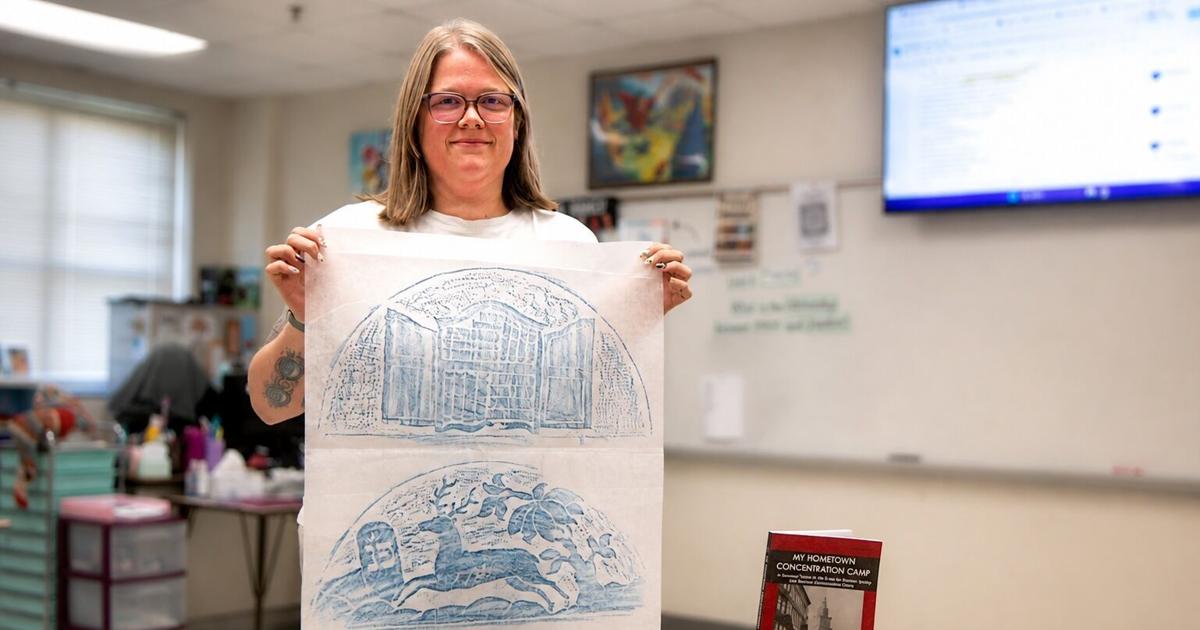
For Southern Lee High School teacher Josie Guin, teaching about the Holocaust now carries the perspective of having stood in many of the places where its atrocities occurred.
Guin traveled to Poland this summer as part of an intensive Holocaust educator seminar that took North Carolina teachers to Auschwitz-Birkenau, Treblinka and Majdanek, along with sites in Warsaw, Krakow and Lublin associated with the Holocaust and prewar Jewish life.
“It was intense,” Guin said. “It was very, very packed full of really hard stuff.”
Guin was one of five teachers selected from more than 350 applicants to receive a scholarship from the North Carolina Center for the Advancement of Teaching Development Foundation’s Holocaust Endowment Fund. The $3,500 scholarships covered the majority of expenses for the weeklong seminar in July.
In addition to the three concentration and extermination camp sites, Guin said she visited the Warsaw and Krakow ghettos, Kielce and several mass grave sites in forests where Jews were killed in mass shootings.
The experience will influence a subject Guin was already bringing into the classroom at Southern Lee.
Guin teaches English II and last year taught Southern Lee’s first Holocaust and Genocide Studies class. She said she noticed the course in the school’s course guide and, because of her previous Holocaust education training, volunteered to develop and teach it.
“I said, ‘Well, I could teach that,’ ” Guin said.
Interest has grown. Guin said she is scheduled to teach two sections of Holocaust and Genocide Studies during the upcoming school year.
“I think through word of mouth,” she said. “Students will say, ‘This is a lot different than what I thought it was going to be. You should definitely take this.’ ”
Guin said the class does not center on graphic images of Holocaust atrocities. Instead, she emphasizes resistance, culture and the experiences of people who lived through the period.
“You have to have a certain level of maturity to take it,” Guin said. “But contrary to popular belief, we don’t look at these graphic, terrible kind of images. We don’t do that. We focus on resistance and culture.”
Guin has also taken students outside the classroom to deepen their understanding. A trip to Greensboro allowed students to visit a Holocaust memorial and meet people connected with its creation.
“They were very respectful,” Guin said. “They learned a lot more. I think they were able to connect it deeper because we actually went somewhere.”
For Guin, Holocaust education is also an opportunity to teach students how to evaluate information and challenge false claims.
“Honestly, I’m teaching these kids critical thinking skills,” she said. “I’m teaching them the ability to be able to evaluate arguments and to evaluate things that are said to them.”
She said she hopes students confronted with Holocaust denial or misinformation will have the knowledge and confidence to investigate those claims.
“If I can get one of my students to look at one of those people and say, ‘Well, that’s not actually true. Let me give you some facts. Let me research it with you,’ I think that we’ve done what we need to do,” Guin said.
One of the most memorable experiences of the Poland trip came when Guin met 97-year-old Holocaust survivor Bernard Offen, who she said survived five camps.
“Once the survivors are gone, you don’t have any more firsthand account,” Guin said, describing a concern shared by Holocaust educators as the survivor population dwindles.
The seminar was led by Rabbi Fred Guttman, who has taught Holocaust education for more than 40 years, and veteran North Carolina Holocaust educator Lee Holder. About 40 teachers representing more than 20 North Carolina school systems participated in the program.
The program also supports the goals of North Carolina’s Gizella Abramson Holocaust Education Act, which became law in 2021 and requires development of Holocaust education curriculum for the state’s schools.
Guin is already planning to take the experience another step. In July 2027, she plans to travel to Europe with a group that will include students from her Holocaust and Genocide Studies class and some of their family members.
The trip is expected to revisit many of the places Guin saw this summer while also including Dachau and stops in Germany, Austria and the Czech Republic.
“It’s a Holocaust tour, essentially,” Guin said. “It’s going to be heavy, but I think they can handle it.”