
Credit: Far Out / Mark ER / MrTomek Polska
Thu 17 September 2026 7:00, UK
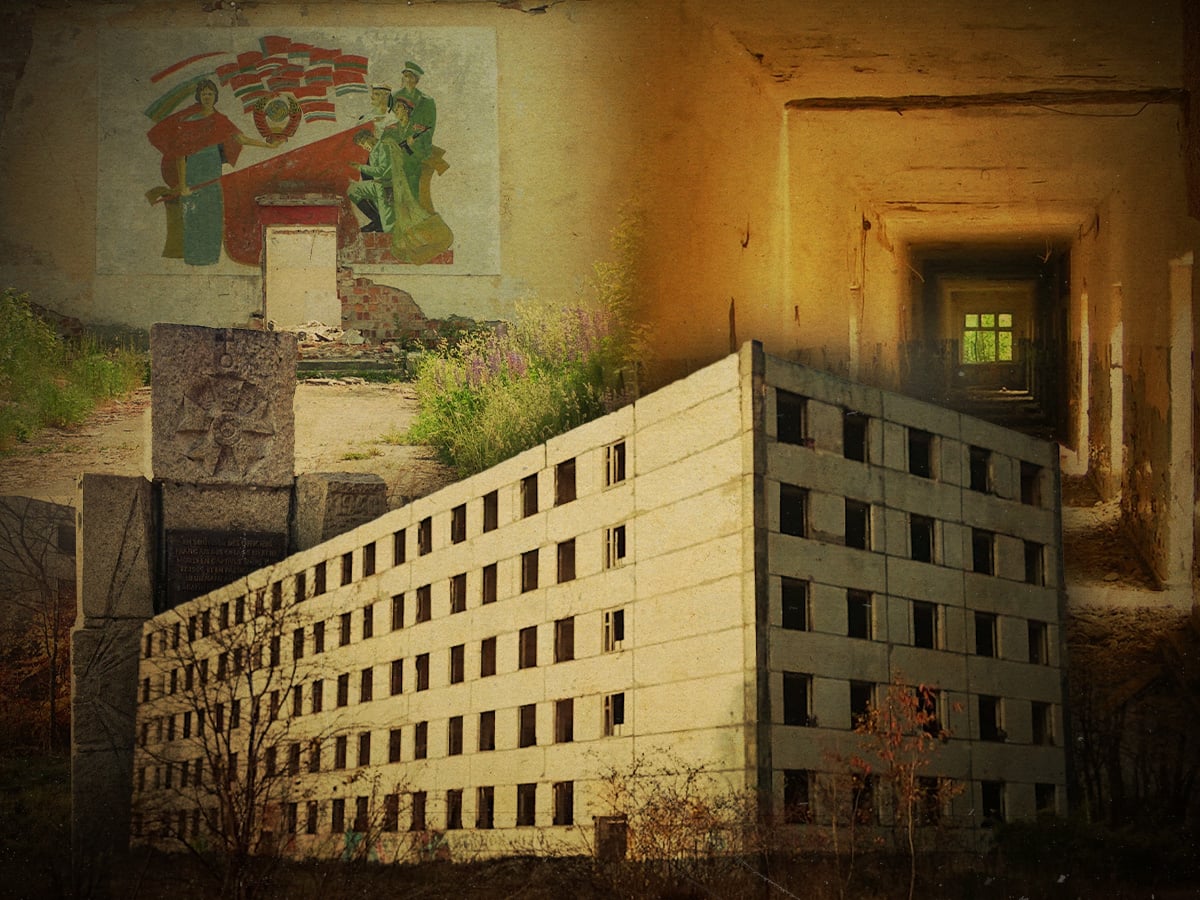
In the north west of Poland, surrounded by tall pine trees, is Klomino. What remains of its apartment blocks and roads are crumbling, with concrete being reclaimed by nature.
This is one of Poland’s strangest abandoned places, the country’s only official ghost town, and one with a mysterious past. At its height, it was home to thousands of people, but now, it’s silent and long forgotten except to urban explorers and photographers. This is the story of Klomino and how successive militaries created an unlovable and now abandoned town.
The settlement itself was only established just over a century ago, in the 1930s, when the land was part of Germany, having been annexed in the First Partition of Poland in 1772. The Nazi regime decided to create a huge military training area, and after being built by the Wehrmacht, it was christened Westfalenhof.
A few short years later, the Germans invaded Poland as the Second World War exploded across Europe, and in autumn 1939, they converted what was then Westfalenhof into a camp to house prisoners of war. Over 8,000 Poles were moved to the camp; while around 75% were soldiers, there were over 2,000 civilians who had been arrested by the Wehrmacht forces.
Throughout the war, the number of POWs ebbed and flowed, with most sent elsewhere, and the demographics changed too, with large numbers of French soldiers being imprisoned there in the early 1940s. As Germany’s war sputtered, the advancing Red Army captured Westfalenhof in January 1945, and from here, it would remain in Soviet hands for decades.
It was during this post-War phase that the town went dark. The German name was replaced with the Russian one of Grodek, and the base would remain Soviet property, despite being on Polish territory, with the place scrubbed from maps, becoming a secret unknown by anyone besides the locals and the estimated 6,000 soldiers based there.
Needing to turn the town into something that met their needs, the Soviets knocked down large parts of the existing German camp, with the remnants rumoured to have been used during the rebuilding of Poland’s capital, Warsaw. The Red Army then created shops, a small hospital and even a cinema in what remained.
 Credit: Far Out / Synek
Its location and the surrounding forestry made secrecy easier, and being a closed military zone meant that nobody, bar those who lived there, who were either servicemen or their families, would be able to visit. This isolated community ran itself, with help from Moscow, but when the Soviet Union collapsed, it was the beginning of the end.
By the end of 1992, the final Soviet troops had left, and the following year the settlement was transferred to the Polish government. It was finally given its Polish name, Klomino, and after being guarded by the army for a year, it was decided that it should be sold.
An asking price of around €2million was set, but the Poles had a problem. Who would want to buy a former military base, relatively isolated, in the middle of a forest? Needless to say, it was a tough ask to find a buyer, and over the following years, the remaining buildings started to fall into disrepair. The government tried hard to find a use for this site, with suggestions of a prison or a drug rehabilitation centre, but nothing ever came to pass.
The asking price continued to fall, but it was never low enough. With the costs for redevelopment only increasing by the year, it never made sense as an investment opportunity. The location and deteriorating buildings were one thing, but there were also the ghosts of its former owners, and why would anyone want to live somewhere that had links to both the Nazis and Soviet oppressors?
Klomino continued to be offered for sale throughout the years, even broken up into smaller plots, but there continued to be a lack of interest, with multiple auctions failing to get buyers. Some plots lacked access to a public road, most lacked infrastructure, and a number are now in such bad condition that demolition is basically inevitable.
The soldiers and POWs have long left, but the former past of Klomino still impacts it today. Combined with the remote location, the town will continue being unable to have a second life, in the same way that many similar projects have managed.
For most of its life Klomino was inaccessible because of tight Soviet controls but now its on maps and freely accessible, it’s unwanted and neglected, save for a small group of fascinating tourists and urban explorers. Now it stands as a memory of two difficult periods of Polish life, and much like the ideologies that defined them, it’s a town that’s incompatible with modern life.
