Javier Martínez
Valencia
16/10/2026 a las 07:53h.
A single alphanumeric code miscopied into a police report was enough to devastate the lives of a Chinese couple resident in l’Eliana, Valencia. After spending five months in prison accused of laundering $21m for an international criminal syndicate, their eight-year-old son was placed into state care and the couple plunged into acute financial distress, with over €750,000 in assets frozen over a phantom account that never belonged to them. A suspected data-transfer error, acknowledged in writing by police as a ‘material clerical error’, has triggered almost two years of an unresolved judicial ordeal.
The nightmare began on the morning of 14 January 2025. A major police operation featuring a helicopter, drones, tactical officers from the Special Operations Group (GEO), and Europol raided the family home in l’Eliana as part of ‘Operation Karasu’, an extensive inquiry directed by an Almería judge into an international underground banking and money-laundering network operating via the ‘hawala’ system.
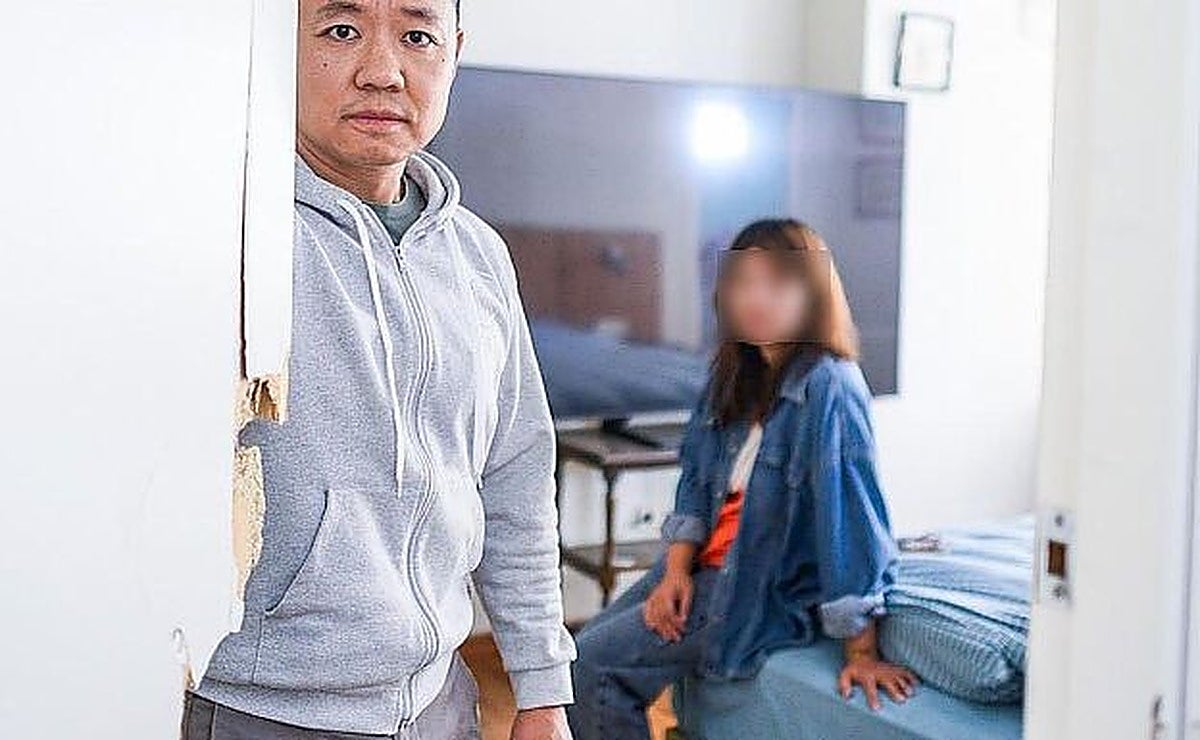
After holding the couple at gunpoint in their bedroom and searching the premises, officers arrested them. The most harrowing consequence was not financial, but personal: their eight-year-old son was admitted to a regional social care centre until authorities permitted his maternal grandmother to assume custody. On 15 January, the day following the raid, the judge remanded both spouses in custody.

The couple point to the damage caused by police during the raid on their family home.
(Kike Taverner)
The prosecution’s case rested upon an IT deduction: in November 2024, Spain’s Economic and Fiscal Crime Unit (UDEF) linked Shaoyuan Y. to a TRON cryptocurrency network address through which $21,514,321 in USDT had moved, branding it a ‘bridge account’ for the criminal ring. Her husband was implicated purely through joint ownership of marital assets. ‘On that sole premise, the raid, pre-trial detention, and the freezing of their assets were authorised, without any surveillance, wiretaps, or cash handovers appearing in the case file,’ said defence solicitor Juan Antonio Signes. A month after their imprisonment, police reports continued to reiterate the fictitious ownership.
Following their release on €60,000 bail in June 2025, the couple discovered that the digital wallet had never ceased operating: it had executed 38 transactions totalling more than $691,000 whilst they were held incommunicado in Picassent prison. In addition, an expert analysis by blockchain security firm Bitrace and official certification from wallet provider imToken confirmed it was an external personal account devoid of any identifying details linked to them.
Confronted with this evidence, UDEF conceded in December 2025 that an ‘involuntary transliteration and data-dump error’ had occurred, admitting Shaoyuan was not the account holder, but merely the sender of an isolated transfer. In March 2026, investigators downgraded the serious blunder to the ‘rectification of a material clerical error’, a stance endorsed by public prosecutors in July.
‘We are not talking about a miscopied digit or a minor detail. They identified the person who supposedly held a cryptocurrency address pivotal to the inquiry, and then attributed an identity and ownership to my wife that did not belong to her,’ the husband maintained.
Once the alleged ownership of the $21.5m collapsed, the financial link was narrowed to three isolated cryptocurrency transfers in December 2022 totalling roughly $50,000. According to the defence, the movement of virtual funds disproves the police theory of commission payments, given that Shaoyuan made an outgoing payment rather than receiving funds.
Financial stranglehold
Despite proving the legitimate origin of their wealth—derived from property sales in Shanghai amounting to €1.5m and verified by Spanish banks—the family remains subject to the freezing of more than €750,000 in assets: their home, €95,000 in seized cash, and a cigar collection valued at €600,000 at risk of spoilage. Left without an income, Shaoyuan and Zhige face enforcement notices from the tax office and social security authorities, alongside mortgage foreclosure proceedings over a debt of €64,429.74.
On 24 September 2026, the investigating judge declined to grant a minimum living allowance and refused to requisition the original Binance records, dismissing them as ‘unnecessary’. Although the judicial ruling noted UDEF’s rectification, it immediately proceeded to repeat the initial allegation regarding ownership of the $21m.
Faced with this situation, counsel for the l’Eliana residents has lodged an appeal before the Provincial Court of Almería seeking a court-monitored monthly living allowance and an order for the full disclosure of five key Binance documents. With the judicial investigation extended until 2 March 2027 and the final police report over a year overdue, the defence has filed formal complaints over undue delays with the High Court of Justice of Andalusia and the General Council of the Judiciary, demanding an end to nearly two years of procedural paralysis born from an account that was never theirs.
Having decided to settle in Spain years ago, the couple sold businesses in China that had taken a lifetime to build, transferring the proceeds legally through standard banking channels. With that capital, they rebuilt their lives and founded the company Zhige now manages. ‘The origin of every single euro is evidenced in the proceedings through 119 documents, including title deeds, sale agreements, bank receipts, and tax records,’ the Chinese businessman told this newspaper.
‘This implies no personal reproach against the judge or police investigators. We are setting out documented facts and their dates, requesting that the original records be examined and that a resolution be reached for a family whose lives have been frozen for nearly two years because of an error admitted by its own authors,’ their defence solicitor affirmed.
comentarios
Reportar un error