This article is part of the Fine Arts & Exhibits special section on how the world of art and museums is pushing boundaries.
If art is a medium that can easily cross borders, a lot of museums have been taking the opportunity to do just that. The Guggenheim Museum has an outpost in Bilbao, Spain, and the Louvre has planted a flag in the Emirates with a branch in Abu Dhabi.
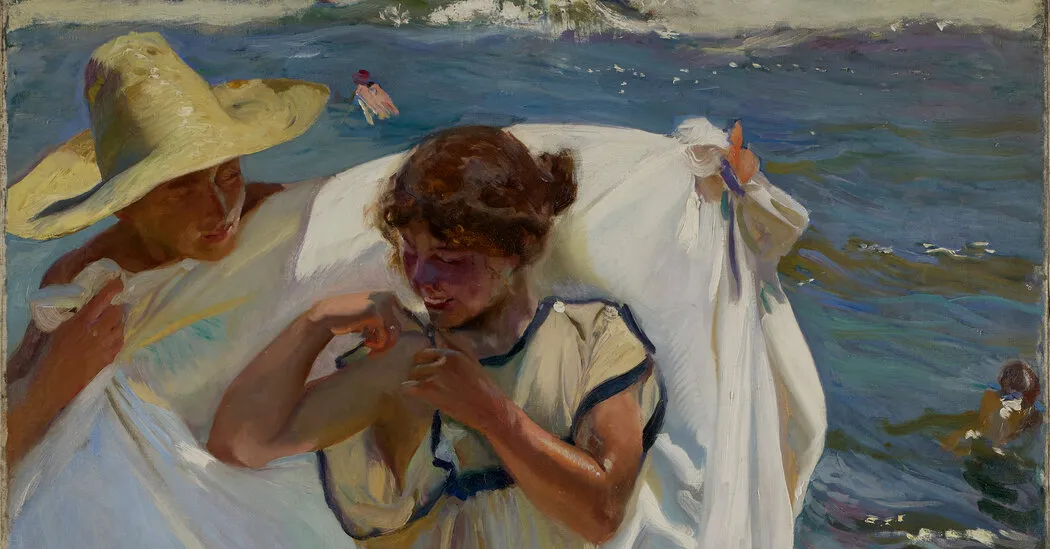
Now, an often overlooked Manhattan institution, the Hispanic Society Museum and Library, is about to follow suit. It is planning to set up shop in Valencia, Spain, and populate the venture with its extensive collection of paintings, prints and papers of the Spanish Impressionist painter Joaquín Sorolla, a native son of Valencia whose work was inspired by the city’s sunny skies.
In some ways, it will be a homecoming for about 220 works by Sorolla, who is best known for his lush scenes of life along the Valencian waterfront and Mediterranean coast. The works, which will be on loan for four years to start, will include sculptures, photographs and personal papers of the artist. The Hispanic Society’s collection of Sorolla’s work is second only to Madrid’s Sorolla Museum, in his former home and studio.
The relationship between the Hispanic Society and Sorolla goes back over a century.
The society was founded in 1904 by the American industrialist Archer Milton Huntington, whose collection of art and historical material from the Spanish- and Portuguese-speaking world formed its core holdings.
Located in Audubon Terrace, a Beaux-Arts complex in Washington Heights, the Hispanic Society houses the largest collection of Hispanic art and literature outside of Spain and Latin America. Its estimated 800,000 items include works by El Greco, Velázquez, Goya and other old masters, along with rare maps, books, ceramics, textiles and antiquities from the Iberian Peninsula.
Huntington was an early champion of Sorolla, bringing him to New York to paint his monumental “Vision of Spain” murals on display at the Hispanic Society and buying some of this best works. But why would a museum with such an extensive Sorolla collection want to send it away?
The answer is that for all the depth and richness of its collection, the Hispanic Society has little display space to show it. Years of deferred maintenance have left its three-building complex with a multimillion-dollar laundry list of physical plant repairs that it is only now beginning to tackle.
Until it does, space for public exhibitions is limited. In addition, as recently as 10 years ago, the society did little fund-raising and kept itself at arms length from the surrounding community. Now it is trying to make up for lost time, and the arrangement with Valencia is part of that.
“Valencia doesn’t have a collection and it does have space,” said Guillaume Kientz, the society’s director and chief executive, and a former curator at the Louvre and the Kimbell Art Museum in Fort Worth. “We have a huge collection and can’t show it all. Sorolla is a hero of Valencia, yet he is nowhere to be found there.” Raising Sorolla’s visibility in Valencia, Kientz said, should also raise the Hispanic Society’s profile in the United States and abroad.
“It’s a win-win-win sort of thing,” he added. “Having a strong presence in Valencia will bring visitorship to New York.”
And some money, too. Under the arrangement, the Valencia regional government will provide about $1 million annually to the Hispanic Society. The loan of the Sorolla collection runs for four years with an option to renew for another four.
The Hispanic Society will also get a cut of merchandise sales from the Valencia museum’s shop. To make it clear where the paintings are from, the Valencia museum, scheduled to open in February, will be called the Hispanic Society of America — Colección Sorolla. It will be housed in the city’s Palacio de las Comunicaciones in the heart of the tourist zone.
Carlos Mazón, then the president of the regional government, said in a 2025 news release that the Sorolla museum would “turn Valencia into an international center of the arts.”
At the moment, the Hispanic Society’s main focus is creating more display space.
The society was closed from 2016 to 2023 while work was done on one of its three buildings, the East Building, at a cost of $22.5 million. The bulk of the money was spent on infrastructure upgrades to the roof, facade and internal systems — improvements not visible to the general public. Currently, the East Building is used mainly for storage and is earmarked as a future exhibition space.
Another infrastructure project, estimated at $25 million, is scheduled to begin next year on the North Building, to allow it to be used as a gallery and conservation studio. This work includes the restoration of two wood paneled galleries that look like they were lifted from the Gilded Age and are the future home for a collection of El Greco (it has seven), Velázquez (three), Zurbarán (two), Murillo and others, and a growing number of works from Latin America.
“We want this to have an Isabella Stewart Gardner vibe” said Kientz, referring to the elegant Boston museum. Money for the renovation will come from the city, the state and private donations. (The society’s charter does not allow it to charge admission, cutting off visitor fees as a source of revenue.)
Fund-raising remains a challenge. Huntington was one of a number of industrial barons of that era to open private museums to show their art. Other collections, however, have higher profiles and were left with deeper pockets.
While many of the works in the Hispanic Society are on par with works in such New York institutions as the Frick and the Morgan Library, its finances are not: The society’s endowment of $100 million pales against $587 million for the Frick and $426 million for the Morgan, according to recent filings.
To fix that, the Hispanic Society was the inaugural partner in Sotheby’s “In Residence” program, in which museums lend works of art — in this case three Sorolla paintings — to be displayed in the auction house’s Breuer building.
When the Hispanic Society was closed for five years in the first round of renovations, collection highlights went on tour and were exhibited at the Prado in Madrid, the Royal Academy of Arts in London, the Museo del Palacio de Bellas Artes in Mexico City, as well as in Houston, Albuquerque and Cincinnati. The idea is that by exposing the collection to a broader audience, dollars may well follow.
Last year, the Hispanic Society set up a Goya Research Center in its library, which holds some 800 Goya prints, as well as drawings by others of that period. It is intended as a place where museums and academics can share findings, hold programs and promote Goya scholars and scholarship. A Goya symposium in September 2025 attracted 200 people and is being repeated this year.
“We want to raise awareness of Goya and foster a new generation of scholars,” Kientz said. The Hispanic Society has one of Goya’s most famous paintings, “The Black Duchess,” a portrait of the 13th Duchess of Alba from 1797.
This fall, the Hispanic Society will hold its annual gala, with the entertainers Gloria and Emilio Estefan as honored guests and a tribute to the fashion designer Oscar de la Renta.
To raise more funds, the society has been weeding out lesser works. Last October, a sale at Christie’s of dozens of old master works netted around $2 million. And, starting 10 years ago, the society has expanded its board to around 25 and set up an International Advisory Committee of nearly 40 people to expand its fund-raising reach.
It has also worked to embrace its local working-class, often Spanish-speaking, neighborhood, and showcased local artists, too. It has teamed up with the Northern Manhattan Arts Alliance to create installations on the society’s vast terrace. Currently featured is “Uptown Visions,” a playful display of neighborhood scenes and characters.
The museum’s terrace hosts outdoor movies, concerts and other summer events. A rotating roster of local artists have had their works displayed in the part of the museum that remains open.
For Hispanic Heritage month in September, the society had a packed schedule of artist talks, music and outdoor movies. November will feature a major exhibition, “Mantilla: Fashion Unveiled,” part of a multiyear fashion initiative.
The society wants to make it clear that it represents the broad expanse of the Hispanic world — from Portugal to the Philippines and all through Latin America — and not just Spain.
“I feel so pleased that we really are integrating ourselves into the community and getting better known” said Mark H. Rosenberg, chairman of the board. “We want to realize the value of this museum and collection. There is nothing else like it. This collection needs to be shown. That’s our goal. And we have to take it one step at a time.”