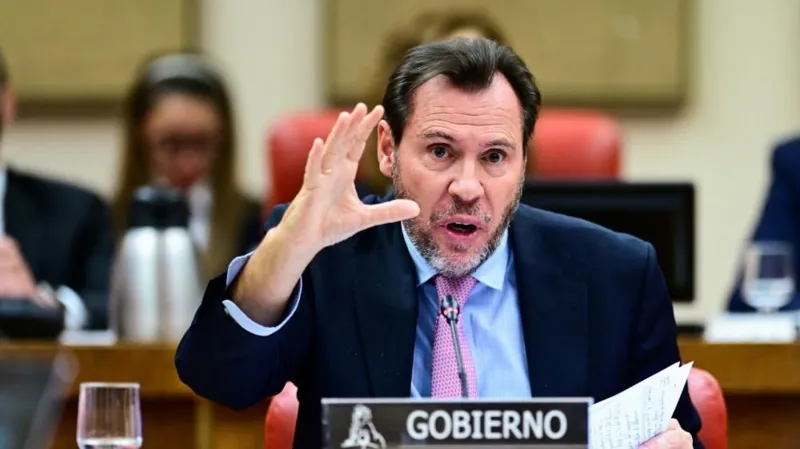
Rabat – Spain’s Transport Minister Óscar Puente has resigned following a deadly high-speed train collision that killed at least 69 people and injured dozens, as questions over railway safety and the government’s handling of the disaster intensify ahead of the November 29 elections.
Puente announced his departure on Tuesday evening during a session in Congress, where lawmakers questioned him about the October 28 collision near Urda, south of Madrid. The accident occurred when a Renfe high-speed train struck the rear of a stationary train operated by private company Iryo.
“A transport minister in a country like Spain cannot remain in office after two accidents of this seriousness in less than a year,” Puente told lawmakers.
He also referred to a separate railway disaster in January that claimed 46 lives. The two accidents have placed Spain’s railway safety record under growing scrutiny and raised concerns about the reliability of its high-speed network.
Puente also announced that he would withdraw his name from the lists for the November 29 early legislative elections.
Political pressure mounts after crash
The minister has faced harsh criticism and increasing scrutiny in the aftermath of the October 28 disaster. The conservative People’s Party (PP) and far-right Vox demanded his resignation, while some government allies also questioned whether he could remain in office.
Opposition lawmakers accused Puente of failing to take responsibility for the state of the railway network. They also criticized his initial remarks about possible human error, which they viewed as an attempt to shift blame away from the government.
Prime Minister Pedro Sánchez acknowledged the damage to public confidence, describing the railway system’s credibility as “broken.”
Puente’s resignation came despite his earlier insistence that he intended to remain in office. He described his departure as a matter of “political dignity.”
Sánchez commended his decision, saying Puente had “faced up to the situation, provided answers and solutions, and then stepped aside.”
He made the difficult decision “out of dignity. Of his own accord. Out of respect for the victims,” the prime minister added.
The timing adds another challenge for Sánchez’s government, which faces voters on November 29. The disaster has become a major political issue, with the opposition likely to question the government’s oversight of railway safety.
Recordings raise questions about crash
The collision has raised serious questions about the communication between train drivers and railway control staff before the accident.
The Renfe train carried 397 passengers, while the Iryo train had 147 on board. Initial reports pointed to a possible failure in the automatic signalling system, which had forced trains to stop along the affected section.
Audio recordings published by Spanish media outlets captured exchanges between Madrid’s control center and the drivers of both trains shortly before the collision.
In one recording, the Renfe driver reports technical difficulties before a control center operator instructs them to continue at normal speed under the Lateral Signalling Block, a backup procedure used when automatic signalling or data transmission fails.
When the driver asks whether to maintain normal speed, the operator replies: “Yes.”
Other recordings capture the Iryo driver reporting that the train had remained stationary because its security system would not allow it to move.
“The train won’t allow me to control the [security] system. That’s why I am still stopped in front of the entry signal,” the driver tells the control center.
The exchanges appear to indicate that railway staff knew the Iryo train remained on the track as the Renfe train approached. Investigators must establish how the two trains ended up on the same stretch of track and whether the procedures in place could have prevented the collision.
Iryo confirmed that its carriages were “struck from behind” by the Renfe train.
The disaster ranks among Europe’s deadliest railway accidents in recent decades and marks Spain’s worst train crash since 2013.